Get Full Government Meeting Transcripts, Videos, & Alerts Forever!
Get email alerts on the Education Steamedu topic
No spam. Unsubscribe anytime.
Lynn Public Schools presents CASA STEAM program of studies emphasizing project-based pathways
Summary
Dr. Shannon Gardner, executive director of innovation and grants management for Lynn Public Schools, presented the City Arts and Sciences Academy (CASA) program of studies to the curriculum subcommittee on Jan. 30, outlining a STEAM-focused, project-based curriculum with pathways in engineering and environmental science and planned arts offerings including AP courses.
Dr. Shannon Gardner, executive director of innovation and grants management for Lynn Public Schools, presented the City Arts and Sciences Academy (CASA) program of studies to the curriculum subcommittee on Jan. 30, outlining a STEAM-focused, project-based curriculum and a tentative trimester master schedule.
Gardner said the school will center STEAM (science, technology, engineering, art and mathematics) and project-based learning, with planned pathways in engineering and environmental science and a broad arts program that will include Advanced Placement courses. “Students at CASA will be in a hands on learning environment with unique opportunities to work on projects that blend STEM topics with the arts,” Gardner said.
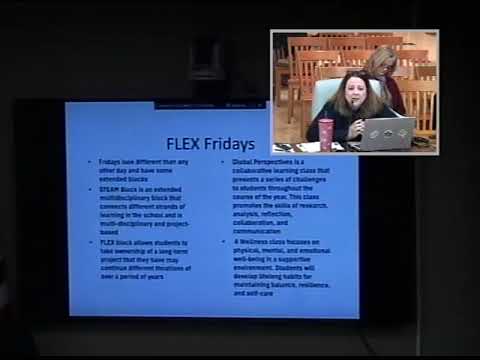
The proposal includes interdisciplinary humanities blocks combining English language arts and history, a designated STEAM block for integrated science instruction, and a flexible Friday schedule with an extended multidisciplinary STEAM block plus a flex block intended for long-term, multiyear student projects. Gardner described a proposed extended-day staffing pattern — one shift of STEM teachers and one shift of humanities teachers — designed to increase access to electives and deeper coursework during trimesters.
Electives listed in the presentation included robotics and coding, media journalism, novel studies, makerspace explorations, art technology and innovation, acoustic folk strings (guitar/ukulele), and mock trial. Gardner said some electives are intended to reinforce core standards (for example, coding to reinforce math skills) and that Cambridge International and Project Lead The Way (PLTW) curricula are under consideration to provide structured sequences and potential college credit.
Gardner said the district applied for PLTW grant funding (decision expected in March) to cover teacher training, durable equipment and supplies; she described a pathway to seek an innovation-pathway designation from DESE (Massachusetts Department of Elementary and Secondary Education) after several years of grant-supported operations as a possible sustainable funding route. “Project Lead the Way is the most highly funded innovation pathway in those types of courses,” she said. Gardner also said Cambridge International courses could yield college-credit-bearing examinations and up to roughly 30 credits over a full sequence.
Committee members responded with praise and questions about enrollment, staffing and costs. Member Dugan asked how electives would help ninth-grade students meet core graduation requirements; Gardner replied that core content courses would be aligned with Massachusetts frameworks and that humanities and STEM blocks are designed to cover required standards. Member Gaitley (committee member) and others praised project-based learning and shared anecdotal examples of former students who benefited from PLTW-type instruction. Gardner said initial applications have exceeded seat capacity and that the district will publish response deadlines so offers can be finalized.
On budgeting, Gardner and district staff said they are developing item specifications and cost estimates for science lab equipment, building infrastructure and Cambridge course costs; some costs will be included in the district’s forthcoming budget documents. Gardner said the PLTW grant and DESE designation are potential external funding sources but that baseline staffing and core costs will be addressed through the regular budget process.
Gardner listed community partners involved in developing the CASA model, including North Shore Marine Science Center (Nahant), Lynn Music Foundation, Lynn Museum & Art Center, North Shore Community College, Tufts University and the Center for Artistry and Scholarship. She said partners will be used to supplement programming as the school scales from initial grades (6 and 9) upward.
The subcommittee voted to approve the CASA program of studies in committee and forward the item to the full school committee for final consideration. The committee’s motion and roll-call votes are recorded in the meeting record.