Spanish Fort council adopts Honor Park conceptual master plan after residents voice concerns about traffic, wildlife and access
Loading...
Summary
The Spanish Fort City Council on an adopted Resolution 1480-2025 approving a conceptual master plan for Honor Park, a 142-acre site split by Highway 225 that the city purchased with Gulf of Mexico oil-and-gas revenue (GOMESA) funds.
The Spanish Fort City Council on an adopted Resolution 1480-2025 approving a conceptual master plan for Honor Park, a 142-acre site split by Highway 225 that the city purchased with Gulf of Mexico oil-and-gas revenue (GOMESA) funds.
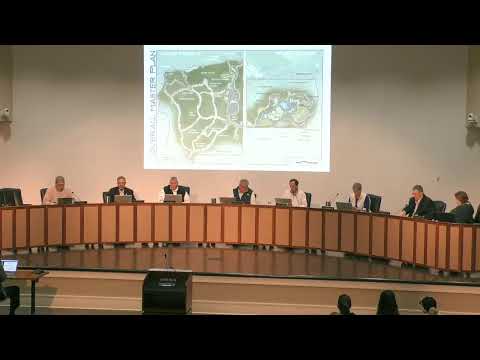
The plan, prepared by Thompson Engineering, designates the west side of the site for low-impact, passive uses — trails, outdoor classrooms, restroom pavilions and a kayak/canoe launch — and leaves more active facilities such as disc golf and an amphitheater for the east side in later phases. The city said it has $3,000,000 for phase 1 of development and plans to use the conceptual plan to pursue additional grants.
The conceptual plan matters because it sets the city’s preservation and development priorities for land county officials had previously approved for high-density development. Council members said the plan will be used to apply for grants and to guide future, more specific site plans that will go through separate public hearings and environmental reviews.
Thompson Engineering representative Christopher Grant told the council the firm received more than 2,000 survey responses and more than 800 written comments that informed the plan, and described natural features the team tried to protect: “It’s a beautiful piece of property. It’s got a half a mile of waterfront along Baymanet Creek,” Grant said. He described the west side as “passive” with roughly 2.5 miles of walking trails, pervious-surface parking and a kayak/canoe launch; the east side is shown for active recreation in the long-term concept.
Residents who spoke at the public hearing urged the council to change or limit elements of the concept. Danny Finch of 32210 State Highway 225 said he and his wife own eight acres adjacent to the east side and expressed strong concern about traffic, noise from a proposed amphitheater and impacts to his privacy: “Are we gonna be calling the police all the time? Are we gonna have privacy fences?” Finch said.
Several speakers raised wildlife and historic-preservation concerns. Daniela Nielsen and other residents said there are multiple bald eagle nests near the proposed boardwalk and asked whether the Bald and Golden Eagle Protection Act or archaeological protections would limit development. “There are multiple nests in that area,” Nielsen said. Phyllis, a neighborhood resident who runs a kayak launch business nearby, warned that increased public access and noise could disrupt nesting birds and turtle habitat.
Mayor (name on file with the city) and staff responded that the adopted document is conceptual, that environmental and cultural-resource studies already done will be respected, and that the city will move trails to avoid large trees and known cultural sites. The mayor said state and federal rules would prevent harm to eagle nests and that “we’re not going to come close to touching an eagle’s nest.” City staff said the state’s A-TRIP grant process and ALDOT permitting will determine needed road improvements and turn lanes for Highway 225 as the project advances; an A-TRIP project to widen parts of Highway 225 is scheduled to bid in April.
City Attorney David Connor and other staff explained why the council was adopting a conceptual plan now: the document demonstrates to grantmakers that the city has a development framework, which many state and federal grant programs require when awarding funds. Connor also said the city performed historical analyses, noting work by the University of Alabama and follow-up studies by the University of South Alabama, and that the city will not remove or harm artifacts discovered during future work.
Councilmembers emphasized buffers between park trails and adjacent houses, said the park will not be open 24 hours, and described gating and enforcement options for any neighborhood trailheads. The mayor said the West Side phase likely will take about two years to move into permitting and construction work, and that the overall concept is a long-range plan that could take decades to realize without additional funding: “This is a 20-year plan,” one councilmember said.
The council voted to adopt Resolution 1480-2025 after public comment. The adopted resolution makes the conceptual master plan a guiding document for phase 1 design and grant applications but does not approve a site plan or authorize construction; those steps will require later, separate approvals, environmental reviews and additional public hearings.
Council and staff listed next steps as completing environmental and cultural-resource reviews, pursuing additional grants to fund later phases, preparing detailed site plans for later public hearings, and coordinating with ALDOT on required road improvements.