Get Full Government Meeting Transcripts, Videos, & Alerts Forever!
Get email alerts on the State Pensions topic
No spam. Unsubscribe anytime.
Consolidated Public Retirement Board reports most state pension plans improving, public employees plan fully funded
Summary
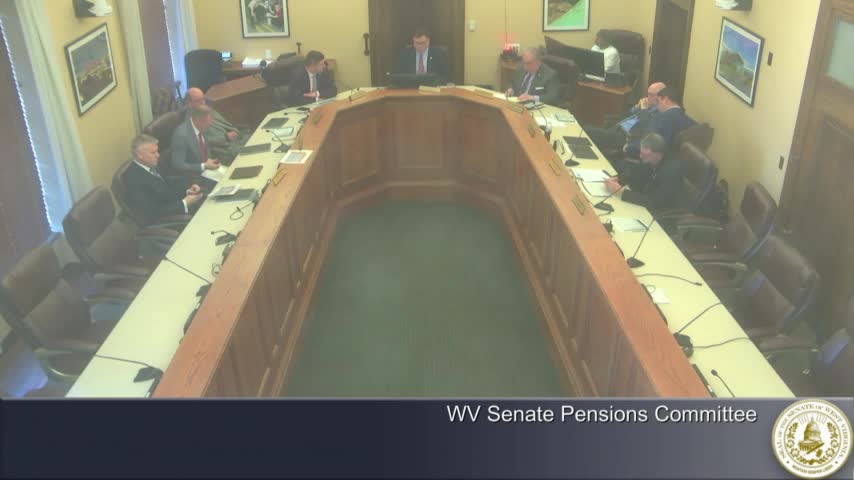
Jeff Fleck, executive director of the Consolidated Public Retirement Board, told the Senate Pensions Committee that the public employees retirement plan is 101.9% funded and other plans show varying levels of progress, while the board continues to monitor assumptions and membership tiers.
Jeff Fleck, executive director of the Consolidated Public Retirement Board, told the Senate Pensions Committee that the public employees retirement plan is now 101.9% funded and reached full funding about 10 years earlier than scheduled.
The update, presented during the committee's meeting, summarized funding levels across the 10 retirement plans the board administers, recent membership shifts between Tier 1 and Tier 2, and the board's long-term actuarial assumptions. "We all should be very proud of the retirement systems in West Virginia," Fleck said, describing the state as a national leader on some funding measures.
Fleck gave an overview of the consolidated board's "cheat sheet," a single-page snapshot of the plans. He said the board administers nine defined-benefit plans and one defined-contribution plan (the latter closed to new participants in February 2005). He described major plans and recent changes: the public employees plan and the teachers defined-benefit plan are the largest; the teachers plan (Teachers' Retirement System) is 83.4% funded and, under the existing amortization schedule, is projected to reach full funding by 2034; the State Police Plan A was closed in 1994 and now contains only retirees; State Police Plan B accepts new officers.
Fleck described other plan-level details included on the sheet: implementation year, active-member counts, retiree counts, employer and employee contribution rates, unfunded accrued liability, percent funded, retirement-age rules, cost-of-living adjustments and the board's investment return assumption. "At the very end the second to last is the interest rate assumption — we assume we're going to get a 7 and a quarter percent return on all these plans," Fleck said, noting that the assumption had recently been reduced from 7.5 percent.
Fleck also reviewed the 2015 Tier 2 changes that increased employee contributions: Tier 1 employees contribute 4.5% of pay while Tier 2 employees contribute 6%. He said Tier 2 membership has grown and for the first time active Tier 2 members outnumber Tier 1 active members. Fleck highlighted other plan-specific notes: the judges' retirement system is funded at about 244% because of historical above-required contributions; the emergency medical services plan's funded ratio rose after roughly 700 9-1-1 employees transferred into that plan; and the natural resources police officer plan had a statutory employer-contribution cap that was removed by the legislature last year, which the actuary said raised the recommended employer rate.
Fleck concluded with overall participant counts from the board's summary: roughly 77,000 active members, about 69,000 retirees, and approximately 37,000 terminated, nonvested former members who still have money in the systems. He answered committee questions about Social Security participation and other technical points during a roughly 10-minute Q&A.
Committee members did not take any formal policy action on this presentation; Fleck said the board will return as needed to answer actuarial questions and provide supporting materials.