Get Full Government Meeting Transcripts, Videos, & Alerts Forever!
Get email alerts on the Criminal Justice topic
No spam. Unsubscribe anytime.
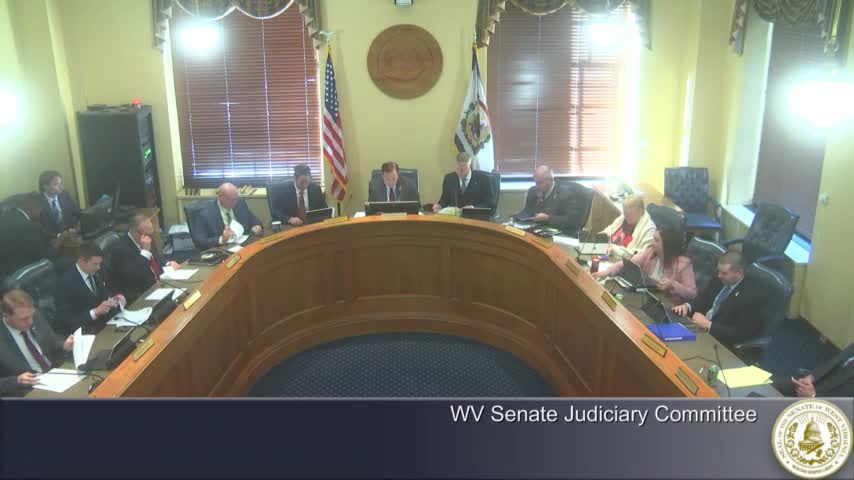
Committee advances bill raising penalties for vehicle fleeing offenses
Summary
A Senate committee approved a committee substitute for Senate Bill 138 that increases penalties for repeated instances of fleeing in a vehicle, adds certain second and subsequent offenses to recidivist-sentencing provisions, and extends the lookback period for prior convictions.
The committee approved a committee substitute for Senate Bill 138, which increases criminal penalties for repeated instances of fleeing in a vehicle and adds some second and subsequent offenses to recidivist-sentencing rules.
Counsel told the committee that the substitute raises penalties for fleeing in a vehicle that causes property damage, bodily injury, or death, and for fleeing while driving under the influence. The committee substitute makes second offenses and third-or-subsequent offenses felonies for several categories and adds those offenses to the recidivist-sentencing statute referenced in the bill. Counsel said the period during which a prior conviction may be considered for recidivist sentencing would change from 10 years to 15 years.
The change to recidivist sentencing was described as an amendment in the committee substitute; Counsel provided a table to the committee showing side-by-side comparisons of current and proposed penalties. The transcript records the counsel explaining the core changes, including the 15-year lookback and the addition to the recidivist provision (§61-11-18 as cited in committee discussion).
Committee members asked for further factual context. The senator from Jefferson asked whether counsel had compared the proposed penalties with surrounding states; Counsel said he had not reviewed neighboring states but that he could obtain that information. The chairman directed Counsel to provide a comparison showing how the bill’s penalties line up with contiguous states or other states in general and asked that information be provided to the committee.
The senator from Ohio asked about likely time served under a typical sentence; Counsel confirmed that under subsection I (fleeing in a vehicle causing death) a second-offense range discussed by the senator — 10 to 20 years — applies and that good-time reductions commonly reduce served time (the committee discussion framed good time as typically cutting a sentence roughly in half, per Counsel’s explanation). The committee also discussed the statutory threshold for what constitutes an instruction to pull over: senators asked whether a clear visual or audible signal is required, and Counsel noted the code language reads ‘‘clear visual or audible signal,’’ interpreted in the committee as an ‘‘or’’ (visual or audible) rather than an ‘‘and.’’
The committee also clarified that the statute’s language excludes ‘‘a person’s reasonable attempt to travel to a safe place’’ from the definition of fleeing; Counsel identified that exception in subsection L of the code text presented to the committee.
Procedural action: the vice chair moved to approve the language of the committee substitute and the committee approved the substitute language by voice vote. The vice chair then moved that the committee substitute for Senate Bill 138 be reported to the full Senate with the recommendation that it do pass; the motion carried by voice vote and the bill was advanced to be reported to the full Senate.
The committee requested that Counsel provide a comparison of the bill’s penalties with surrounding states and other states and supply that analysis to the committee prior to further consideration by the full Senate.