Get Full Government Meeting Transcripts, Videos, & Alerts Forever!
Get email alerts on the Auditor Revenue Pcard Delinquent Land topic
No spam. Unsubscribe anytime.
State auditor pitches fee increases, P-card expansion and privatized delinquent-land sales to generate revenue
Summary
State Auditor Mark Hunt told the Senate Finance Committee his office can grow special revenue through modest securities-fee increases, better use of the P-card and privatized marketing of delinquent land sales, and outlined concerns about costly contracts for OASIS and OpenGov.
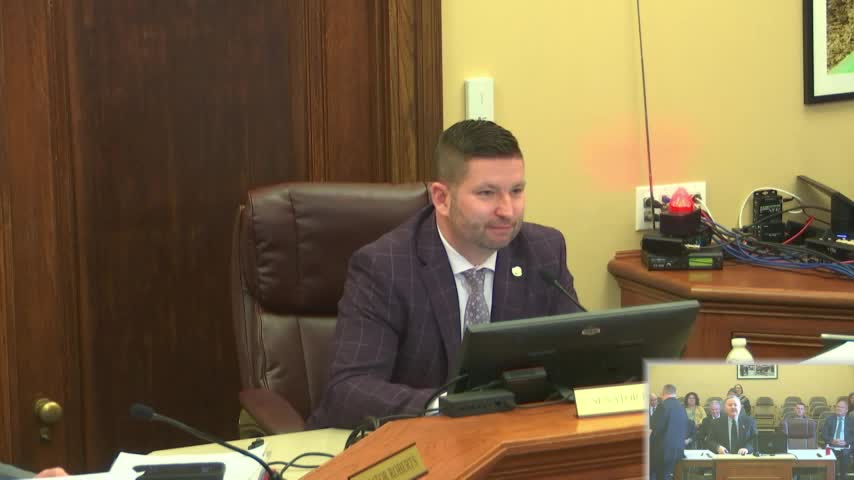
State Auditor Mark Hunt told the Senate Finance Committee on Feb. 13, 2025, that his office can raise significant revenue for the state by increasing securities-review fees, expanding use of the state purchasing card (P-card) and changing how delinquent land is marketed and sold.
Hunt, newly in office, said the auditor’s office produces “income for the State of West Virginia in excess of $300,000,000 a year” and that the office’s operating budget is about $23 million, of which roughly $2.7 million comes from general revenue. He described several “low-hanging fruit” proposals he said would boost receipts to the General Revenue Fund and provide additional special revenue for the auditor’s office.
On securities-review fees, Hunt said a modest increase in per-offering fees would raise revenue and would be borne by large investment houses rather than West Virginians. He said an increase of about $528 per offering would generate an additional $1.7 million for the auditor’s office and $1.7 million for the General Revenue Fund.
Hunt urged wider use of the state P-card, saying the state currently spends roughly $500 million a year on P-card purchases and receives about $10 million in rebate payments now. “If we got some of the other entities and agencies on board that are not using the P card, we could double that to possibly a billion dollars and we could double that that amount,” Hunt said, adding the auditor’s office monitors P-card transactions in real time with U.S. Bank and treats misuse as a criminal offense.
Hunt also proposed altering the sale process for delinquent land, which he said is now routinely purchased by a small group of buyers for low base amounts. “What I would like to see is a real auction process on the front end,” he said, suggesting the auditor contract with a vendor to market parcels statewide so that bids better reflect market value; under Hunt’s proposal some of the excess above the tax base would be split between counties, general revenue and the auditor’s office.
Hunt criticized the state's expenditures on two technology contracts. He said OASIS has cost the state in the hundreds of millions and that a predecessor signed “a new 10 year contract for $40,000,000 a year.” He also said the OpenGov transparent-checkbook service receives roughly $9 million a year for limited usage, noting last year the site had 1,600 hits.
Senators asked follow-up questions about whether vendors would add convenience fees for card purchases, whether counties and colleges could be required to use the P-card and how the proposed delinquent-land auction would handle redemption and survey costs. Hunt said the state code designates the P-card as the preferred method of payment but that there is no statutory penalty for not using it; he also said new policies will allow cash, checks and credit cards for property redemptions starting May 1 to make redemption easier for homeowners.
Hunt said some of his proposals would take two to three years to fully materialize and that fee changes or statute changes would require legislative action. He did not present formal bills during the hearing but said a securities-fee increase and legislation to privatize certain delinquent-land marketing are pending under other lawmakers’ sponsorships.
The auditor took no immediate committee vote on the proposals; they were presented as options the office believes would increase special revenue and reduce reliance on general revenue allocations.