Get Full Government Meeting Transcripts, Videos, & Alerts Forever!
Get email alerts on the Hb101 Age Of Consent topic
No spam. Unsubscribe anytime.
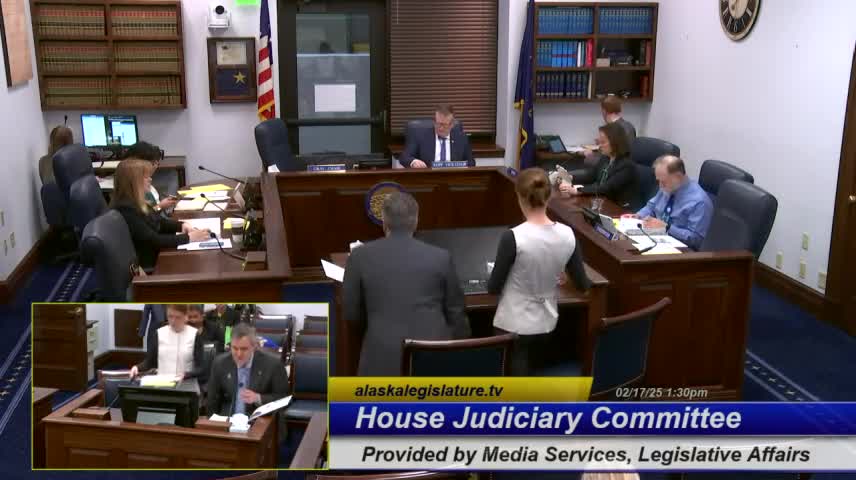
House Judiciary hears HB 101 to raise Alaska age of consent to 18; sponsors, advocates, law enforcement testify
Summary
Representative Andrew Gray presented House Bill 101 to raise the age of consent to 18 with a four-year close-in-age exemption. Advocates, victim-service providers and law enforcement supported the bill at a Feb. 17 public hearing; the committee did not vote and invited further questions and potential amendments.
Representative Andrew Gray, sponsor of House Bill 101, told the House Judiciary Committee Feb. 17 that the bill would raise the statutory age of sexual consent in Alaska from 16 to 18 and retain a close-in-age exemption often called a Romeo-and-Juliet clause.
"Our statutes as they are now simply do not adequately protect 16- and 17-year-olds from predators in Alaska," Gray said in opening remarks, citing statistics from the UAA Justice Center and other sources and describing Alaska's high rates of sexual violence and child sexual abuse. He said the bill retains a four-year close-in-age exemption so that consensual sexual activity among peers would not be criminalized.
Claire Bedard, staff to Representative Gray, described the bill's structure and said the measure requires changing multiple statutes to update the legal definition of a minor. "Sections 1 through 6 amend multiple statutes to update the definition of a minor," Bedard said. Bedard told the committee that the bill changes many criminal statutes, updates sentencing guidelines, and lists statutes to be repealed; section 29 denotes applicability and section 30 provides an effective date.
Invited testimony included victim-services advocates, law enforcement and a youth advocate.
Keeley Olsen, executive director of STAR in Anchorage, testified in support of the bill and described barriers victims face under the current law. "16 and 17 year olds are minors. They are children," Olsen said. She detailed cases she said illustrated how adults can manipulate older teens and argued that the current age of consent makes prosecution more difficult in substance-facilitated assaults. Olsen cited Anchorage Police Department figures the committee heard: in 2023, APD investigated 68 cases involving 16- and 17-year-old alleged victims. She told members parents and crisis hotlines regularly receive calls describing manipulation of teens but lack legal remedies under current statutes.
Josh Moore, a law-enforcement supervisor from Fairbanks, testified that the existing statutory gap hampered investigations of predatory relationships between significantly older adults and 16- or 17-year-olds. "We have had reports with 80-year-old men with 17-year-old girls having sexual contact. There's nothing in that that says that's okay," Moore said, adding officers often can only pursue charges for furnishing alcohol rather than sexual assault when victims are 16 or 17.
Randy Brieger, executive director of Abused Women's Aid in Crisis, and youth advocate Eleanor Dorganos also testified in support. Dorganos, who said she had been assaulted as a younger teen and later sought justice, told the committee that being above the age of consent when reporting complicated her ability to get support and legal remedies.
Committee members asked several technical and policy questions. Representative Vance and others raised fiscal concerns noted in public-defender fiscal estimates, which described an indeterminate impact because the agency could not estimate how many defendants might be affected. Vice Chair Kopp asked a Department-of-Law–type question about how many cases per year would fall into the statutory gap; testifying law enforcement estimated isolated cases in some regions (Moore estimated two to three per year in his patrol region).
Committee members also discussed related statutes the bill does not change, including marriage statutes; Gray said the bill did not change the statutory marriage age requirements and that any committee member could propose an amendment if they wished. During final remarks, Chair Gray corrected an earlier statement by citing a provision in current statute: an affirmative defense exists when a defendant reasonably believed the other person to be at or above the age of consent and took reasonable measures to verify that age.
No vote was taken. The hearing record includes testimony from advocates, law enforcement and a youth advocate; the committee indicated it would follow up on technical questions and possible amendments in later proceedings.