Get Full Government Meeting Transcripts, Videos, & Alerts Forever!
Get email alerts on the Eviction Law topic
No spam. Unsubscribe anytime.
Committee debates revisions to eviction law, habitability and accommodation defenses
Summary
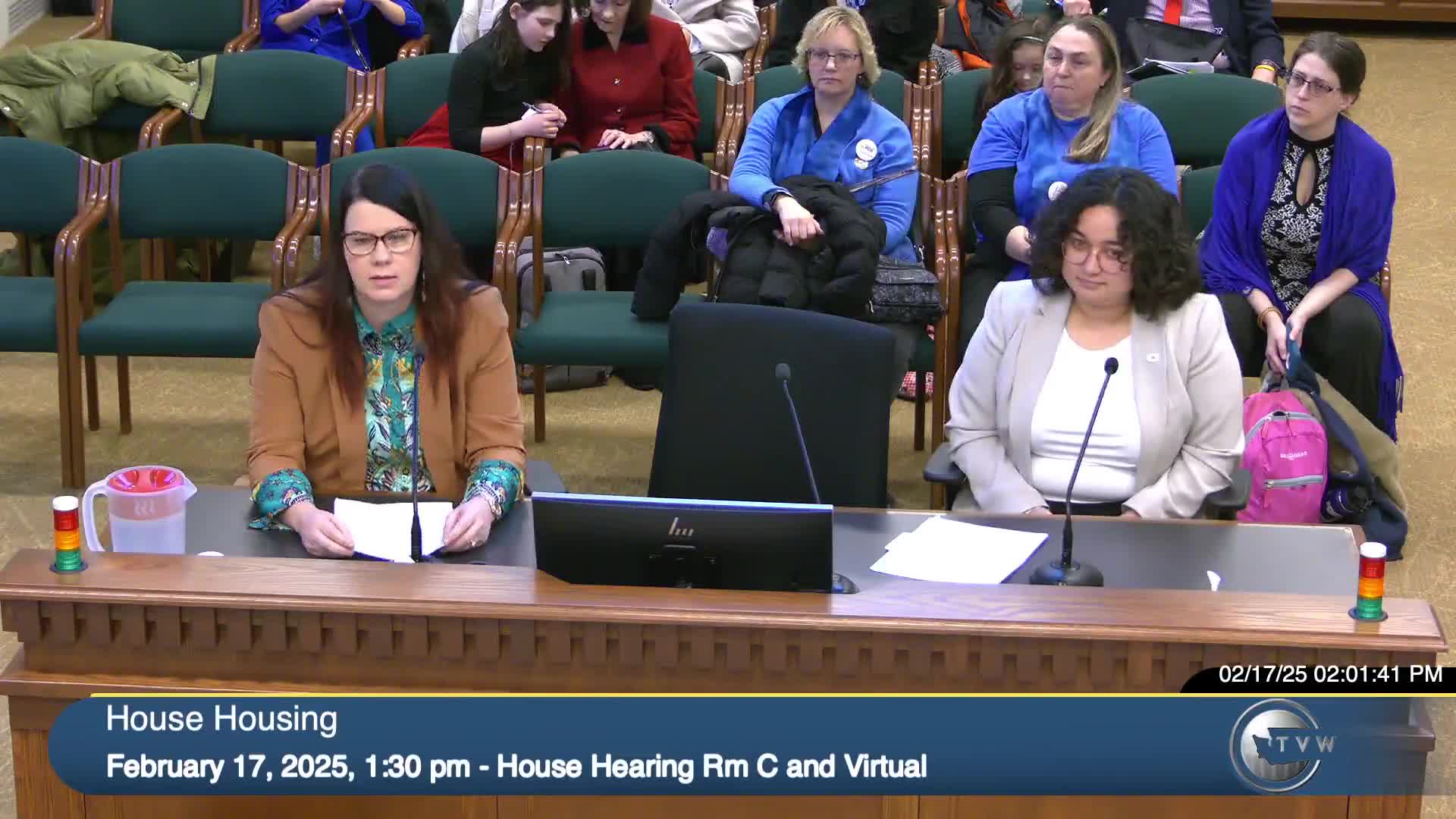
House Bill 19-15, a broad revision to eviction-related provisions of Washington's Residential Landlord-Tenant Act (RLTA), drew contested testimony Feb. 17 before the Washington State House Housing Committee, with landlord groups urging rejection and tenant advocates and legal services urging support.
House Bill 19-15, a broad revision to eviction-related provisions of Washington's Residential Landlord-Tenant Act (RLTA), drew contested testimony Feb. 17 before the Washington State House Housing Committee, with landlord groups urging rejection and tenant advocates and legal services urging support.
The bill matters because it would change eviction notice periods, create new defenses for tenants in unlawful detainer actions, alter repayment-plan rules after judgments, and restrict when landlords can obtain money judgments — changes that parties on both sides said could affect the speed of evictions, housing stability for low-income tenants and landlords' legal and financial risks.
Audrey Vasek, staff to the committee, summarized the bill's main changes: it reorganizes causes for eviction to place required notice periods at the start of each cause; for certain covered dwelling units (including some federally funded units), nonpayment would require at least 30 days' written notice rather than the 14-day standard; notices for substantial breaches must specify acts, date/time and identities involved; the bill defines unlawful harassment consistent with the civil protection order law; and it removes obsolete references to an expired eviction-resolution pilot and rescinded proclamations.
Significant substantive changes would create two affirmative defenses for tenants in unlawful detainer proceedings: that unpaid rent resulted from the landlord's failure to maintain habitability under statute or common-law implied warranty, and that a landlord failed to provide reasonable accommodations for a tenant's disability. The bill would also bar a landlord from receiving a money judgment for rent in actions that were not brought for nonpayment of rent. Repayment plans after a judgment would be limited to situations where the back rent can be repaid in less than six months (extending the current 90-day window to six months), and repayment plans may not include fees and costs — only back rent.
Rep. Richards, the bill sponsor, said the measure largely codifies existing case law and clarifies the statute so tenants and landlords can better understand rights and procedures. "This is just an effort to bring forward the timeframe for a particular notice and for what behavior to the very front of the sentence so that an average lay person can... know exactly what they need to do," Richards told the committee. He said longer notice for federally subsidized units reflects existing practice and gives tenants more time to pursue rental assistance.
Landlord and housing-industry witnesses strongly opposed the bill. Mac Mayo, of the Washington Multifamily Housing Association and a housing-law practitioner, said the proposal "will exacerbate problems by putting all of the risk on the housing providers" and warned that codifying habitability and accommodation defenses would clog courts and lengthen processes. Gordon Haggerty, a small rental housing provider in Seattle, told the committee he needs "to be able to get [dangerous tenants] out quickly and safely" and argued the bill would raise costs and drive small providers from the market. Several other housing providers described increased legal exposure, difficulty collecting unpaid rent and unintended consequences such as higher rents, larger security deposits and tighter tenant screening.
Panelists and members discussed practical timelines. Mac Mayo described the eviction process in some jurisdictions as taking several months in practice, factoring in notices, summons and complaint, show-cause hearings and sheriff-execution of writs; he said a complex, behavior-based eviction can take roughly five months from start to sheriff execution in his experience.
Opposing those concerns, Christopher Brunetti of Northwest Justice Project said the bill would strengthen the "Just Cause" protections and codify defenses recognized by appellate courts. He told the committee the changes would give trial courts better guidance, help preserve housing for low-income tenants (particularly those on federal subsidies or fixed incomes), and expand the practical availability of repayment plans by increasing the permissible repayment period to six months. "These are the poorest, most vulnerable tenants in our state," Brunetti said, arguing that extending notice and repayment windows can help tenants obtain assistance and avoid homelessness while still preserving remedies for landlords.
Committee members asked about several points: how the bill affects the ability to accept rent while proceeding on non-rent bases for eviction; whether the bill would strip landlords of attorney-fee recovery in good-faith actions; interactions with existing Washington Supreme Court and Court of Appeals decisions (witnesses referenced Wilson v. Daniels and other appellate opinions); and uncertainty created by litigation over CARES Act-era protections. Sponsors and staff said some changes are intended to codify current judicial interpretations; opponents said codification would create more litigation and financial exposure.
The committee closed the public hearing on HB 19-15 after hearing from dozens of stakeholders and asked parties to submit amendments for upcoming executive-session deadlines. No final committee vote was recorded on Feb. 17.