Get Full Government Meeting Transcripts, Videos, & Alerts Forever!
Get email alerts on the Transportation topic
No spam. Unsubscribe anytime.
Farm and hauling operators tell House committee longer truck-trailer combinations improve efficiency and pose no added safety risk
Summary
During a House public hearing on House Bill 1898, farmers and commercial haulers testified that allowing longer truck-trailer combinations would increase efficiency, reduce trips and emissions, and would not create new safety issues, while local officials also voiced support.
Farmers and commercial haulers told a House committee during a public hearing on House Bill 1898 that allowing longer truck-and-trailer combinations would let operators use equipment more efficiently, cut trips and emissions, and would not compromise safety.
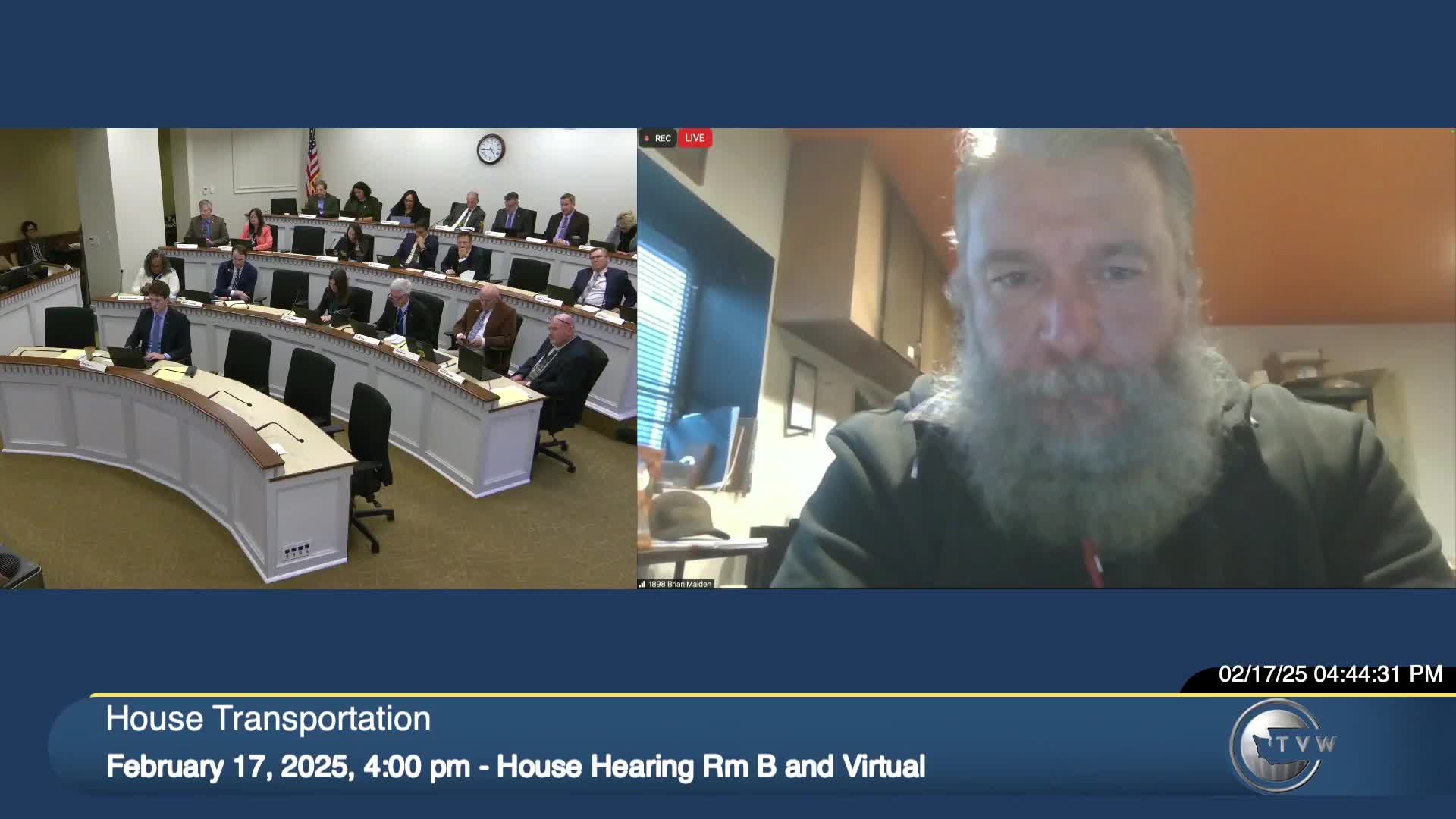
The testimony matter-of-factly tied the proposal to savings on fuel and equipment costs and to reduced wear on roadways. "I don't believe there's a maximum length on the outfit," said Brian Maiden, who identified himself as a farmer and hauler. "So there's, really no safety concern, to to worry about." Maiden also said using the proposed combinations would let farmers avoid owning extra equipment that sits idle because current rules make some assets inefficient to use.
Why it matters: supporters said the change would lower operating costs for farmers and reduce vehicle miles traveled. "That's less wear and tear on my equipment, less wear and tear that I'm gonna be, spending on or less money I spend on fuel, less time I'm on on the road, less emissions," said Justin McLennan, who described himself as a transportation operator. Caleb Gwerter, testifying on behalf of the Washington Farm Bureau, told the committee the bill would "help reduce farms and or reduce carbon footprints from farms as they're transporting product from farm to farm, farm to processor, and farm to port in some cases." Gwerter also pointed to a prior change that increased weights for specific commodities, saying it had produced measurable carbon reductions for milk haulers.
Local elected officials who testified also supported the measure. "I would strongly support it," said Marty Hall, who identified himself as a commissioner in Columbia County and a farmer. Hall said he had checked with local public works engineers and found no agency objections to the vehicle type on highways; he also described how the proposed truck-trailer combinations track more predictably than similarly long semi-trailer combinations.
Committee members asked about safety. Representative Stevie asked whether "there are any added safety concerns by going longer that we need to know about?" Maiden replied that the trailer sections are already capped at 68 feet end to end and said the proposed combination is "a lot more maneuverable, to get in and out of tight spaces where possibly you may have to back up to get loaded or unloaded."
The public hearing record closed after the final witness. The committee did not take a final vote during the hearing and next steps were not specified on the record.