Get Full Government Meeting Transcripts, Videos, & Alerts Forever!
Get email alerts on the Occupational Therapy Board Budget topic
No spam. Unsubscribe anytime.
Occupational Therapy Licensing Board projects steady revenues while preparing for new OT doctorate programs
Summary
The Occupational Therapy Licensing Board told the Ways and Means subcommittee it expects modest growth in licensees as new doctorate programs come online, is funded by licensure fees, and operates at 1.5 FTE with a roughly $793,000 governor‑recommended budget for the next biennium.
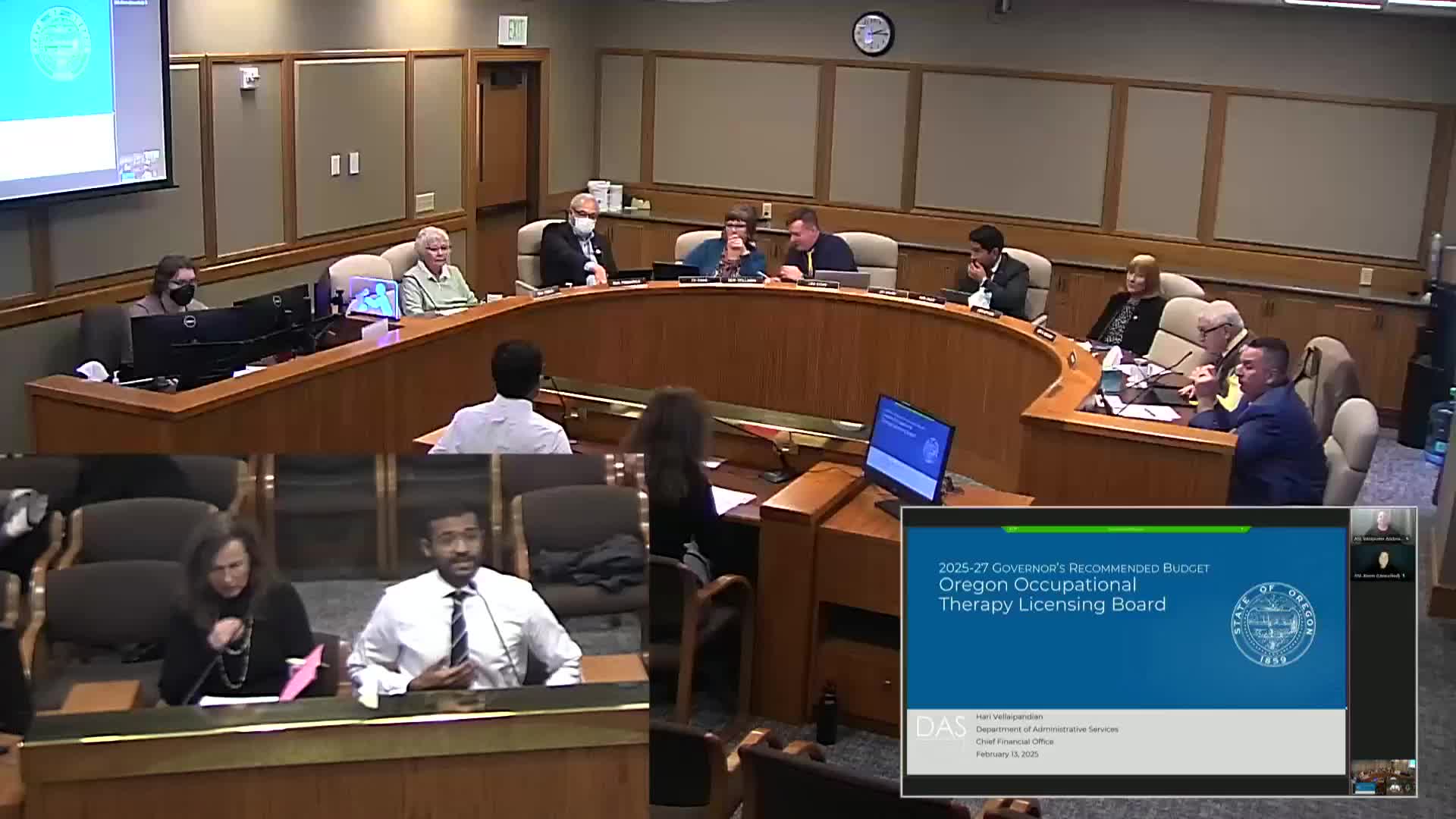
Good afternoon. The Oregon Occupational Therapy Licensing Board presented its governor‑recommended budget and licensing data on Feb. 17 during the Joint Committee on Ways and Means Subcommittee on Education hearing on Senate Bill 5524.
Nancy Schuberg, executive director of the Occupational Therapy Licensing Board, said the board regulates about 2,752 active licensees — including roughly 470 occupational therapy assistants — and manages licensing, background checks and investigations with 1.5 FTE. "We license applications 98% of the time within 1 to 3 days of receiving all the required documentation," Schuberg said, describing a licensing system the board launched in 2020 that performs primary source verification and allows applicants to track outstanding items online.
Schuberg told the committee renewals occur in even‑numbered years and account for about 75% of revenue; the governor’s recommended budget of approximately $793,000 reflects a roughly 5% increase to absorb inflationary costs and maintains current service levels without policy‑package requests. The board conducts FBI fingerprint background checks on new applicants and state-level criminal background checks at renewal. Investigations have averaged about 20 cases per year in recent years; the board uses an interagency investigator contract to manage complaint workloads without a full-time investigator on staff.
Several new educational programs recently started or plan to start in Oregon, including Western Oregon University and George Fox University cohorts that began in fall 2024 and a planned program at the University of Western States with a 2026 cohort target. Schuberg said the board expects additional license growth in the next two to six years as graduates enter practice and said the board’s staffing and systems are prepared to handle that growth without immediate fee changes.
Schuberg provided required reduction options and noted past fee increases occurred after a long period with no increases; the board is not requesting fee changes for the 2025–27 biennium at this time. The subcommittee did not vote on the budget during the hearing.