Get Full Government Meeting Transcripts, Videos, & Alerts Forever!
Get email alerts on the Naturopathic Board Budget topic
No spam. Unsubscribe anytime.
Oregon Board of Naturopathic Medicine seeks steady funding; tight budget relies on licensing fees
Summary
The Board of Naturopathic Medicine told the Ways and Means subcommittee its governor‑recommended budget will sustain current operations at three FTEs, noting the board’s broad formulary, investigation workload and changes to continuing‑education approval rules.
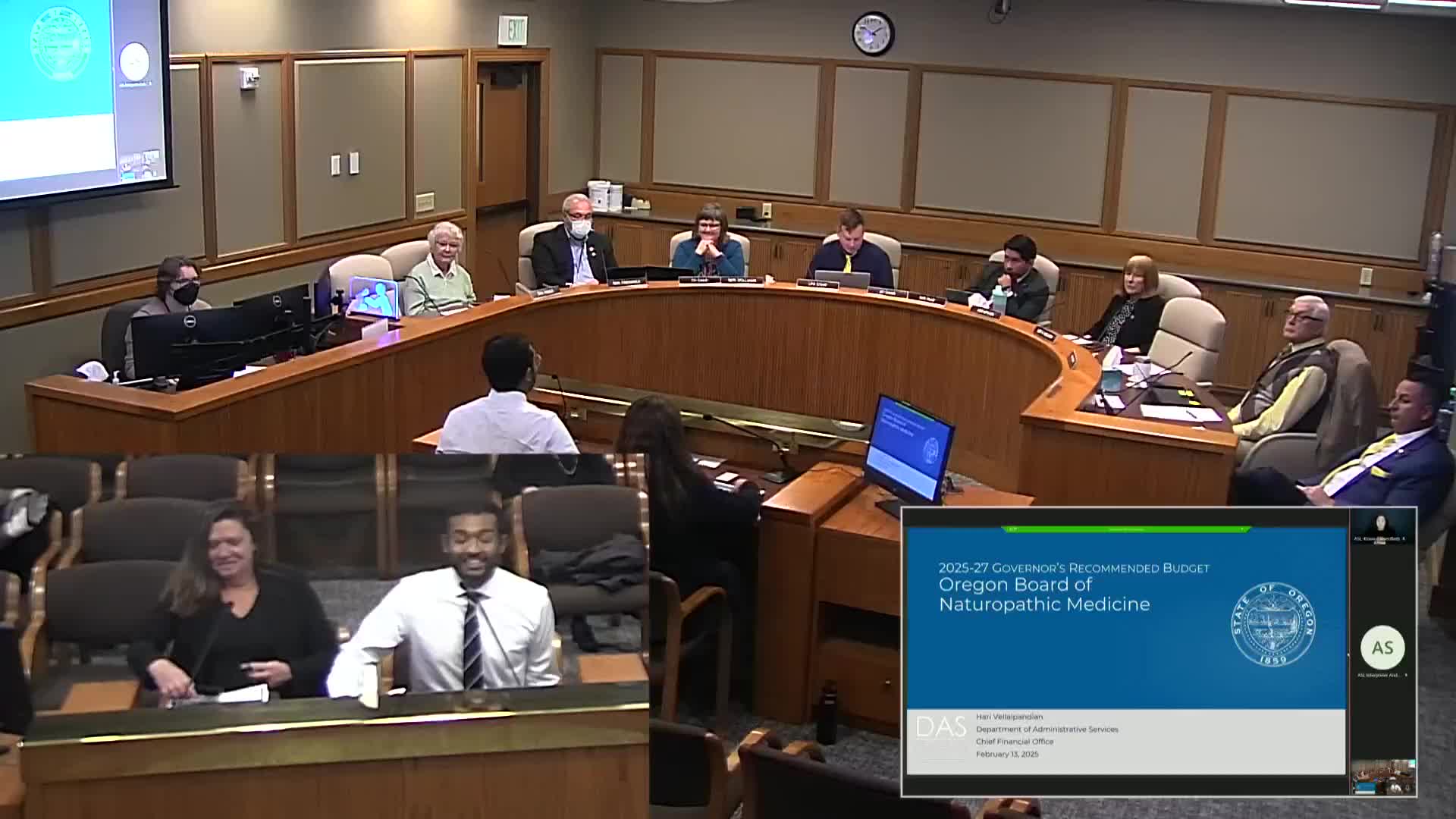
Good afternoon. The Oregon Board of Naturopathic Medicine presented its governor‑recommended budget and program priorities during the Feb. 17 public hearing on Senate Bill 5524 before the Joint Committee on Ways and Means Subcommittee on Education.
Marybeth Baptista, executive director of the Board of Naturopathic Medicine, told the committee the board regulates approximately 1,200 licensed naturopathic doctors in Oregon and maintains one of the nation’s most expansive prescribing formularies. "In Oregon, the legislature has defined us as primary care physicians by statute," Baptista said, describing the profession’s authority to provide prevention, diagnosis and management of acute and chronic conditions as well as selected minor surgery and injection therapies.
The board is an other‑funded agency that relies on license application and renewal fees, exam administration and a small amount of sales and civil‑penalty revenue. DAS budget analyst Hari Velopondian told the committee the board needs about five to six months of ending balance because renewals occur at the end of the calendar year; the governor’s recommended budget makes a small services‑and‑supplies reduction to reflect a projected revenue shortfall and holds staffing steady at three FTEs.
Baptista described recent rulemaking to remove barriers to licensure (for example, allowing a copy of a birth certificate instead of a certified copy for applicants born outside the U.S.) and a disciplinary‑action matrix the board adopted to promote consistent sanctions. The board also overhauled continuing‑education approval rules to prioritize education that benefits Oregon licensees and to reduce staff and board time spent approving out‑of‑state or for‑profit programs that produce little local benefit.
Committee members questioned investigation timelines and case complexity. Baptista said the board’s target is to complete investigations within six months but that a small number of complex cases, jurisdictional issues, pending civil litigation or criminal matters had extended timelines; she noted that of nine cases open at the end of 2024, four were subsequently closed. The board said it plans to improve plain‑language communication about rulemaking and the legislative process.
Baptista closed by thanking DAS staff and legislative aides for support during the session; the subcommittee took no vote at the hearing on Senate Bill 5524.