Get Full Government Meeting Transcripts, Videos, & Alerts Forever!
Get email alerts on the Privacy Geolocation topic
No spam. Unsubscribe anytime.
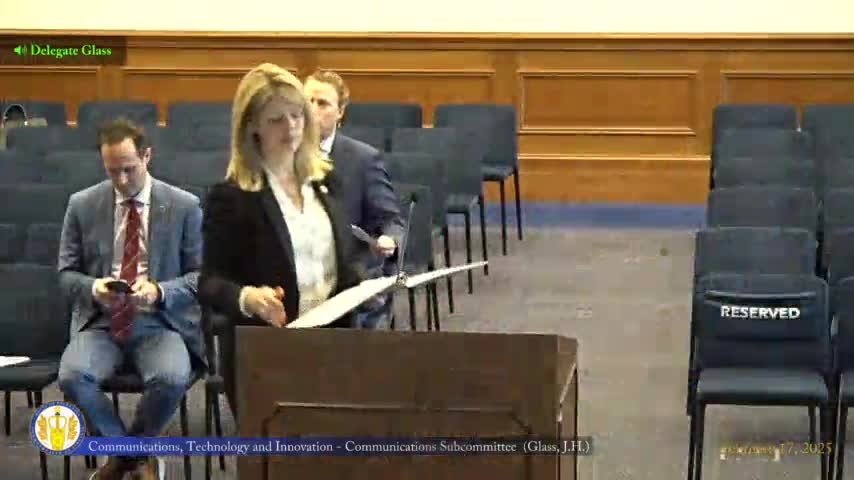
Subcommittee lays SB 1023 on table after debate over ban on sale of precise geolocation data
Summary
The subcommittee debated Senate Bill 1023, which would ban the sale of precise geolocation data, citing national-security and consumer-protection concerns. Supporters urged an outright ban; industry groups said existing Virginia law is sufficient. The measure was laid on the table on a 6-3 vote.
Senate Bill 1023, a bill that would ban the sale or offer for sale of precise geolocation data about customers, was discussed in the Subcommittee on Communications, Technologies and Innovations and then laid on the table by a 6-3 vote.
The bill’s sponsor, Senator Perry, told the panel the measure would “protect the sale of people's geolocation data from being sold” and said the proposal was prompted by reporting that buyers of precise location data could track people who work at national-security facilities. “This is...a national security issue,” Perry said, arguing the state should act where Congress has not.
Supporters at the hearing described concrete harms tied to location-data sales. Irene Leach of the Virginia Citizens Consumer Council said privacy is “the biggest issue before our country” and called SB 1023 “an excellent piece of legislation that will protect consumers.” Matt Schwartz of Consumer Reports said location data can reveal where people worship, seek health care or support political causes, and that brokers sell the information “without the knowledge or explicit consent of most consumers.”
Industry and technology trade groups opposed or urged further review. Margaret Durkin of TechNet told the subcommittee that Virginia’s existing consumer privacy framework already treats precise geolocation as sensitive data and that the Virginia Consumer Data Protection Act (VCDPA) addresses many of the bill’s goals. William Chanas Martinez, representing a state privacy and security coalition, asked that the bill be referred to the Joint Commission or study committee (JCOTS) to evaluate its interaction with the current framework.
Senator Perry said enforcement of a state ban would likely proceed through the attorney general’s office. Testimony from consumer advocates also warned that location data sales can be used to target vulnerable groups for predatory marketing.
After questions and brief discussion, Delegate Lopez moved to lay SB 1023 on the table; the subcommittee recorded the motion as approved on a 6-3 vote.
The hearing record shows competing views about the need for a new statutory ban versus relying on the VCDPA and related enforcement. No amendment language or next-step referral was adopted at the subcommittee stage; the bill’s proponents indicated they would continue advocacy.