Get Full Government Meeting Transcripts, Videos, & Alerts Forever!
Get email alerts on the Mortuary And Cemetery Board Budget topic
No spam. Unsubscribe anytime.
Mortuary and Cemetery Board outlines budget, indigent-disposition program to Ways and Means subcommittee
Summary
The Oregon Mortuary and Cemetery Board presented its governor-recommended budget and data on the indigent-disposition program during a Feb. 17 public hearing on Senate Bill 5524, citing steady staffing, inspection requirements and a $30 death filing fee that funds the program.
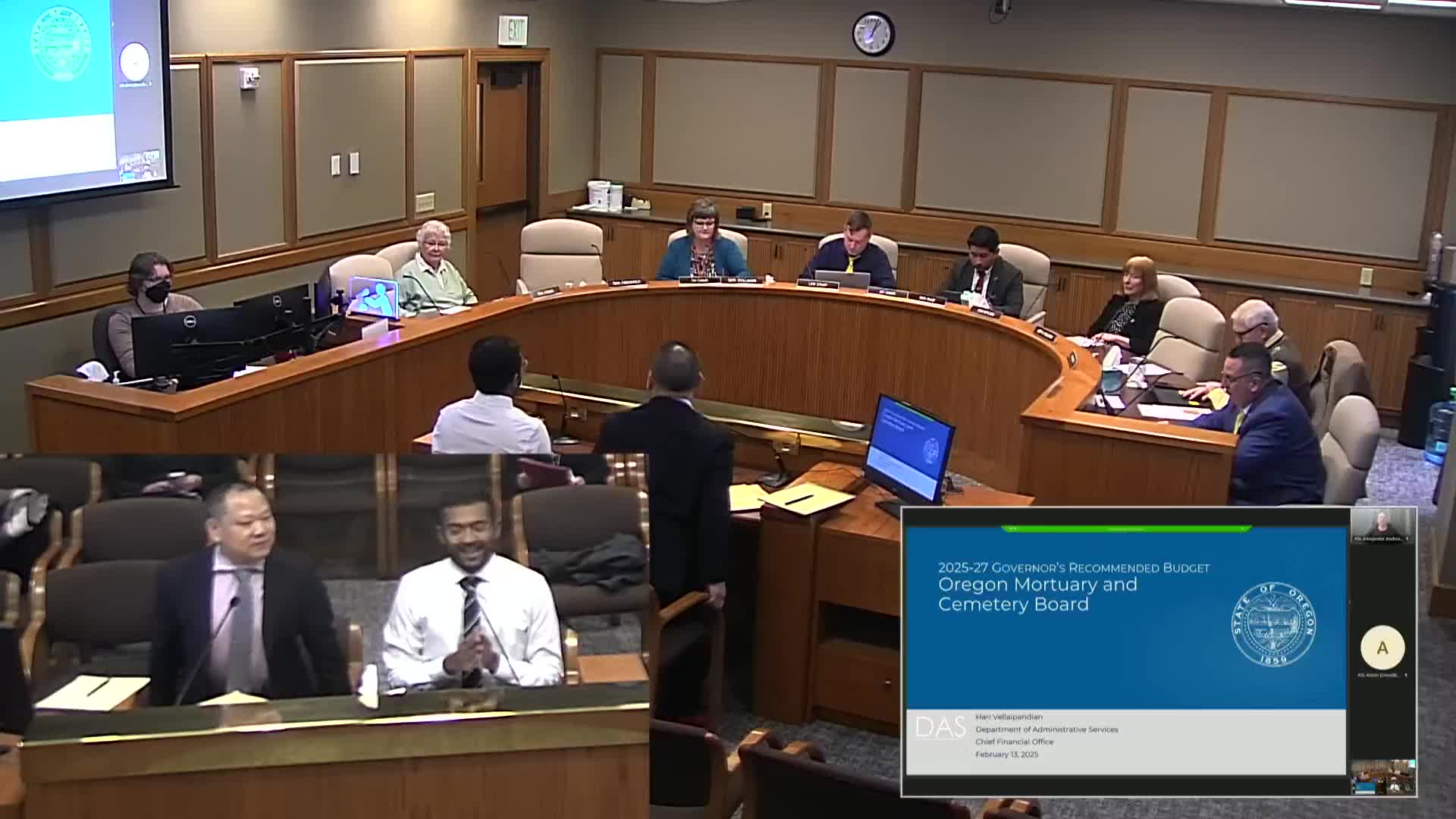
Good afternoon. The Oregon Mortuary and Cemetery Board presented its governor-recommended budget and an overview of its licensing, inspection and indigent-disposition programs on Feb. 17 during a public hearing of the Joint Committee on Ways and Means Subcommittee on Education on Senate Bill 5524.
The presentation, made by Hari Velopondian of the Department of Administrative Services’ Chief Financial Office and Chad Russell Isles, executive director of the Oregon Mortuary and Cemetery Board, said the board is an other‑funded agency that is self‑sustained primarily by a $30 death filing fee and license revenues. "The Oregon Mortuary and Cemetery Board is an other funded agency," Velopondian said. "This funding comes predominantly from the death filing fee." The governor’s budget maintains current services, keeps the agency at seven full‑time equivalent positions and reflects small increases driven by rent and inflation.
The indigent‑disposition program reimburses licensed funeral establishments and immediate disposition companies when a decedent’s disposition is unpaid. Isles told the committee $16 of the $30 death filing fee is allocated to the IDP fund and $14 to the board’s operating account. He said the IDP fund has existed in some form since 1993 and was transferred to the board in 2015; changes took effect Jan. 1, 2016. Isles described the program’s eligibility as cases where a deceased person lacks a death‑benefit or insurer, has no relative with the legal right and means to pay, or no one willing to pay.
Board officials presented inspection and enforcement work: the board maintains seven FTEs, two inspectors and an investigator and carries out statutorily required inspections of licensed death‑care facilities at least once every biennium under ORS 692.320(2)(a). Isles said inspectors primarily take a preventative approach that emphasizes education during inspections, and that most routine deficiencies are administrative and do not result in formal discipline. The board reported exceeding its key performance measure for facility inspections in recent years.
Committee members asked about recurring issues and longer‑term concerns. Representative McLean raised pioneer and church‑owned cemeteries that may lack maintenance or records; Isles said many smaller cemeteries are nonprofit with volunteer boards that are aging and that abandoned or unlicensed cemeteries fall outside the board’s authority. Senator Weber asked for an explanation of alkaline hydrolysis; Isles described it as a water‑ and heat‑based process that reduces human remains and yields processed remains similar in form to cremated remains, and said Oregon currently has several alkaline hydrolysis machines and one natural organic reduction facility.
Committee members also asked about pricing oversight and whether the board monitors funeral home rates; Isles said the board does not set or monitor prices and described cost‑comparison and preplanning as ways the public can manage cost risk. Isles closed by urging continued budget support and by reminding the panel of the board’s consumer‑protection mission: "People will forget what you said. People will forget what you did, but people will never forget how you made them feel," he said, noting the board’s focus on public health and safety.
The subcommittee did not take a vote during the hearing. The hearing record includes the board’s budget request and program data presented to the committee as part of Senate Bill 5524.