
Bill would let transit agencies use third-party CDL testers to speed hiring; supporters say it reduces weeks-long delays
Get AI-powered insights, summaries, and transcripts
Subscribe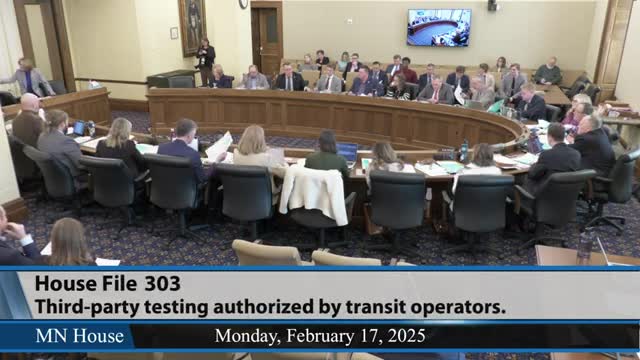
Summary
House File 303 would allow transit agencies to conduct third-party CDL testing similar to the school-bus model; transit leaders said current wait times of six to eight weeks for CDL testing hamper hiring and force service reductions in Greater Minnesota.
House File 303 was presented to the committee on Feb. 17, 2025, to expand current law that allows third-party commercial driver license (CDL) testing for school bus drivers to include public transit operators in Greater Minnesota.
Representative Perryman introduced the bill and said it would permit transit agencies to use third-party testing to shorten CDL licensing timelines. Ryan Daniel, CEO of Saint Cloud Metrobus and president of the Minnesota Public Transit Association, said long waits for CDL testing—"the average wait time for CDL tests in Minnesota ranges from 6 to 8 weeks, and in some instances, it can extend beyond 10 weeks"—cause candidates to accept other jobs and force agencies to reduce routes.
Kurt Couture of Cedar Valley Services (Smart Transit) described local impacts: testing candidates often must travel more than an hour for a pre-trip road exam, extending onboarding timelines by weeks and contributing to suspended service in some jurisdictions. "Having a third party testing system that is similar to school bus entities ... will help make sure we can get our new hires trained and tested and on the road," Couture said.
Supporters argued that the school-bus model already permits third-party testing and posed no safety tradeoffs; they framed the bill as a workforce solution rather than a cost driver. Representative Cagle expressed concern about privatizing public services and urged investment in state testing capacity, while supporters noted the proposal carries no direct additional cost and is intended to address staffing shortages that leave riders without service.
The committee laid House File 303 over for further consideration.