
Freeze on local-food federal purchases leaves farmers and food banks owed money and cancelling orders
Get AI-powered insights, summaries, and transcripts
Subscribe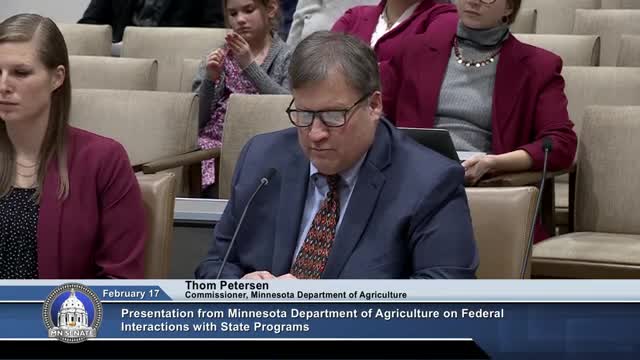
Summary
Minnesota farmers and food banks told the Senate committee that the federal pause on Local Food Purchase Assistance and other USDA programs has left grants unreimbursed, purchases unpaid and processing and delivery plans in limbo.
Minnesota Department of Agriculture officials and multiple speakers from the farming and food‑security communities told a Senate committee that the federal pause on grant reimbursements has interrupted farmer contracts and food‑bank purchases. "Currently, we have about 1.5 to $2,000,000 in payments to grantees that are on hold," Commissioner Tom Peterson said of the Local Food Purchase Assistance (LFPA) program.
Food banks and nonprofit partners said the freeze has immediate effects on supply and local purchases. Virginia Witherspoon, executive director of Channel One Regional Food Bank (a partner of Second Harvest Heartland), told the committee Channel One has a $125,000 LFPA grant with roughly $77,000 left that it cannot currently spend, and that it is owed $10,000 for chicken purchases it advanced to a small supplier. She said one Rochester-area nonprofit of farmers is owed $83,000 and has laid off half its staff. "We had to immediately stop buying the chicken for the food shelf," Witherspoon said.
Direct-marketing farmers and small producers described canceled purchases and payment uncertainty. Hannah Bernhardt, a beginning diversified livestock farmer, said she had a Local Food Purchase Assistance sale scheduled for March that was canceled when funding froze and that she is now scrambling to find new buyers for beef already booked for processing. Bernhardt also said a Conservation Stewardship Program contract through NRCS is on hold, complicating spring planning.
Why it matters: LFPA and related programs create predictable market outlets for small and emerging farmers, support school meal and emergency-food programs, and provide protein and produce for food shelves. When reimbursements are delayed, small farmers lack the cash flow to invest in seed, feed, processing slots and staff, and food banks lose predictable suppliers of protein that they say low-income shoppers value.
Numbers and timing: Peterson said MDA applied for approximately $18 million (LFPA plus Local Food for Schools) and that state plans are due by April 30 for some programs. The department signed a contract in January 2025 but said federal actions are day to day. Several nonprofit witnesses told the committee they had made advance purchases or set processing dates and now face staff layoffs or canceled orders if funds are not reimbursed.
Ending: Witnesses urged state support and called for the federal delegation to press for release of funds. Committee members asked agency leaders about contingency options and whether the state should step in to stabilize contracts while federal reimbursements are pending.