
Committee hears resolution to study human-trafficking victim services and reentry programs
Get AI-powered insights, summaries, and transcripts
Subscribe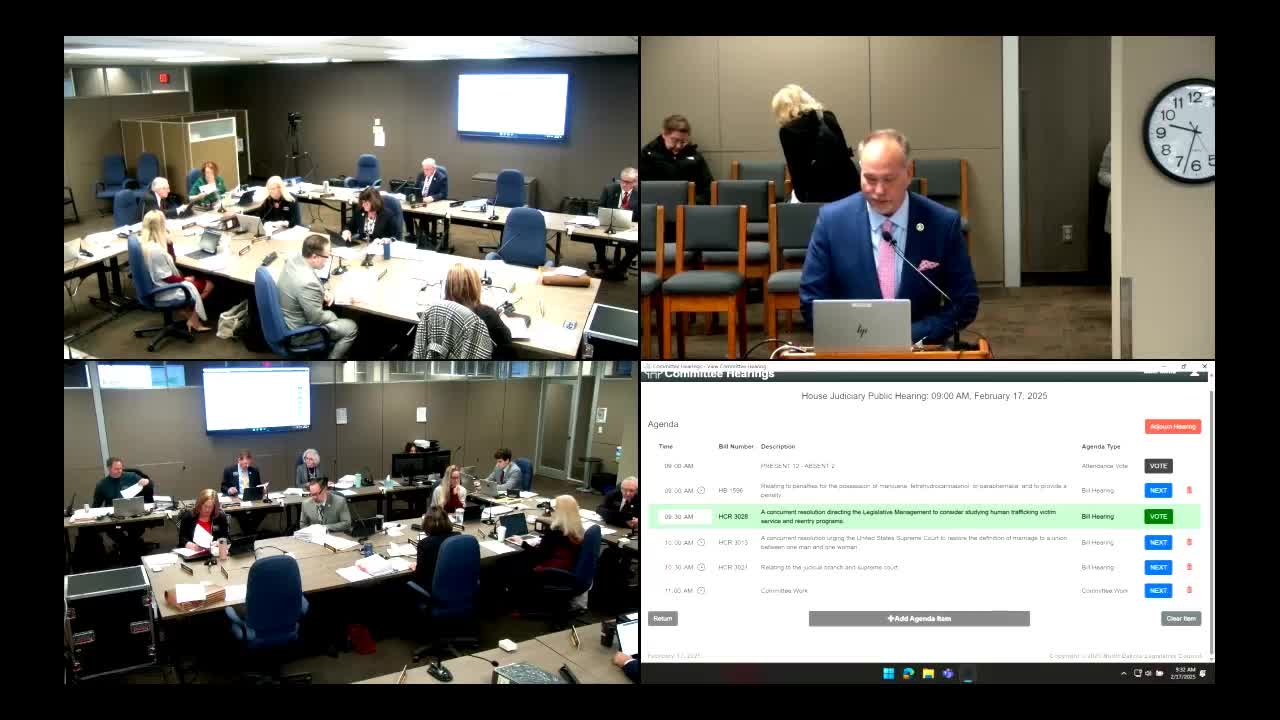
Summary
House Concurrent Resolution 3028 would direct legislative management to study victim services and reentry programs for human-trafficking survivors; sponsors and service providers described gaps in data, funding and shelter/transportation safety and urged inclusion of survivor voices in any study.
Representative Steve Vetter opened testimony on House Concurrent Resolution 3028, saying the measure would direct legislative management to study human-trafficking victim services with a focus on reentry into the workforce and protections against coercion and reprisals from traffickers.
"The main purpose... is for reentry and protection from the bad guys," Vetter said, describing his interest in identifying programs and service gaps that impede survivors' safe reintegration.
Policy and service providers testified in support. Jacob Thompson of North Dakota Family Alliance Legislative Action emphasized the severe mental-health and social harms trafficking victims face and endorsed a formal study to determine how the state can better support survivors' reintegration. David Tamasia of the North Dakota Catholic Conference and Stacy Schaffer, executive director of 31A Project, outlined service gaps including inconsistent definitions and data, lack of funding and workforce capacity, unclear standards for residential treatment lengths, and the need for survivor-centered, trauma-informed models.
Schaffer described 31A Project's programs — a demand-reduction diversion program for solicitation offenders, statewide education and a survivor mentorship program — and provided service metrics: 166 trainings in 2024 (a 40% increase from 2023), and growth from 10 survivors served in the first year of the mentorship program to 62 in 2024, with 85% trafficked in North Dakota.
A survivor, Leah Isaac, provided extended testimony about her multi-year experience of trafficking, homelessness, shelter interactions and barriers to documents, housing and stable services. Isaac urged that survivors be given a role in shaping services and that studies and funding prioritize wraparound support: "When we address only one aspect of well-being, we risk leaving individuals with incomplete support." Her testimony stressed anonymity, transportation safety, and long-term mentoring.
Committee members asked about overlaps with prior interim studies; Vetter said his proposal focuses more narrowly on reentry and survivor protection than prior efforts. The committee closed the hearing after taking public and written testimony and did not vote on the resolution at that time.
Ending: Supporters asked that the study include survivor perspectives and practical recommendations on funding, shelter safety and coordinated reentry supports; 31A Project offered to assist with the review if the resolution is approved.