Get Full Government Meeting Transcripts, Videos, & Alerts Forever!
Get email alerts on the Treatment Courts topic
No spam. Unsubscribe anytime.
Senate Judiciary Committee backs renaming 'drug courts' to 'treatment courts'
Summary
The Senate Judiciary Committee recommended a due-pass on House Bill 1030 to replace the term “drug court” with “treatment court,” citing a desire to destigmatize substance use disorder and align adult and juvenile specialized dockets. Supporters emphasized access to treatment as the central issue.
The Senate Judiciary Committee voted to give a due-pass recommendation on House Bill 1030, which would replace references to “drug court” with “treatment court” in state law, after presenters and service providers told senators the change would help reduce stigma and better reflect the therapeutic focus of those specialized dockets.
Sponsor and presenter Scott Johnson summarized a recent review of statutory language required to replace “drug court” with “treatment court,” noting the Supreme Court convened a work group and consulted corrections, health and human services, judges and program participants. “Resoundingly, survey participants noted that access to treatment resources was their number 1 concern,” Johnson said, urging the committee to recommend a do-pass.
Kim Jacobson, director of Agassiz Valley Human Service Zone, told the committee the change “supports our communities by taking an important step toward de stigmatizing substance abuse” and described zone work coordinating reentry services and treatment referrals. Travis Fink, executive director of the North Dakota Commission on Legal Counsel for Indigence, also testified in support, saying the rename “indicates to the participants…the support of the North Dakota legislature” for recovery.
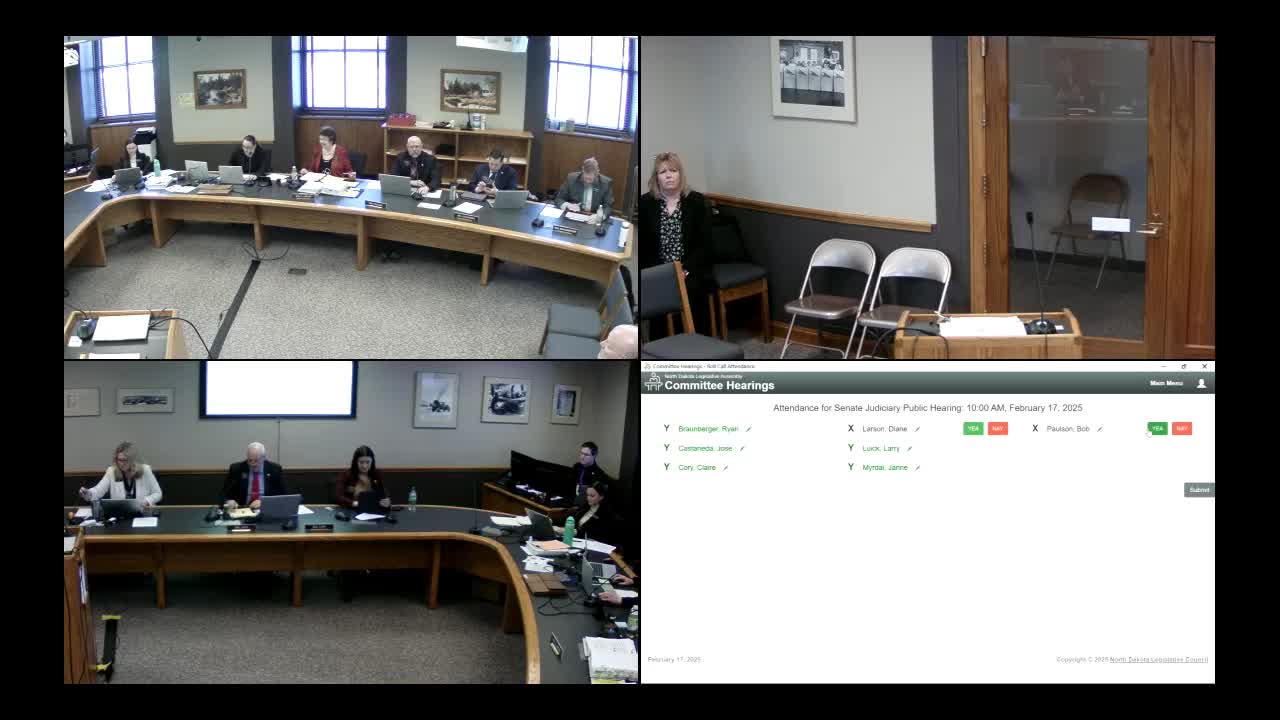
Committee discussion was brief. Senator Meerdal moved a due-pass recommendation; Senator Castaneda seconded. The committee recorded a unanimous voice and roll-call vote. Chair Larson appointed Senator Cory to carry the bill out of committee.
The bill, as discussed, does not change program funding or operations; presenters and survey respondents emphasized that improving access to treatment resources is a separate, higher-priority operational need than the naming change itself.
Votes at the committee: motion moved by Senator Meerdal, seconded by Senator Castaneda. Recorded votes in transcript included Senator Castaneda (Aye), Senator Luke (Yes), Senator Mittel (Aye), Senator Paulson (Aye), Senator Brownberger (Aye), Senator Cory (Aye), Chair Larson (Yes). Motion carries.