Get Full Government Meeting Transcripts, Videos, & Alerts Forever!
Get email alerts on the Education topic
No spam. Unsubscribe anytime.
Committee sends public-comment cleanup bill to amending order after split testimony
Summary
Senate Bill 1007, a cleanup measure removing a sentence that limited public comment to agenda items, was sent to the fourteenth order for possible amendment after proponents said the change would restore community voice and opponents warned it could create open-meeting and quasi-judicial problems.
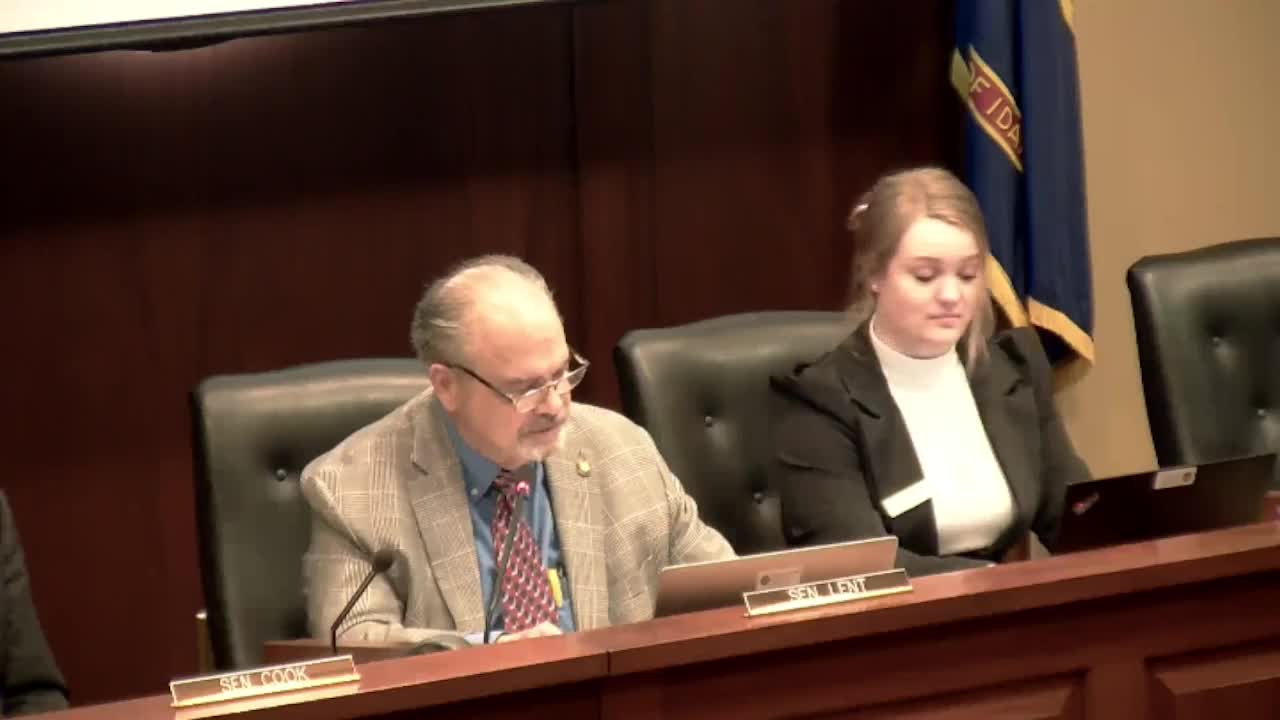
The Senate Education Committee voted to send Senate Bill 1007 to the fourteenth order for possible amendment after hours of testimony and questions about whether removing a statutory sentence limiting public comment to agenda items would broaden public participation or undermine meeting procedures.
Senator Cindy Carlson introduced the bill as a cleanup of language from a prior enactment identified in testimony as Senate Bill 1361. Carlson said the sentence proposed for removal — "Public comment shall be limited to items listed on the meeting agenda" — has led some districts to deny patrons the chance to speak and has prevented opportunities for constituents to raise concerns that fall outside a posted agenda.
Several patrons and school officials spoke in favor. Melanie Phillips, a parent from Kuna, described pressing her own district for six months on using "advanced opportunities" funding for driver's education. Phillips said her public comments prompted administrators to research the issue and the district approved an approach that she estimated "has saved a community about a half a million dollars and counting." Christina Hardy, a District 23 resident, said in five years she rarely sees public comment used at board meetings and that allowing nonagendized comment produced only a small time burden in her district. Leslie Bjerke, vice chair of the Coeur d'Alene School Board, said her board historically allowed patrons to speak about nonagenda matters without incident and that the board preferred to set local parameters.
Quinn Perry, deputy director of the Idaho School Boards Association, testified in opposition. Perry said the change would remove a carefully negotiated limit enacted last session and could turn board meetings into a "free for all" in some circumstances. Perry warned school boards sometimes act in a quasi-judicial capacity — for example in expulsions or termination hearings — and that airing grievances in open comment could bias later proceedings. Perry also noted the statute requires agendas be posted 48 hours in advance and questioned how removing the agenda limitation would interact with open-meeting requirements.
Senators discussed possible compromises, with Perry saying the association had offered alternative language but that Senate Bill 1007 as written "does not get us there." Senator Woodward moved to send the bill to the fourteenth order for possible amendment; the motion carried on a voice vote. Earlier in the hearing, Senator Zito offered a motion to send the bill to the floor with a due pass that failed for lack of a second.
Committee members also requested additional information: Senator Woodward asked the committee staff to arrange a briefing from the Idaho State Department of Education about eligible uses of the "advanced opportunities" program, after witnesses described using that funding for driver's education.
The bill will advance to the fourteenth order for amendment work and further committee consideration.