Get Full Government Meeting Transcripts, Videos, & Alerts Forever!
Get email alerts on the Public Safety Police Budget topic
No spam. Unsubscribe anytime.
Legislators review Idaho State Police budget as director warns of staffing shortfalls and seeks funding for fentanyl, forensic and IT work
Summary
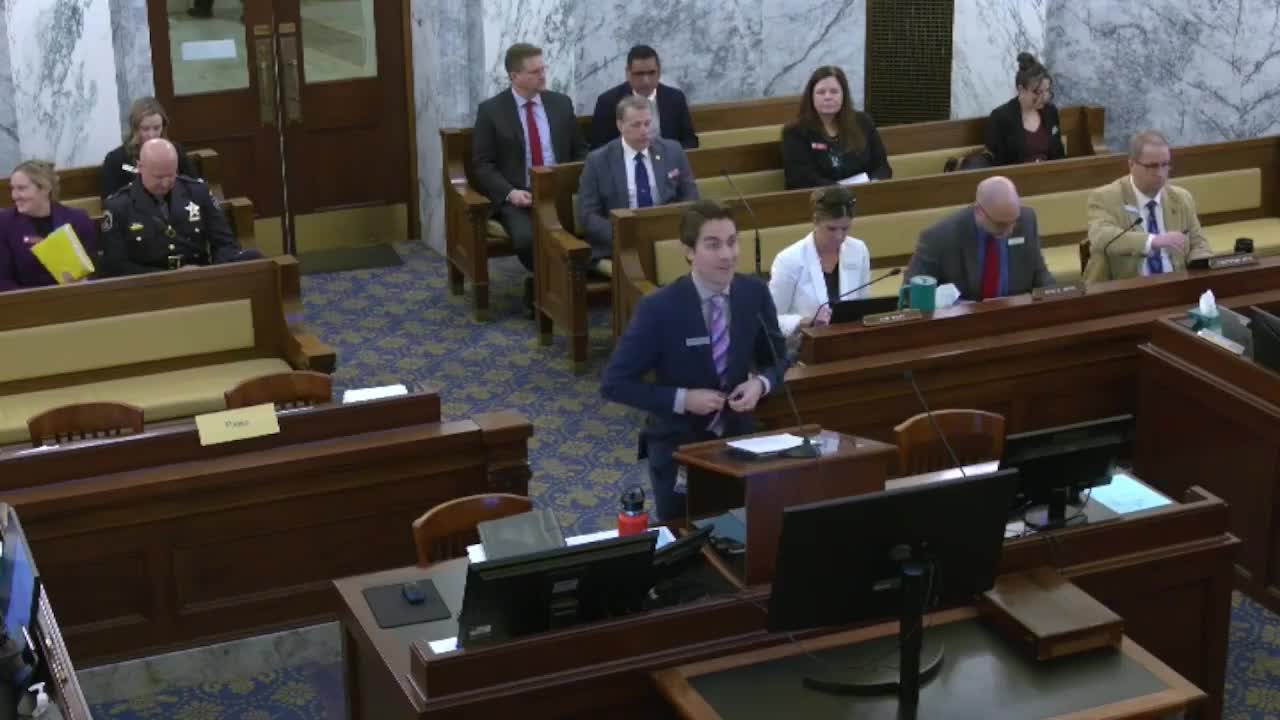
The Joint Finance and Appropriations Committee reviewed the Idaho State Police budget on Feb. 12, hearing requests for new investigators, forensic staff and technology upgrades as Director Colonel Bill Gardner warned of recruitment and retention problems that have left many patrol districts undersupplied.
The Joint Finance and Appropriations Committee heard a budget review for the Division of Idaho State Police on Feb. 12 that highlighted personnel shortages, a slate of enhancement requests and plans for new forensic facilities and investigator units.
Noah Peterson, budget policy analyst with the Legislative Services Office, told the committee the division is allocated 583.67 full-time positions and reported about 38.67 positions vacant as of August of last year. Peterson reviewed enhancement requests that include adding fentanyl-focused investigators, consolidating certain IT positions under the Office of Information Technology Services (OITS), and funding a new remote housing unit.
The committee also heard from Colonel Bill Gardner, director of the Idaho State Police, who stressed the operational effect of vacancies and pay competition with local agencies. “We are genuinely struggling with what we pay our troopers compared to what the cities and counties around them do,” Colonel Gardner said, noting recent losses of troopers to municipal and out-of-state employers.
Why it matters: Committee members said the staffing shortfalls affect patrol coverage in parts of the state and asked for data and proposals to improve recruitment and retention. The budget requests reviewed would preserve or expand investigative capacity and technology infrastructure used by statewide law enforcement.
Major requests and program details - Fentanyl-focused unit: An enhancement would add 10 full-time positions (FTP) and $1,043,300 to create a unit focused on fentanyl trafficking and mitigation (Peterson). The governor separately recommended a $500,000 one-time Millennium Fund appropriation to support a related fentanyl public information campaign. - Special investigations unit for Idaho Department of Correction (IDOC): A request would create a 4-person investigations unit (one detective sergeant and three detectives) specific to investigations at IDOC facilities. Total request: $757,300 (approximately $443,300 ongoing, $314,000 one-time) and four FTP (Peterson). - Forensic staffing and lab management: An enhancement seeks one FTP and $118,200 for a forensic deputy lab manager to help manage a growing forensic services operation and a new lab building (Peterson). Colonel Gardner described plans for a new, larger forensic laboratory in Meridian and a separate renovation to add a Twin Falls lab focused on drug identification. - Sexual assault kit initiative (SACI) investigators: The agency now proposes hiring two full-time investigators (converted from planned part-time contractors) with a net $0 transfer from operating to personnel costs because contractors lacked post certification privileges (Peterson). - Fleet, digital forensics, and ILETS requests: Other requests include converting two fleet contractors to FTP ($63,300 net personnel cost), transferring a two-person digital forensics team into forensic services (net 0 transfer, $203,700 moved to personnel), and a $233,000 ongoing request from the Idaho Law Enforcement Telecommunications (ILETS) fund for a disaster recovery database site (Peterson). - Highway Distribution Account (HDA) fund shift: Peterson described a requested transfer of $4,995,500 and 37.48 FTP in fiscal year 2026 tied to prior statutory changes (Senate Bill 1201 of 2019) that have reduced HDA distributions to the Law Enforcement Fund. That shift, the analyst said, would allow the patrol program to maintain current operations. - Federal funds and SORNA compliance: The agency seeks a $659,700 shift of federal appropriations to miscellaneous revenue for certain contracts, and $50,000 in federal grant funds for compliance with the Sex Offender Registration and Notification Act (SORNA) (Peterson).
Operational context and concerns Committee members pressed for details on centralizing IT functions. Peterson described an agency request to move 20 IT FTP to OITS (a net increase in operating costs reported as $144,300); the governor’s recommendation reduced that transfer to 16 FTP and reflected a different net cost ($281,500) in the recommendation.
Colonel Gardner described tactical results from the division’s drug interdiction efforts: “Over the last year, we've seized over 65,000 fentanyl pills, over a pound of fentanyl powder, [and] 150 pounds of methamphetamine,” and he noted a recent separate operation that seized 50 pounds of methamphetamine. He told lawmakers the concentrated interdiction “saturation” operations enable those seizures.
On financial-crime investigations, Gardner told the committee that administrative subpoena authority limited to financial records in drug and human-trafficking cases would help investigators follow money trails more quickly.
Housing and remote posts Peterson described a supplemental request of $268,100 for a remote housing unit originally planned for Mackay but moved to Fairfield at the agency’s request; Colonel Gardner said partnership with the Idaho Transportation Department on site utilities made Fairfield preferable and could save taxpayer dollars.
Recruitment, retention and pay Lawmakers asked for turnover and pay-comparison data after members raised concerns about vacancies concentrated in northern and rural districts. Gardner said vacancy rates vary by location and that some districts are “decimated,” with few applicants for open trooper positions in northern Idaho. He said training a trooper through probation costs roughly $1 million per trooper (agency estimate cited in committee discussion) and expressed frustration when trained officers leave for better-paying city jobs.
Next steps and committee action No formal committee votes on ISP budget line items were recorded in the transcript for this presentation. Committee members asked the agency and Legislative Services Office to provide additional detail on vacancy and turnover data, grant timelines and fund transfers. Gardner and staff said they will follow up with requested information.
Ending note Gardner closed by thanking the committee for an 8% compensation increase for troopers in the current cycle and for the committee’s time, and he noted a trooper from Pocatello had been named a finalist for a national trooper award.