Get Full Government Meeting Transcripts, Videos, & Alerts Forever!
Get email alerts on the Municipal Budget topic
No spam. Unsubscribe anytime.
Middleborough manager presents balanced FY26 budget; retirement and debt drive increases
Summary
Town Manager James McGrail presented a $113 million FY26 budget for the Town of Middleborough on Feb. 3, citing a 10% contractually required increase in retirement contributions and higher debt service tied to Bristol Plymouth as the principal drivers of a modest overall tax increase.
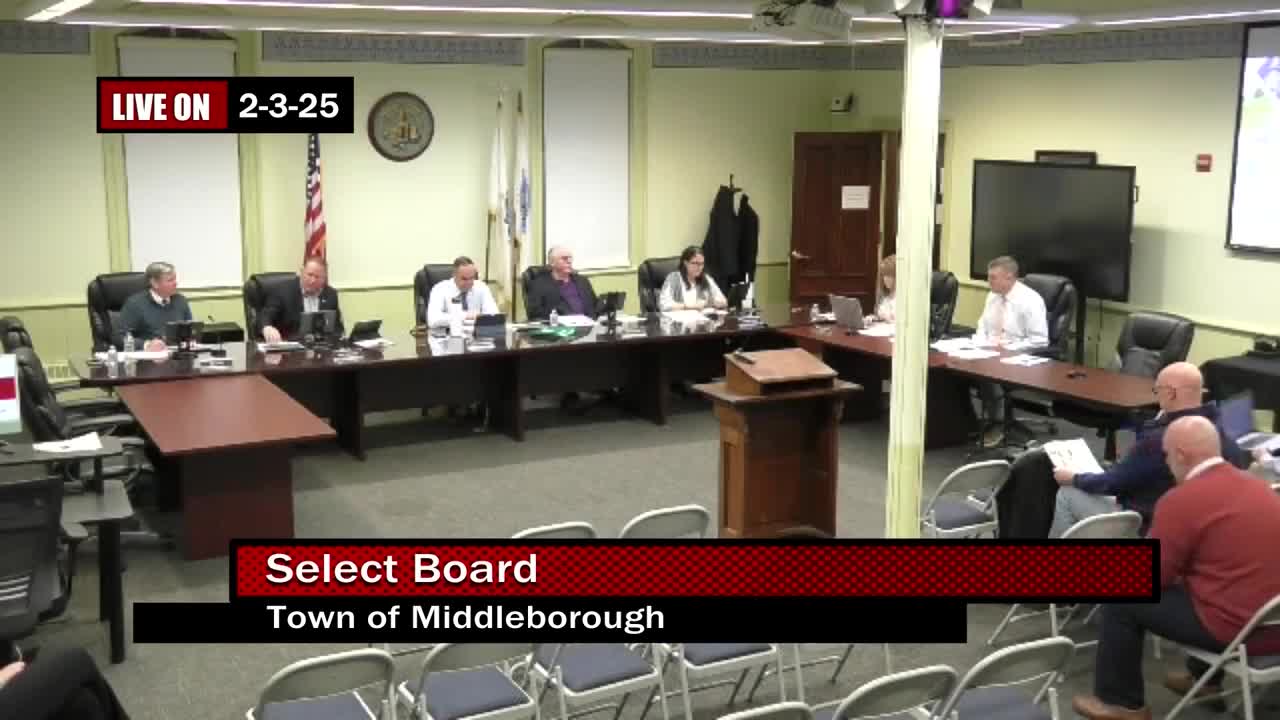
Town Manager James McGrail presented the Town of Middleborough’s proposed fiscal year 2026 budget during a joint meeting with the Finance Committee on Feb. 3, saying the town will present a balanced spending plan totaling about $113,308,000.
McGrail said the budget reflects conservative revenue estimates and limited new spending beyond previously discussed items, with the principal cost increases coming from a roughly 10% increase in the town’s retirement appropriation and higher debt service tied to Bristol Plymouth Regional Technical School. “A 10% increase in our retirement budget is about $1,100,000,” McGrail said, adding, “that pretty much eats up our entire Proposition 2½ increase.”
Why it matters: the retirement jump and new debt payments mean most operating departments saw only modest year‑over‑year growth; without those two items the combined general government and school budgets increase by less than 3% from FY25, McGrail said. The presentation laid out revenue assumptions, reserve plans and targeted investments in public safety and capital projects.
Key revenue and reserve assumptions McGrail described conservative assumptions for new growth (budgeted at $1 million) and local receipts, including a cautious outlook on meals, hotel and cannabis taxes. He said local receipts are budgeted to rise by $700,000 versus FY25 and noted a continued reliance on indirect costs returned from enterprise funds, which are higher this year because enterprise funds have taken on more debt.
He also highlighted grant revenue: the town received about $6.9 million in grant awards in calendar 2024, which he said provided one‑time relief to taxpayers and supported capital projects. McGrail pointed to a recent reaffirmation of the town’s stable bond rating by S&P and said financial policy work (five‑year forecasts, a financial summit and adoption of policies) contributed to that result.
Public safety and staffing changes The only notable service expansions in the FY26 operations budget, McGrail said, are funding tied to a SAFER grant for firefighters and the full‑year funding for eight civilian dispatchers. He described an interim arrangement in which four civilian dispatchers will be budgeted in the police department and four in the fire department while the town continues planning toward a single dispatch center at the police department. “We’re probably a little bit of ways away from that,” McGrail said.
Debt strategy and Bristol Plymouth McGrail described a multi‑year approach to absorb the Bristol Plymouth debt instead of adopting a debt exclusion. He said the town will use measured annual increases in the levy and transfers into a debt stabilization account from free cash, with a plan to appropriate the remaining first‑year payment at the fall town meeting after final borrowing amounts are known. The town will continue taking “small bites” each year to build the levy allocation for that payment.
Reserves, free cash and one‑time receipts The presentation showed a certified free cash balance of $3,144,000 this year and a stabilization fund of about $3,000,000 that McGrail said the administration intends to grow toward a 10% goal. He said anticipated one‑time receipts from two property sales (Campus 44 and Station Street) should boost free cash certification this spring and allow additional deposits to stabilization, OPEB, and debt stabilization.
Roads, capital and enterprise funds McGrail said the town invested roughly $2.3 million on roadways in the prior year and expects to continue elevated paving to improve long‑term pavement condition, noting that Chapter 90 alone would not make comparable progress. He described enterprise fund positions as improved: sanitation retained earnings have recovered to about $1.5 million after restructuring fees, wastewater and water retained earnings remain adequate to support near‑term projects, and water planning includes multi‑million dollar capital projects and a $33 million project in the longer term.
Other budget items and human resources McGrail said he included $30,000 for a new management training program in HR and reiterated that the school department budget was prepared using a previously agreed five‑year projection. He also noted the town contributes annually to an OPEB trust while currently funding retirees from the levy and expects the trust contributions to reduce long‑term OPEB pressure.
Public comment and finance committee questions During public comment, resident Paula Fay urged the board to increase the Council on Aging food and supplies line, saying the COA repeatedly requests basic supplies and meals support. McGrail responded that perishables funding has been increased in recent years — from about $60,000 previously to $90,000 — and said staff will review the request again.
Next steps McGrail outlined a schedule of department presentations to the Finance Committee in February and March, with the school superintendent scheduled for March 10 and a planned vote on the budget in the following week.
Ending The town manager closed the presentation after roughly an hour, saying the budget is “pretty modest” except for the known retirement and debt pressures and that he will continue to provide specific department briefings to the Finance Committee and Select Board ahead of spring town meeting.