Get Full Government Meeting Transcripts, Videos, & Alerts Forever!
Get email alerts on the Behavioral Health topic
No spam. Unsubscribe anytime.
Senate advances bill targeting behavioral-health crisis after debate over fiscal note
Summary
Senate Bill 42, aimed at coordinating Colorado’s behavioral-health crisis response and codifying a Medicaid waiver, cleared second reading after senators debated a fiscal note later reduced to zero and agreed to stakeholder meetings.
Senate Bill 42, described by sponsors as a set of measures to address Colorado’s behavioral-health crisis, cleared second reading and was ordered engrossed and placed on the calendar for third reading after a day of debate over its fiscal impact.
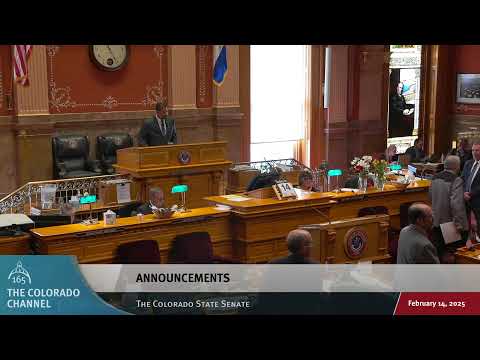
The bill, introduced by Senators Cutter and Amabile and Representative Bradfield, was discussed on the Senate floor Feb. 14, 2025. Senator Rich questioned the bill’s cost and broader fiscal priorities, saying the proposal carried a fiscal note of $607,000 in fiscal year 2025–26 and $50,000 in 2026–27 before amendments. "This also has a fiscal note of $607,000 in fiscal year 2526, and 50,000 in 2627 in future years," Rich said, urging colleagues for a no vote on that basis.
Senator Madeleine, who participated in committee amendment negotiations, said those concerns were addressed on the floor and in appropriations. "We ran amendments in committee and then again today in appropriations that brought the fiscal note down to 0," she said, adding the bill also codifies a Medicaid waiver obtained last year and will conduct a one-day stakeholder meeting by videoconference to share best practices statewide.
Senator Frizzell described local models that informed the measure, noting Douglas County’s community response teams that pair law enforcement with mental-health clinicians and health-care providers. "This program that's actually grown, and done amazing work," Frizzell said, praising statewide information-sharing on best practices to help other jurisdictions implement similar responses.
Procedurally, the Committee on Appropriations recommended amendments and referred the bill to the committee of the whole with a favorable recommendation; the committee-of-the-whole report was adopted and SB42 was placed on the third-reading calendar. The committee-of-the-whole adoption was recorded in the transcript as 29 yeas, 0 nays, 0 absent and 6 excused.
Sponsors said the bill’s remaining measures are intended to coordinate existing tools, codify the new Medicaid waiver, and convene stakeholders to reduce duplication and spread proven community models. The adopted amendments reduced the bill’s net general-fund impact to zero, according to statements on the floor.