Get Full Government Meeting Transcripts, Videos, & Alerts Forever!
Get email alerts on the Military National Guard topic
No spam. Unsubscribe anytime.
Rhode Island lawmaker reintroduces 'Defend the Guard' bill to bar overseas combat call-ups without a congressional declaration
Summary
Representative Place reintroduced House Bill 5,378, which would prevent Rhode Island National Guard members from being federally activated for foreign combat roles unless Congress issues a formal declaration of war. The state's adjutant general and other witnesses opposed the bill, citing federal law, readiness and funding risks.
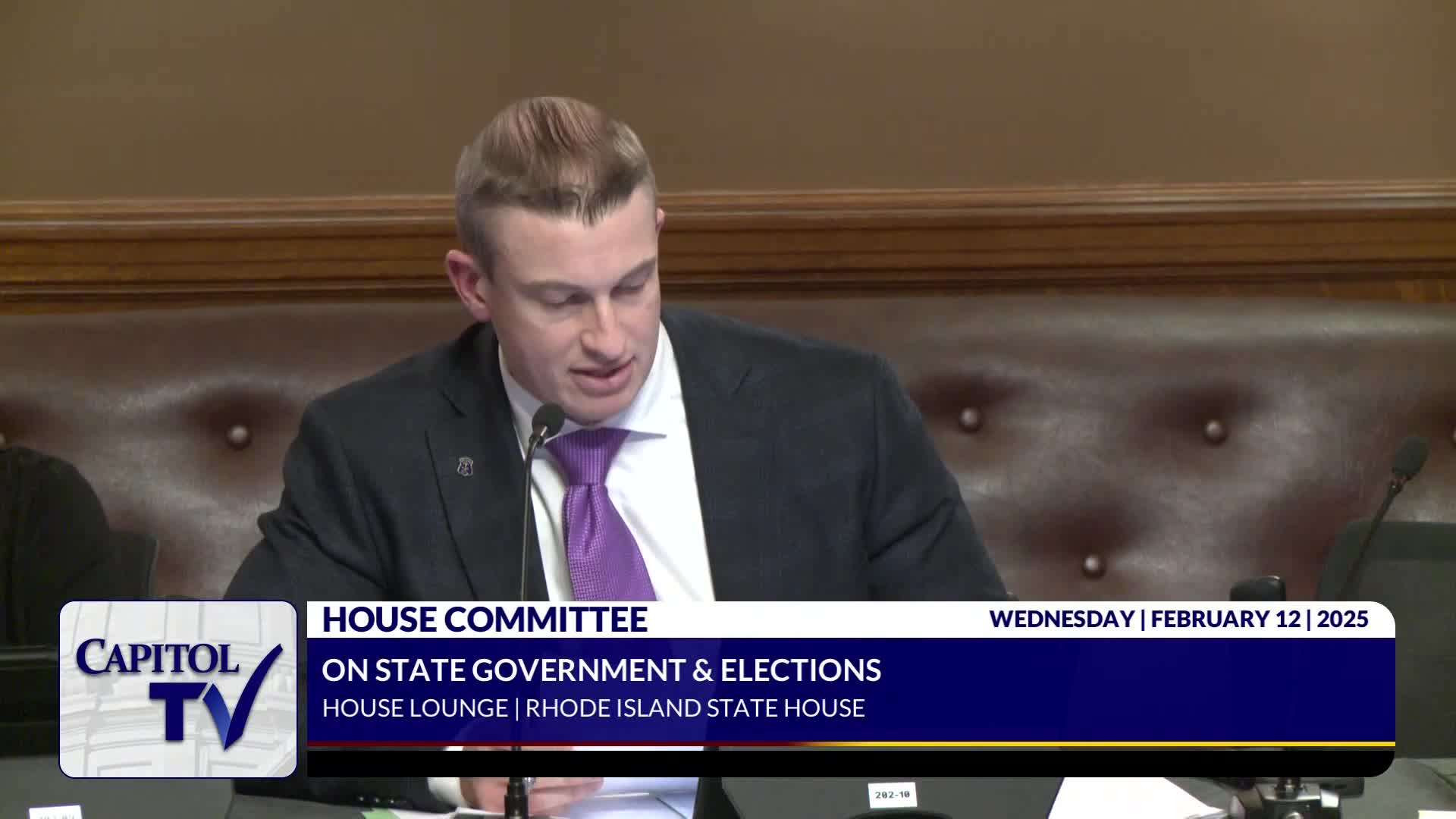
Representative Daniel Place reintroduced House Bill 5,378 on behalf of the sponsor, proposing that Rhode Island ‘‘will not allow its National Guard to be called up for federal service in combat roles without an express declaration of war by the Congress,’’ he told the House Committee on State Government and Elections. The committee opened the session by voting to hold all seven bills on the calendar for further study in a procedural motion passed by voice vote.
The bill, described by Place as a ‘‘defend the guard’’ measure, would bar state authorization for Guard members to be mobilized for foreign combat unless Congress issues a formal declaration of war. Place told the committee he is motivated by what he described as long-running use of a single post‑Sept. 11 authorization to send U.S. forces overseas and said he wants Congress to ‘‘do their job’’ before Guard members are used in combat roles.
Brigadier General Andrew Chabot, the adjutant general and commanding general of the Rhode Island National Guard, testified in opposition. Chabot said the proposal conflicts with federal law and would harm guard readiness and federal‑state partnership. He told members that roughly 98% of the Guard’s funding comes from the federal government and that the Guard supports both federal and state missions, including pandemic response and wildfire support. Chabot said passing the bill could ‘‘signal to the federal government that we are unreliable partners and risk the reallocation’’ of federal resources.
Pat Ford, speaking on behalf of a national veterans and libertarian network, said similar measures have been introduced in multiple states and argued the bills would force Congress to use the Constitution’s declaration‑of‑war power. Ford and other witnesses cited recent statehouse activity elsewhere, including a unanimous Virginia House vote on comparable language, as part of a broader movement in “defend the guard” proposals.
Committee members asked about constitutional limits and operational impacts. Representative McGaugh asked whether the bill would hamper rapid responses to insurrections; Place and Chabot both said state law cannot supersede constitutional and federal authority in domestic emergencies and that the bill targets foreign combat activations. Chabot emphasized the Guard’s dual federal‑and‑state oath and cited the National Defense Act of 1903 as the statute that established the modern dual role. No final committee decision on the substance of HB 5,378 was taken; the committee’s procedural vote at the start of the meeting placed the bill on hold for further study.
The committee recording shows no amendment or formal disposition of HB 5,378 beyond that procedural hold. If the bill advances, the committee will have further hearings to weigh constitutional, readiness and funding concerns raised during testimony.