Get Full Government Meeting Transcripts, Videos, & Alerts Forever!
Get email alerts on the County Finance Audit topic
No spam. Unsubscribe anytime.
Independent auditors give Lexington County unmodified opinion; transfers to capital projects leave planned overall deficit
Summary
At the Feb. 11 Lexington County Council meeting, auditor Bill Hancock of the Brittingham Group delivered the county's annual audit, reporting an unmodified opinion, a $3.3 million positive variance in operations and a planned overall deficit of about $16–17 million driven by transfers to capital projects.
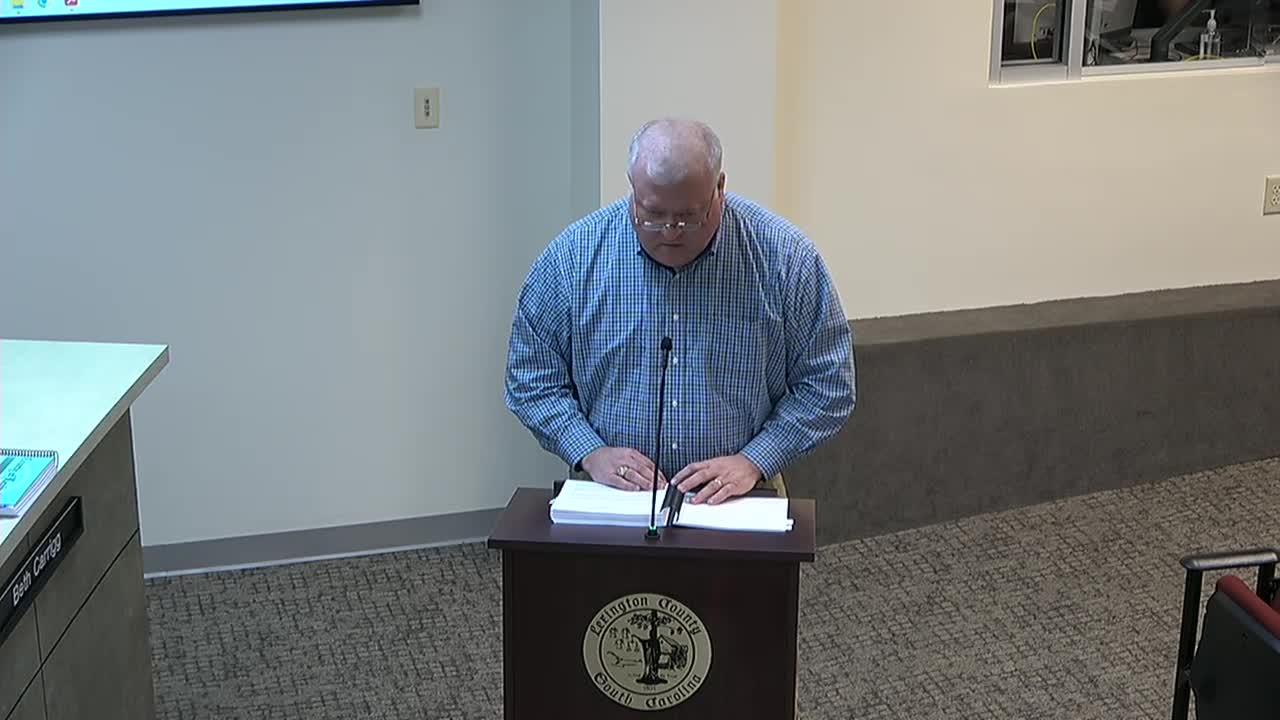
Bill Hancock, partner at the Brittingham Group, told the Lexington County Council on Feb. 11 that his firm issued an unmodified (clean) opinion on the county’s 2023–24 financial statements.
Hancock said the audit found no material weaknesses in internal control and no instances of noncompliance with laws, regulations or grant requirements. “If there had been some problems along the way, we would have been discussing them before now,” Hancock told the council.
The audit shows the county ended the fiscal year with about $3,300,000 in positive operating results but recorded an overall deficit of roughly $16 million to $17 million after planned transfers. Hancock said the general fund transferred more than $20 million out, with almost $15 million going to the capital projects fund to pay for ongoing projects rather than borrowing.
Hancock also reported that Lexington County qualified as a “low-risk auditee” for federal grant reporting because it spent more than $750,000 of federal funds and had no prior findings for two consecutive years. The audit document lists roughly $11,670,000 in federal-sourced expenditures for the year; Hancock said some of that money was spent directly by the county and some was passed through to other agencies.
On long-term retirement liabilities, Hancock said the county’s share of the South Carolina Retirement System’s unfunded liability has been improving. “Roughly, we’re at about a 58% funded status right now,” Hancock said, and attributed the improvement to investment returns that have recently exceeded the long-term assumed rate used in actuarial calculations.
Council members asked clarifying questions during the presentation, including whether a widely reported $1.8 billion state-level issue affected county finances; Hancock and others said it was a state matter and not tied to Lexington County. The audit presentation pointed the council to a list of major capital projects and to footnotes in the audit report for further detail on project costs and accumulated expenditures.
County staff said the practice of using reserves to fund capital projects prevented the county from having to borrow for those projects in the most recent fiscal year.
Hancock closed by inviting council members to call his office with questions and by noting that the audit report and supplemental documents include detailed information on grant compliance, transfers and capital project schedules.