Get Full Government Meeting Transcripts, Videos, & Alerts Forever!
Get email alerts on the Local Taxes Homestead Exemption topic
No spam. Unsubscribe anytime.
South Kingstown officials urge homestead-exemption authority to protect year-round homeowners
Summary
Town officials and the bill sponsor asked the House committee for authority to grant a homestead tax exemption of up to 10% to year-round South Kingstown homeowners, citing pressure from short-term rentals and rising property values; witnesses described litigation that has complicated local short-term rental registries.
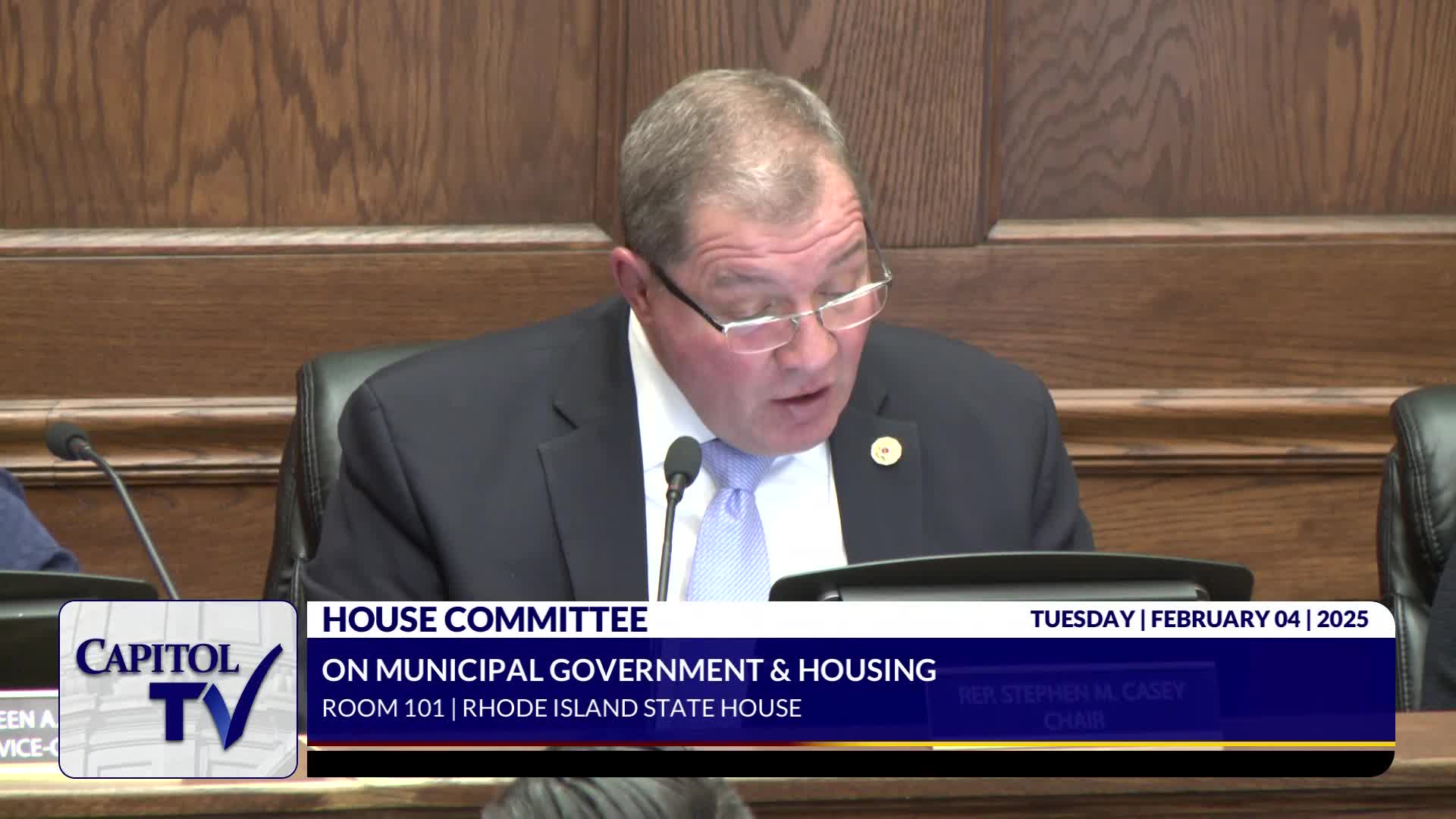
Providence — Officials from South Kingstown and their state representative told the House Committee on Municipal Government and Housing on Feb. 4 that House Bill 5030 would allow the town to adopt a homestead tax exemption for year-round residents and provide relief for homeowners facing rising property values driven in part by short-term rentals.
Representative McEntee, the bill sponsor, said the exemption — proposed up to 10% in the town’s request — would give the town a tool to ease tax burdens on year-round residents who face rising assessments and increasing numbers of nonresident owners. “We ask that you pass this legislation so these councilmen next to me can start working on this Homestead Act to benefit the year-round residents of South Kingstown,” he said.
South Kingstown council members described pressure on the local housing market from out-of-state buyers and the University of Rhode Island area. JG Wegmont, a South Kingstown town council member, said a homestead exemption is intended to help working families, seniors and young professionals remain in the town. He noted the town is also evaluating municipally owned sites for affordable housing development.
Committee members asked for more concrete data on the scale of short-term rentals and the fiscal impact of any specific exemption level. Council members and Representative McEntee said that litigation and differing court decisions have made it difficult for towns to gather reliable platform registration data. The panel discussed two court rulings referenced by witnesses: a decision in Narragansett that prompted a temporary stay on enforcement and a separate Superior Court ruling cited in Exeter that involved zoning authority for short-term rental ordinances. Council members said that, once reliable registration data are available, the town will be better able to model the fiscal effects of a homestead exemption.
Representative Fogarty, who served on the town council, said anecdotal evidence suggests short-term rentals are increasing and that the town’s experience mirrors other coastal communities. Representative Speakman said Narragansett’s homestead program has functioned as intended there, with higher taxes falling on nonresident owners when a homestead exemption is adopted locally.
The committee closed the hearing and placed the bill on further study; no substantive committee vote on the underlying exemption was taken that day (see “Votes at a glance”).
Ending: South Kingstown leaders and sponsors said the legislation would be the first step; officials plan to return with registration data and modeled fiscal numbers that would show the exemption’s local impact.