Get Full Government Meeting Transcripts, Videos, & Alerts Forever!
Get email alerts on the Psychedelics Policy topic
No spam. Unsubscribe anytime.
Committee hears testimony on bill to decriminalize personal cultivation and possession of psilocybin mushrooms
Summary
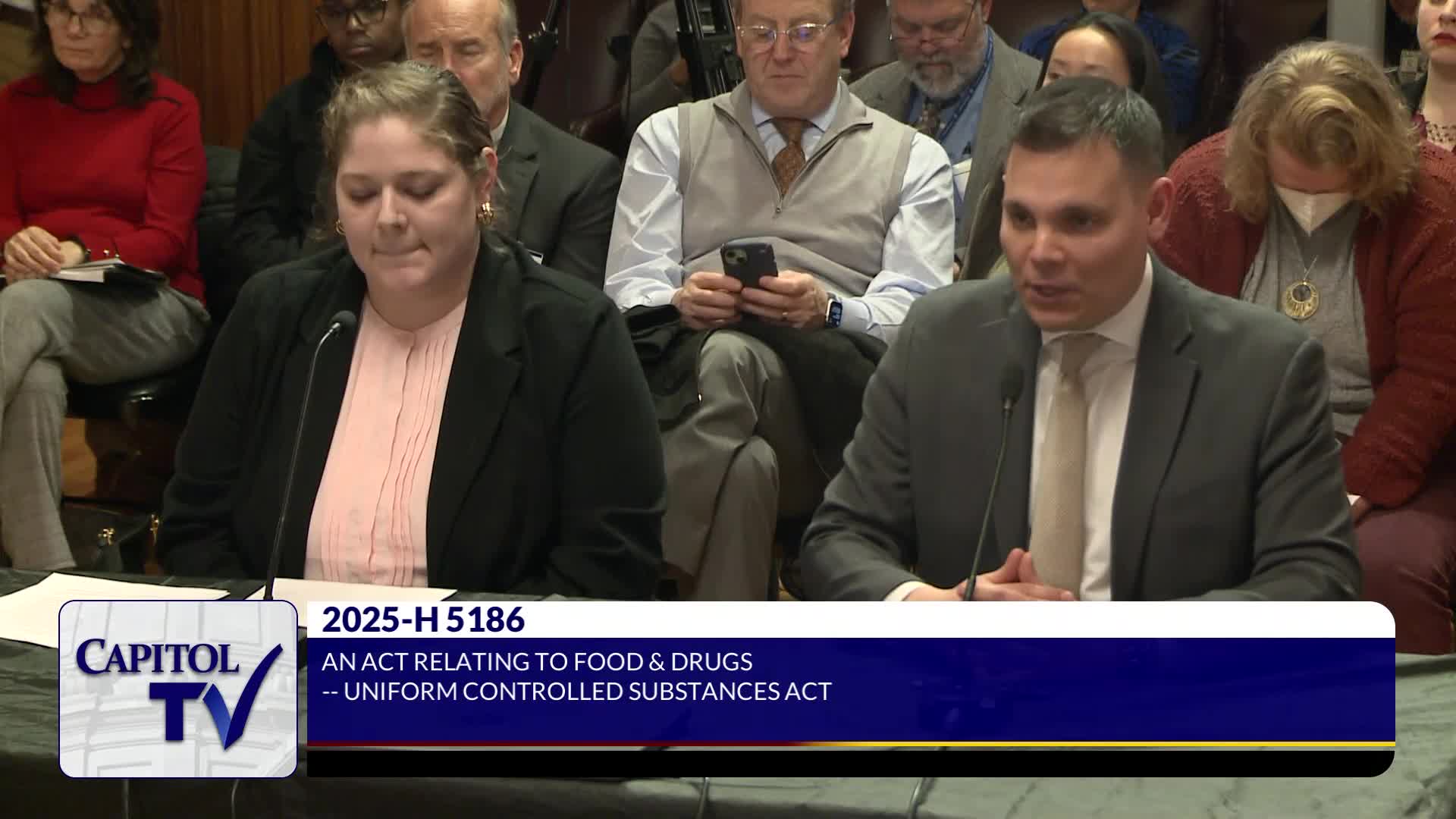
Rep. Potter presented House Bill 5186 to the House Judiciary Committee, seeking to decriminalize personal cultivation and possession of psilocybin-containing mushrooms and to have the Department of Health adopt enabling rules contingent on federal programs.
Representative Potter introduced House Bill 5186, described in testimony as a decriminalization measure for personal possession and home cultivation of psilocybin mushrooms for personal use. Potter told the committee the bill is largely identical to a version the House passed two years earlier and said it removes an earlier drafting error that could have enhanced penalties for larger amounts.
Professor Victoria Lippman, a visiting professor of law at Roger Williams (and fellow at Harvard’s Petrie-Flom Center), testified as a policy and legal expert, offering national context. Lippman told the committee that jurisdictions nationwide have moved to decriminalize or create regulated access programs for naturally occurring psychedelics, that state measures vary from pure decriminalization to regulated systems (Oregon, Colorado), and that evidence from research institutions indicates medical promise for PTSD, severe depression and addiction. She said the bill before the committee is a “smart” decriminalization approach that would not require creating a new regulatory agency or a commercial market, and that it would not change DUI law — presence of controlled substances in a person’s system could still be used by law enforcement and would remain a misdemeanor under existing law.
Committee members asked practical and safety questions. A committee member and multiple public commenters asked whether psilocybin is a hallucinogen or psychedelic; Lippman answered that “psychedelic” is the common contemporary term and that state measures to date have targeted naturally occurring substances such as psilocybin rather than lab-synthesized substances such as LSD. A nurse in public comment said she was concerned about labeling unregulated homegrown products as “medicine” without laboratory testing for dose, purity and contaminants; Lippman and the sponsor responded that some people will prefer regulated, lab-tested access (FDA or regulated access models), but the bill being considered is focused on personal use and would not allow commercial sales.
Witnesses and members also asked about roadside or spot testing for impairment. Lippman and other witnesses said technology to detect psychedelics at the roadside is not currently reliable in the way alcohol breathalyzers are; identification typically requires laboratory analysis of blood, urine or hair.
Public commenters included a registered nurse who emphasized infection and contaminant risks with homegrown products, and an academic/witness who underscored the low-risk, high-safety profile cited in research and argued the bill would reduce criminal enforcement burdens. Supporters framed the bill as a public-health oriented decriminalization that would not create a commercial market or change DUI statutes; opponents and some questioners urged caution on public-safety and medical-evaluation issues.
The transcript records testimony and questioning but does not include a committee vote on this bill during the hearing segment.