Get Full Government Meeting Transcripts, Videos, & Alerts Forever!
Get email alerts on the Clean Heat Standard topic
No spam. Unsubscribe anytime.
Supporters and utilities debate Clean Heat Standard as committee weighs pathways to meet Act on Climate goals
Summary
House Bill 5,167 would direct the EC4 to establish a clean‑heat credit program to drive building electrification and weatherization; advocates argued it targets emissions from delivered fuels and includes equity provisions, while utilities and fuel retailers raised cost and implementation concerns and urged more analysis
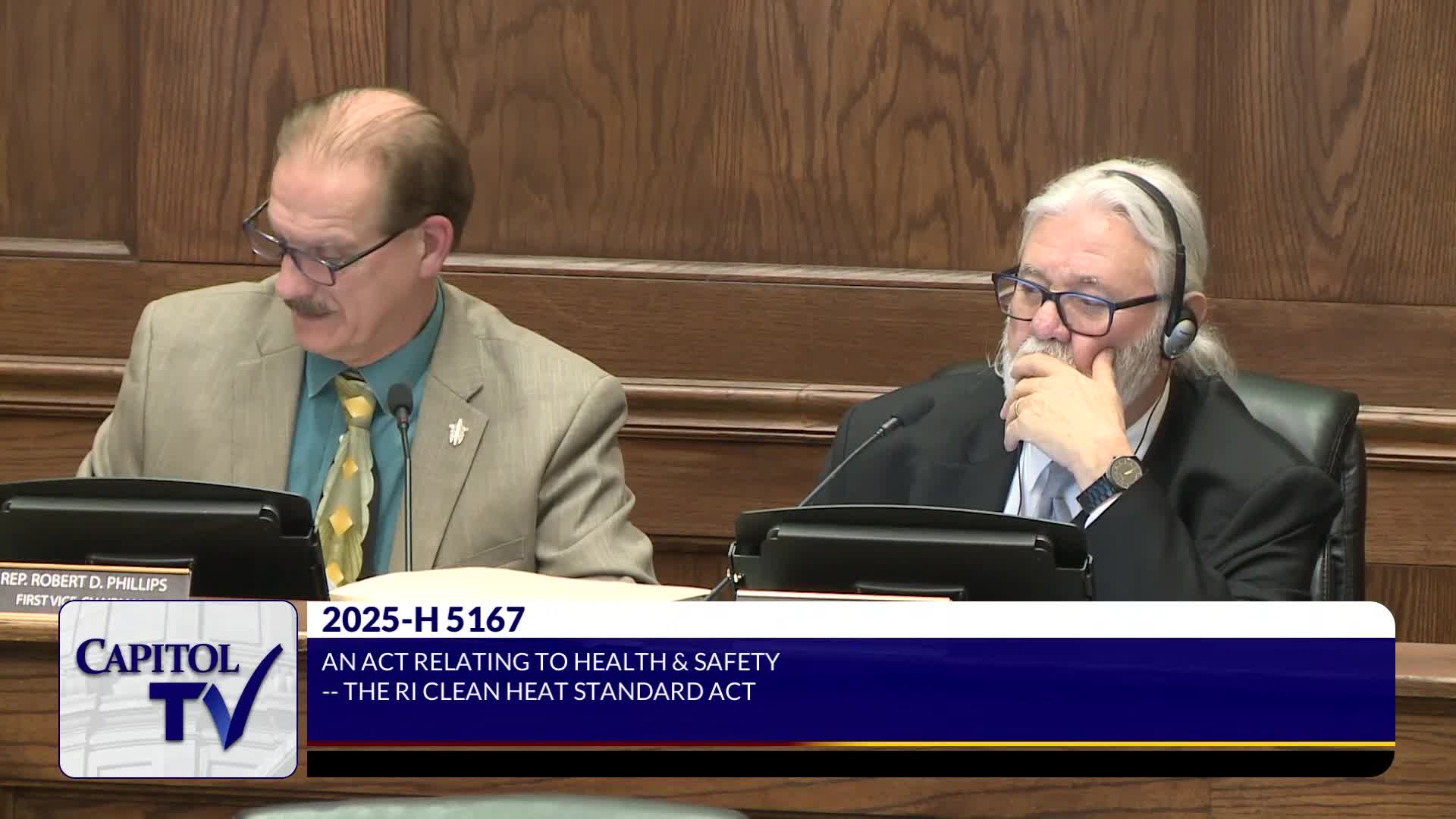
Representative Courtvien introduced House Bill 5,167, which would direct the Executive Climate Change Coordinating Council (EC4) to create and implement a clean heat standard requiring heating fuel suppliers to acquire increasing amounts of clean‑heat credits.
Tina Munter of Green Energy Consumers said the policy would work like the state’s renewable energy standard and could accelerate adoption of heat pumps, weatherization and other measures, with an equity provision requiring 40% of credits go to low‑ and moderate‑income homeowners. “If we don't adopt a clean heat standard, what other policies will we adopt to meet our Act On Climate goals?” Munter asked.
Witnesses for the energy sector urged caution. Nicholas Succi of Rhode Island Energy said the state lacks foundational data and that Vermont’s recent assessment estimated large cost increases under its own clean heat pathway. “There has been no cost benefit assessment conducted to determine how this proposed policy would impact fuel prices across the state,” Succi said. Lynette Menard of the Energy Marketers Association said many delivered‑fuel retailers are small, local businesses that have already supported renewable blends and asked for more cost analysis and use of existing programs.
Conservation and energy advocates, including the Conservation Law Foundation and several witnesses who described successful home electrification projects, urged the committee to adopt tools that include delivered fuels in the transition. Committee members discussed jurisdictional coordination with EC4 and the Public Utilities Commission and whether the EC4’s upcoming 2025 climate plan and PUC “Future of Gas” docket should guide legislative choices.
Committee members asked for more detailed cost modeling and coordination with EC4 and state agencies before advancing the bill; no final committee vote was taken at the hearing.