Get Full Government Meeting Transcripts, Videos, & Alerts Forever!
Get email alerts on the State Budget topic
No spam. Unsubscribe anytime.
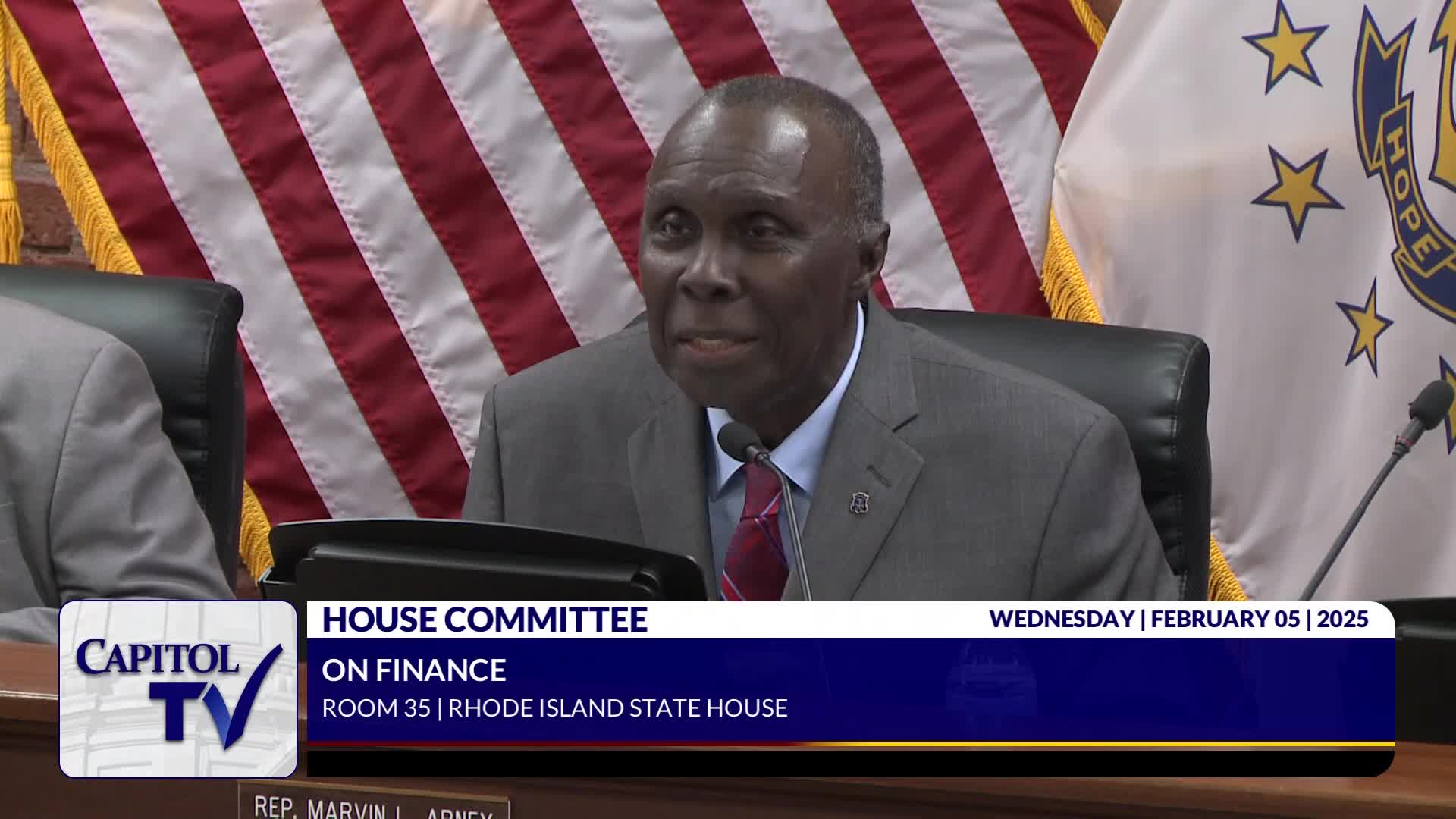
House Committee on Finance hears overview of governor’s fiscal 2026 budget; officials flag out‑year gap
Summary
Budget staff told the House Committee on Finance that the governor’s fiscal 2026 plan uses roughly $185 million in one‑time funds for ongoing commitments and projects a roughly $300 million gap for fiscal 2027. The presentation outlined revenue proposals, Medicaid and human‑services changes, local aid adjustments and capital assumptions.
Sharon, a member of the governor’s budget staff, told the House Committee on Finance that the governor’s fiscal 2026 proposal uses about $185 million in one‑time surplus funds to cover ongoing commitments and leaves a projected roughly $300 million budget gap for fiscal 2027.
“The governor’s budget is based on current federal law,” Sharon said, explaining assumptions behind Medicaid and other federal match rates. She outlined a mix of strategies: capping statutory growth for some human‑service and local‑aid lines, shifting costs to other fund sources, targeted tax and fee increases, and program‑integrity efforts that assume new staff will generate net savings.
The overview matters because the committee will use the presentation as a baseline for upcoming subcommittee hearings and statutory changes. Sharon said the executive branch and agencies will provide detailed hearings starting the next day so lawmakers can probe assumptions and implementation plans.
Sharon emphasized that the budget relies on several one‑time moves and management assumptions that carry risk in later years. Key items she highlighted included a proposal to defer a required transfer of roughly $43.3 million to the retirement system and a supplemental rainy‑day fund, an expected $9.5 million digital advertising tax in fiscal 2026, and a proposed 50‑cent increase in the cigarette tax. The governor’s plan also raises the indirect cost recovery charge on restricted receipt accounts from 10% to 15% and proposes a series of Medicaid rate adjustments intended to reduce state general‑revenue exposure.
On Medicaid and human services, Sharon described several technical and policy changes: capping certain statutory rate increases (she cited a 2.3% cap on nursing home inflation in line with the caseload estimates), restructuring hospital supplemental payment programs to favor a payment with a higher federal match (an option the administration projects would save the state roughly $22 million but would reduce hospital payments by about $23.5 million compared with status quo), and delaying a statutory increase for some home‑and‑community‑based service rates pending a biennial study. She also listed program‑integrity measures that would add staff with up‑front costs and net savings later — for example, a proposal that includes about six new positions and $1.2 million in staff and operating costs with a projected $6.9 million in recoveries.
Sharon reviewed the closing numbers for fiscal 2024, noting audit reconciling items and late federal filing treatments that increased available resources relative to earlier estimates. She said revenues and underspending pushed the current‑year position into a projected surplus (the budget office’s quarterly projection showed about $77 million), which the governor would use and supplement to provide roughly $87 million in resources to help with fiscal 2026. She cautioned, however, that many items are point‑in‑time and will be revisited in the regular revenue and caseload estimating processes.
On education, Sharon said most of the governor’s recommendation follows current law, including roughly $30 million to update core instruction aid to current enrollment and an $11 million targeted increase for schools and districts serving the highest concentrations of poverty (she identified Central Falls, Newport, Pawtucket, Providence and Woonsocket). She noted that teacher retirement and school construction costs are driving larger long‑term obligations; school construction payments are rising toward and above $200 million annually as previous building authorizations come due.
Local‑aid and capital assumptions include flat funding for some restricted aid programs, continuation of certain municipal road programs using transportation funds, and an assumption the Department of Transportation will begin collecting some toll revenue during fiscal 2026 for capital planning purposes — Sharon said the timing and details of any toll plan are not yet available. The governor’s capital proposals also assume continued use of Rhode Island Capital Plan (RICAP) balances for a mix of projects and proposed new debt authority in some long‑running projects, including a revised estimate for a long‑term care facility project that the budget office now estimates could be closer to $190–200 million and may require additional debt authority in a future year.
Committee members asked questions probe the assumptions and risks. Representative Diaz asked whether the budget contains a provision to backfill the state if the enhanced federal Medicaid match were reduced; Sharon replied, “No. The governor’s budget is based on current federal law. So the federal law right now is you get 90%.” Representative Edmonds asked whether opioid settlement funds are secure; Sharon replied that those settlement dollars derive from lawsuits with distributors and manufacturers and are governed by the settlement process and advisory committee rather than the same federal appropriations risk.
The hearing sets the schedule for article hearings; Sharon and agency staff will appear in the coming days for subcommittee review of Article II and Article III elements, and the committee chair scheduled more budget hearings beginning the next day. The panel established a quorum at the start and closed the session after the presentation and questions.
Lawmakers and staff will next move into targeted agency hearings where many technical corrections, proposed statutory changes and fund shifts will be examined in detail.