Get Full Government Meeting Transcripts, Videos, & Alerts Forever!
Get email alerts on the Restricted Receipts topic
No spam. Unsubscribe anytime.
Administration proposes raising indirect cost recovery to 15%; unions warn of impacts on workerscomp and pushback on restricted-receipt changes
Summary
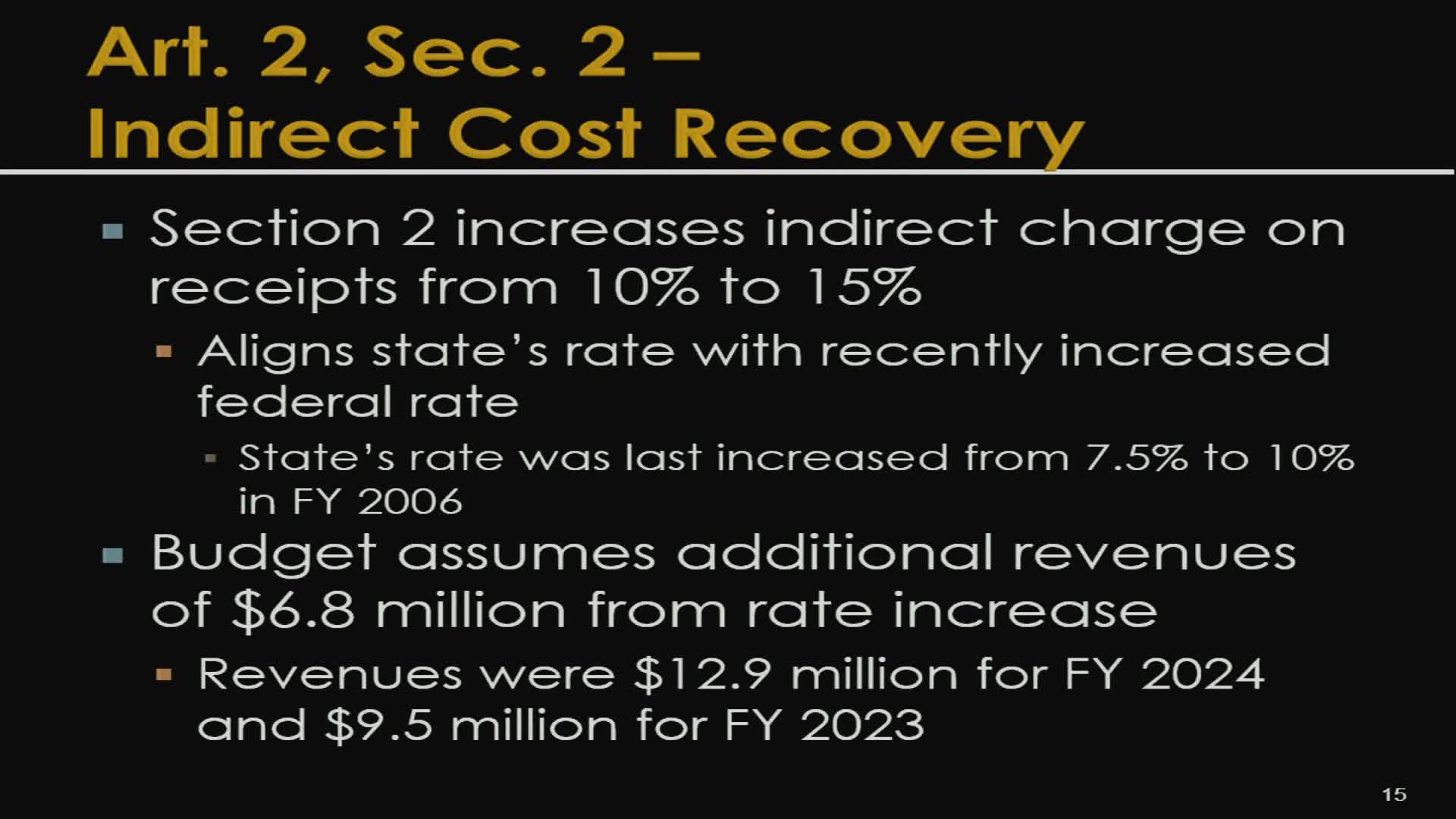
The governor's budget would raise the state's indirect cost recovery rate on receipts from 10% to 15% and create technical restricted-receipt accounts, including Medicare Part D billing for the state psychiatric hospital; labor leaders warned the change could pull money from workers' compensation funds.
State budget officials told the House Committee on Finance that the governor's recommended budget increases the state's indirect cost recovery rate on applicable receipts from 10% to 15% and creates several technical restricted-receipt accounts; labor groups and agency directors raised concerns.
Sharon told the committee that "section 2 increases the indirect charge itself on receipts from 10% to 15%." The administration said the change aligns the state's recoverable rate with a recent federal minimum and that the budget assumes roughly $6.8 million of additional revenue from the change.
State Budget Officer Joe Cadiga explained the policy parallel to federal practice: "we are proposing the same thing for state restricted receipt accounts, moving that from 10% to 15%." The administration also described a technical proposal to establish a restricted-receipt account at the Department of Behavioral Healthcare, Developmental Disabilities and Hospitals (BHDDH) to collect Medicare Part D pharmacy reimbursements tied to the state psychiatric hospital.
BHDDH Director Rich LeClaire told the committee the hospital has been working to separate operations and complete credentialing necessary to bill Medicare Part D and that the credentialing process has taken time: "the pharmacy has to be credentialed by the 3 health care plans, separately ... that takes many months," and agency staff say billing has not yet begun.
Labor witnesses warned the rate increase could reduce funds available inside employer-funded workers' compensation accounts. Patrick Crowley, president of the Rhode Island AFL-CIO, said the existing 10% indirect charge currently takes nearly $2 million annually from the workers' compensation system and that a 50% increase in the recovery rate would extract more funds from three workers' compensation accounts (administrative fund, uninsured employers fund, and uninsured protection fund). Crowley said shifting those funds could push upward pressure on employer premiums and reduce money available to pay injured workers.
Union witnesses also testified in opposition to a separate but related budget proposal to pause a supplemental pension transfer (discussed in another committee item), arguing the assembly should keep supplemental pensions and restricted receipts in place to support retirees and active employees.
The administration also told the committee that the judiciary returned about $580,000 of unspent, restricted funds allocated for the marijuana expungement project; the governor proposes reverting those restricted receipts to general revenue to help close the current-year deficit.
Committee members asked for more detail on how the indirect recovery rate would be applied to specific restricted accounts, the expected timing for BHDDH Medicare billing, and whether workers' compensation accounts could be carved out from the change. Labor representatives urged the committee to consider statutory exemptions to protect the workers' compensation funds from increased indirect cost charges.