Get Full Government Meeting Transcripts, Videos, & Alerts Forever!
Get email alerts on the State Fiscal Recovery Funds topic
No spam. Unsubscribe anytime.
House Finance hears proposal to let governor reclassify leftover federal recovery funds, reduce reporting frequency
Summary
Budget office and administration staff told the House Committee on Finance that the governoris seeking authority to reclassify state and local fiscal recovery funds (SFRF) at risk of federal forfeiture to other eligible, already-obligated uses and to move Pandemic Recovery Office reporting from quarterly to semiannual through 2026.
The House Committee on Finance on Tuesday heard administration testimony that the governoris proposing two changes affecting federal state and local fiscal recovery funds: expanded executive authority to reclassify at-risk SFRF dollars and reduced reporting frequency by the Pandemic Recovery Office.
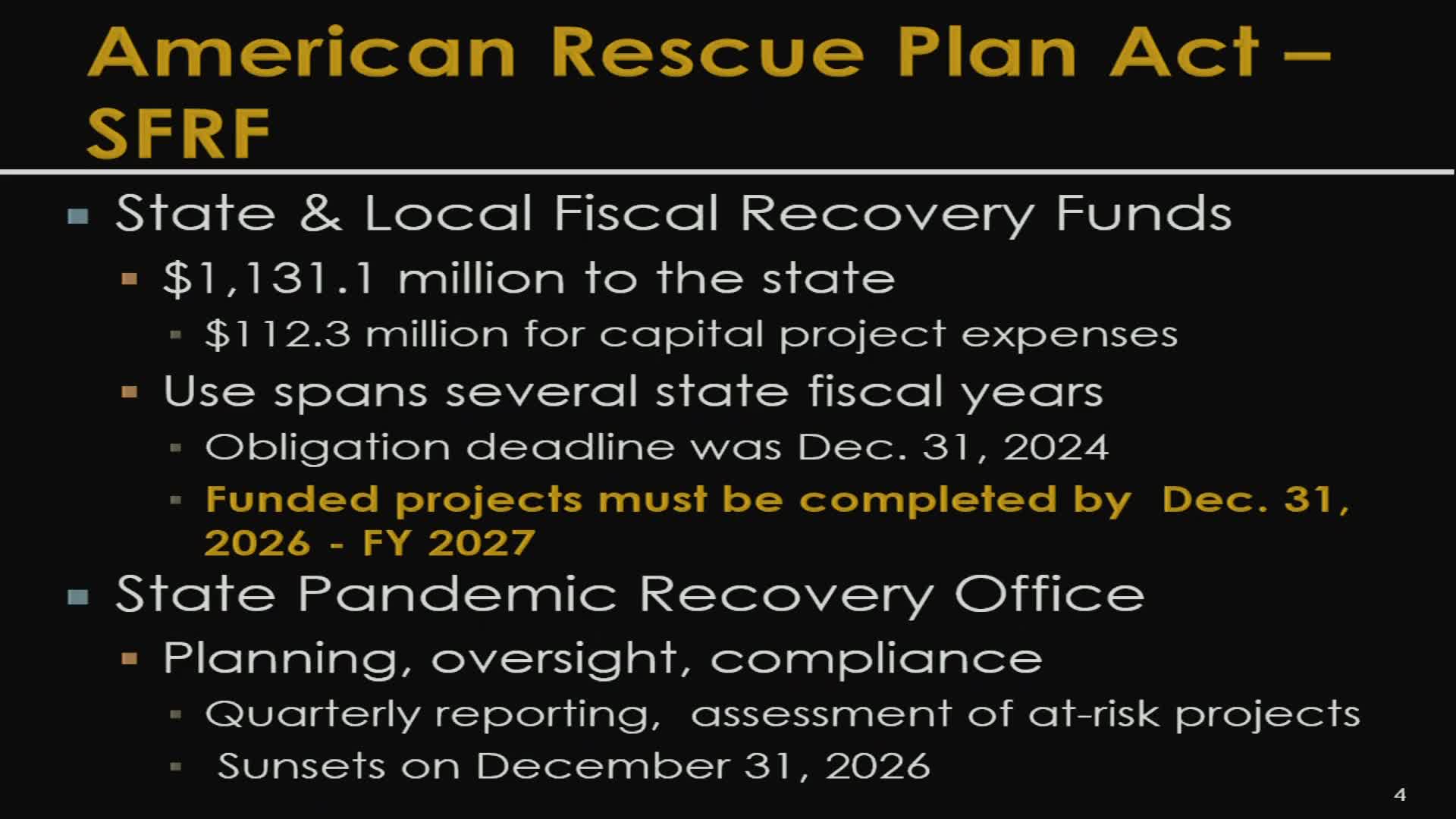
Administration officials said the reclassification power would let the governor reassign funds that were obligated by Dec. 31, 2024, but later came in under budget or otherwise produced unspent balances, to other eligible, already-obligated uses rather than automatically routing them to the unemployment insurance trust fund.
Sharon, the administration presenter, told the committee "the pandemic recovery office, their last quarterly report under these changes would be due on 01/31/2025 and then would move to twice yearly reporting ending, at the October 2026." State Budget Officer Joe Cadiga said the change in reporting reflects new U.S. Treasury guidance and a different risk profile: "we no longer think it is necessary to be reporting quarterly." He added that reclassification would be limited to uses that were obligated by 12/31/24 and are eligible under Treasury rules.
Why it matters: Committee members and staff flagged fiscal and compliance risks. The administration said two projects, both in the Department of Housing, were already classified as at-risk and totaled about $4.3 million; more projects are being monitored. Cadiga and Pandemic Recovery Office staff said reclassification cannot create new spending after the federal obligation deadline and would be constrained by federal eligibility rules.
Committee members asked how the reclassification authority would operate in practice and whether it could be used to backfill other federal funding that is later rescinded. Cadiga said reclassification could not be used for prospective, newly conceived spending; it would only permit moving eligible, previously obligated amounts to other eligible obligations. He and his staff said they would provide more project-level detail to the committee on the at-risk items.
The proposal would also alter the reporting cadence for the Pandemic Recovery Office (PRO). Administration materials presented to the committee state the final PRO quarterly report would be due Jan. 31, 2025, and thereafter reporting would move to semiannual updates ending with a report in October 2026.
Committee members pressed for project-level detail and asked whether reclassification could be used to address mid-year federal changes; Cadiga said the administration is monitoring federal developments and would return with more specifics as needed.
No formal action or vote was taken at the hearing; members heard the administrationand asked for follow-up documentation, including PRO project reports and clarifications on what changes would require assembly notification.