
Warwick officials split over bill to create temporary school budget commission amid reported deficit
Get AI-powered insights, summaries, and transcripts
Sign Up Free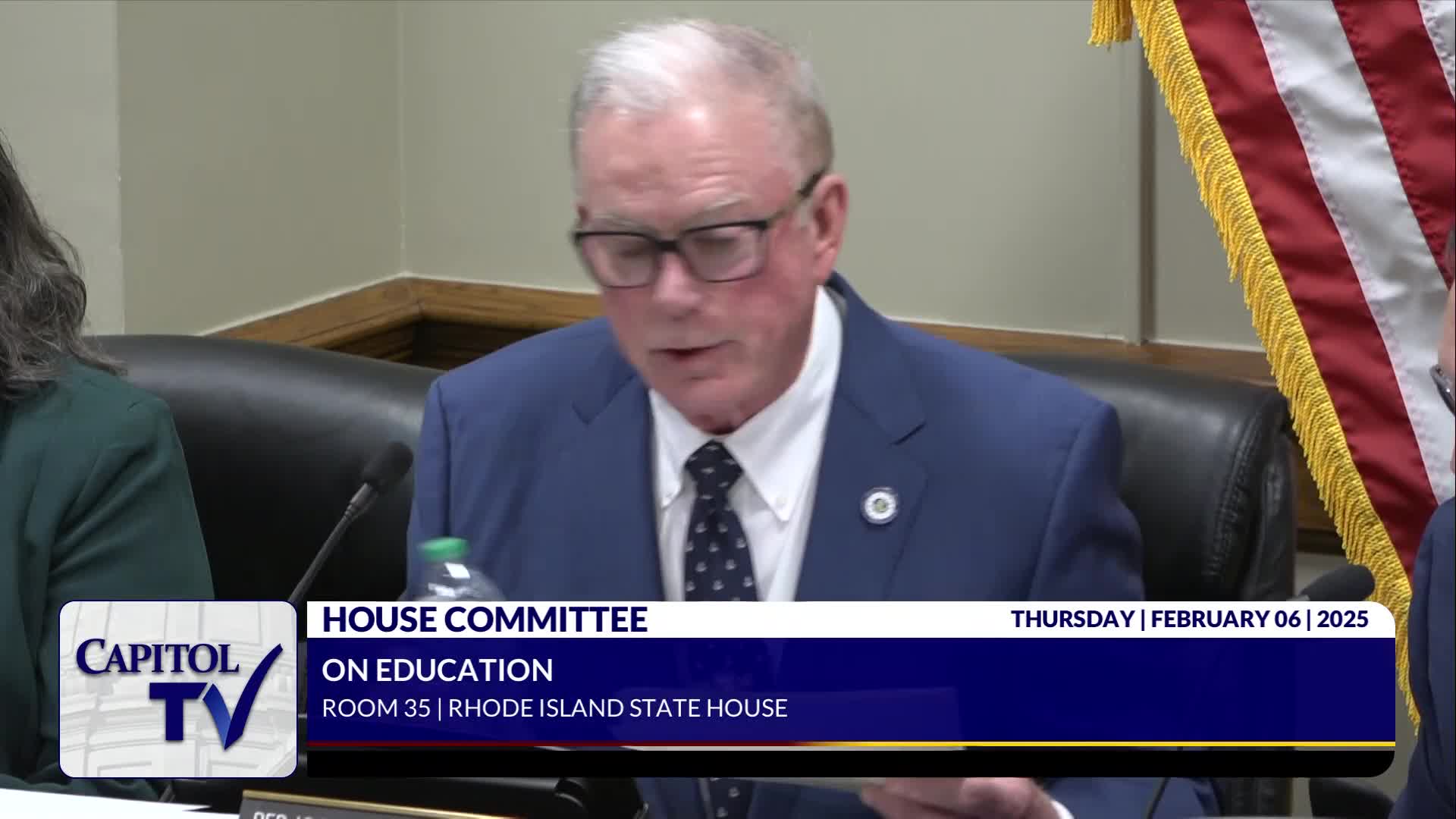
Summary
Mayor Frank Boccozzi and Warwick leaders asked the House Committee on Education to authorize a temporary budget commission to address a multi-million-dollar projected shortfall in Warwick Public Schools.
Mayor Frank Boccozzi and the Warwick delegation asked the Rhode Island House Committee on Education on Feb. 6 to authorize a temporary Warwick Public Schools Budget Commission (H 5252) to examine a reported budget shortfall and recommend a multi-year amortization plan.
Boccozzi told the committee the school department notified city leaders in December of a possible additional deficit “in the neighborhood of $9,000,000” on top of unresolved prior year issues, and that in combination with recent borrowing and capital projects the city’s bond rating and capacity to build two planned high schools could be at risk. “If our bond rating is lowered . . . it’s gonna cost tens of millions of dollars more for these high schools and that would sink the project,” the mayor said, urging an independent commission with narrow financial authority.
Sean Galligan, chairman of the Warwick School Committee, and Lynn Danbrook, superintendent of Warwick Public Schools, testified in strong opposition. Galligan told the committee the $10,000,000 figure was a worst-case, and that the school committee had already taken measures that reduced the projected shortfall. “The deficit is not $10,000,000. That number is not materializing,” Galligan said, and he described roughly $2.89 million in cuts already taken plus an additional $3 million “in the pipeline.”
Superintendent Lynn Danbrook said the district had reduced the initial projection to about $5.7 million and was preparing to present another $2.5 million in cuts to the school committee, bringing the gap to “a little over $3,000,000.” Danbrook asked the committee to reject H 5252 as duplicative and disruptive of ongoing work with the Rhode Island Auditor General. “Budget decisions cannot be made by a group of business people who lack the understanding of the nuances of public education,” she said.
Union and staff witnesses echoed the superintendent. Darlene Netko, president of the Warwick Teachers Union, said existing state law and Auditor General oversight already apply and warned that the proposed commission would usurp an elected school committee. “This commission come in, we don't know how much it's going to cost, would usurp our elected school committee,” Netko said.
Opponents argued the bill risks removing local control over personnel and spending decisions. Galligan noted statutory language in the proposed measure referencing authority over budget formulation and execution and warned that personnel decisions are a large component of the budget. “Personnel, we are willing to work with . . . provide our individuals over to the city council and the mayor. We presented a plan,” he said, but added that an outside commission with no residency requirement could make decisions without local context and that existing Title 16 protections and the superintendent’s expertise matter for student services.
Supporters, including former councilman Robert Cushman and city officials, characterized the proposal as limited in scope and intended to preserve the city’s bond rating and long-term capital projects. Cushman urged the committee to consider statutory fiscal overseer provisions (45-9) and said Warwick’s financial pressures on liabilities and borrowing required outside scrutiny.
Committee members pressed both sides on timing, authority, and precedent. Representative Bea said she worried about setting a state-level precedent for other municipalities to request similar commissions and suggested local leaders try to resolve differences first. Vice Chair Kislak and others asked whether city finance staff could perform the work without special legislation; Mayor Boccozzi said the city lacks the authority and capacity and that the legislation would confer needed authority.
Several witnesses said the city council later amended the proposal to exempt collective bargaining contract changes; Darlene Netko and others confirmed the city-level amendments preserve union contract protections through 2027. The mayor and witnesses said the commission would expire once two objectives were met: approval of the FY 2526 school budget and a resolution addressing the deficit prospectively.
No formal committee vote on H 5252 is recorded in the hearing transcript; the session proceeded with public testimony and questions.
The committee received written testimony both for and against the bill and heard about ongoing work with the Rhode Island Auditor General’s office. School leaders urged continued reliance on existing oversight channels and a collaborative, local approach; city leaders urged a narrowly focused commission to protect long-term capital plans and the bond rating.
Ending: The hearing closed with committee members indicating further review; witnesses asked the committee to consider the fiscal facts and timing before taking action.