Get Full Government Meeting Transcripts, Videos, & Alerts Forever!
Get email alerts on the K12 Testing And Policy topic
No spam. Unsubscribe anytime.
House study group flags testing, DIBELS and high‑dosage tutoring burdens; lawmakers call for collaborative fixes
Summary
Members of the K–12 study group told the House Education Committee that the group’s four public meetings produced a concise set of findings: concern about testing volume, third‑grade retention timing, use of DIBELS as an assessment, administrative burden from high‑dosage tutoring and questions about vendor quality and accountability.
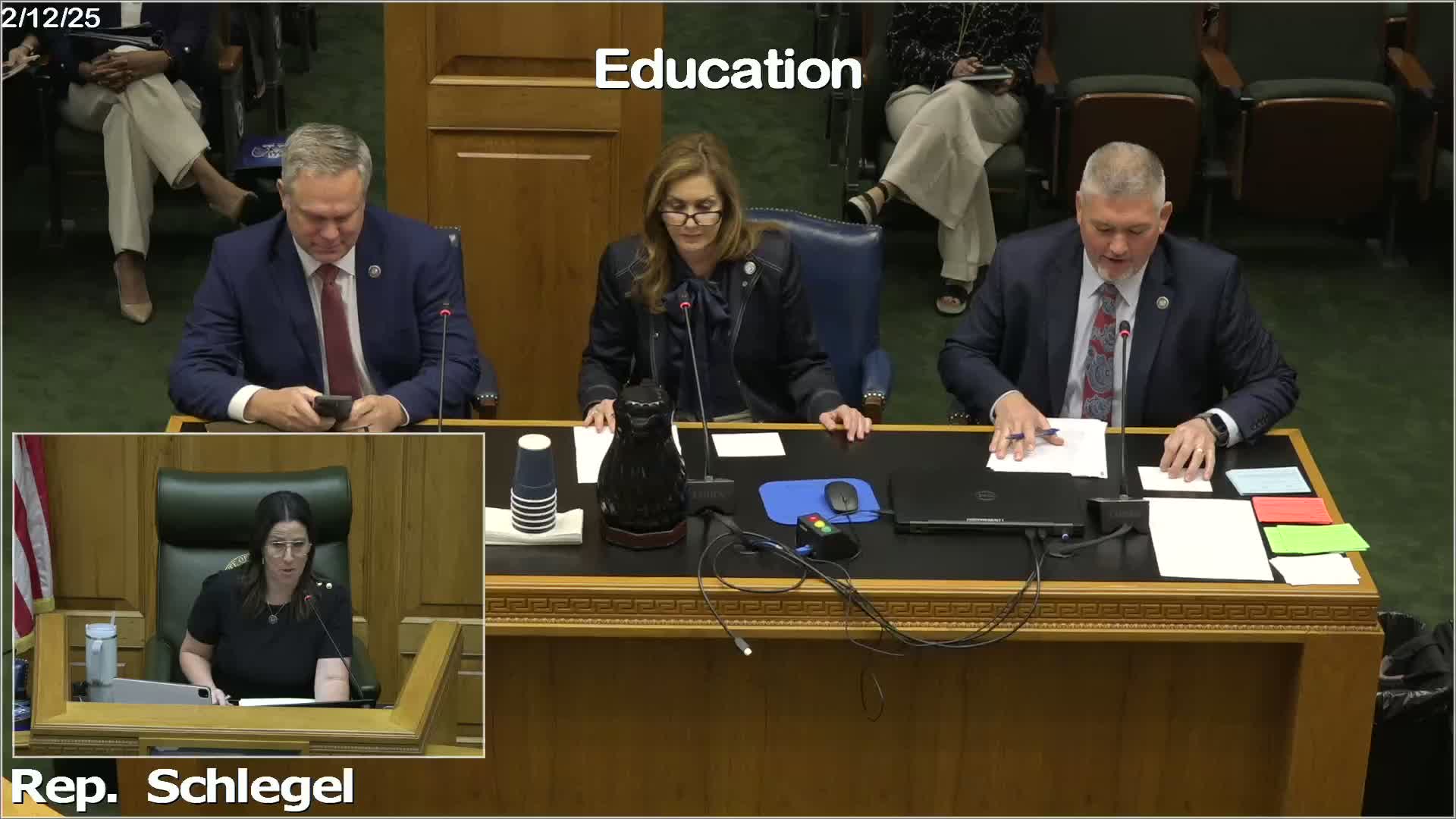
Representatives Roger Wilder and Bamberg presented the findings of the K–12 education study group to the House Education Committee on Feb. 12, summarizing four public meetings and a set of prioritized findings that group members said emerged from teachers, administrators and superintendents statewide.
"Are we teachers or are we testers?" Representative Roger Wilder paraphrased public testimony captured in the group’s report as he summarized concerns about assessment volume and the pressure created by multiple screeners and tests.
Top findings listed by Wilder and reiterated by others included: - Testing volume: The study group reported a perspective that Louisiana administers many more tests than the federal minimum; testimony cited a comparison of 32 Louisiana tests versus a federal minimum of 17, and members said the number of tests raised concerns about instruction time being crowded out by testing administration. - Third‑grade retention timing: The group heard wide concern about the implementation of the law commonly referenced as Act 422 of 2023 and its third‑grade retention component. Several witnesses urged moving accountability earlier (to first grade) or otherwise adjusting timing and supports so retention is not the first effective intervention. - DIBELS and assessment use: Task‑force members reported findings that DIBELS, originally designed as a screener, is increasingly used as a summative assessment and that this usage can misrepresent comprehension and place students and teachers in difficult positions. - High‑dosage tutoring (HDT): The group described administrative and staffing burdens tied to HDT mandates, especially the commonly quoted 4:1 tutoring ratio. Members reported cases where HDT implementation has been outsourced or conducted via remote vendors; concerns included contractor quality and infeasible time demands for teachers who must both teach and document interventions.
Representative Wilder also reported concerns about ‘‘test shaming’’ where teacher accountability metrics are affected by parental non‑participation in mandated tests and where special‑education students can receive non‑representative scores. He said the group wanted to preserve accountability while addressing perceived inequities in how scores and participation affect school ratings.
State and local education leaders who testified in support of the report — including Brad Norris (K–12 task force; Iberia Parish School Board), Janet Pope (Louisiana School Boards Association) and Michael Falk (Louisiana Association of School Superintendents) — told the committee the report reflected on‑the‑ground challenges and offered actionable next steps.
Representatives in the committee urged the study group to move from findings to collaborative solutions with BESE (Board of Elementary and Secondary Education), the Department of Education and local districts. Wilder and Bamberg said the next steps would include broader stakeholder meetings in weeks to come to prioritize feasible changes and proposals for wins that can be implemented collaboratively. No binding legislative action was taken during the hearing.
Ending: Committee members thanked the task‑force members and stakeholders; Wilder and Bamberg said they will reconvene stakeholders in coming weeks and will return with potential solutions.