Get Full Government Meeting Transcripts, Videos, & Alerts Forever!
Get email alerts on the School Budget topic
No spam. Unsubscribe anytime.
Harford County schools face roughly $20M near‑term increase; board and administration weigh cuts, fund balance use and future fees
Summary
Superintendent Bolsom presented a budget update showing a multi‑million‑dollar gap driven by higher projected costs and uncertain state funding. The board discussed reducing the planned use of fund balance, potential position reductions, transportation costs, and possible fees or outsourcing to close gaps.
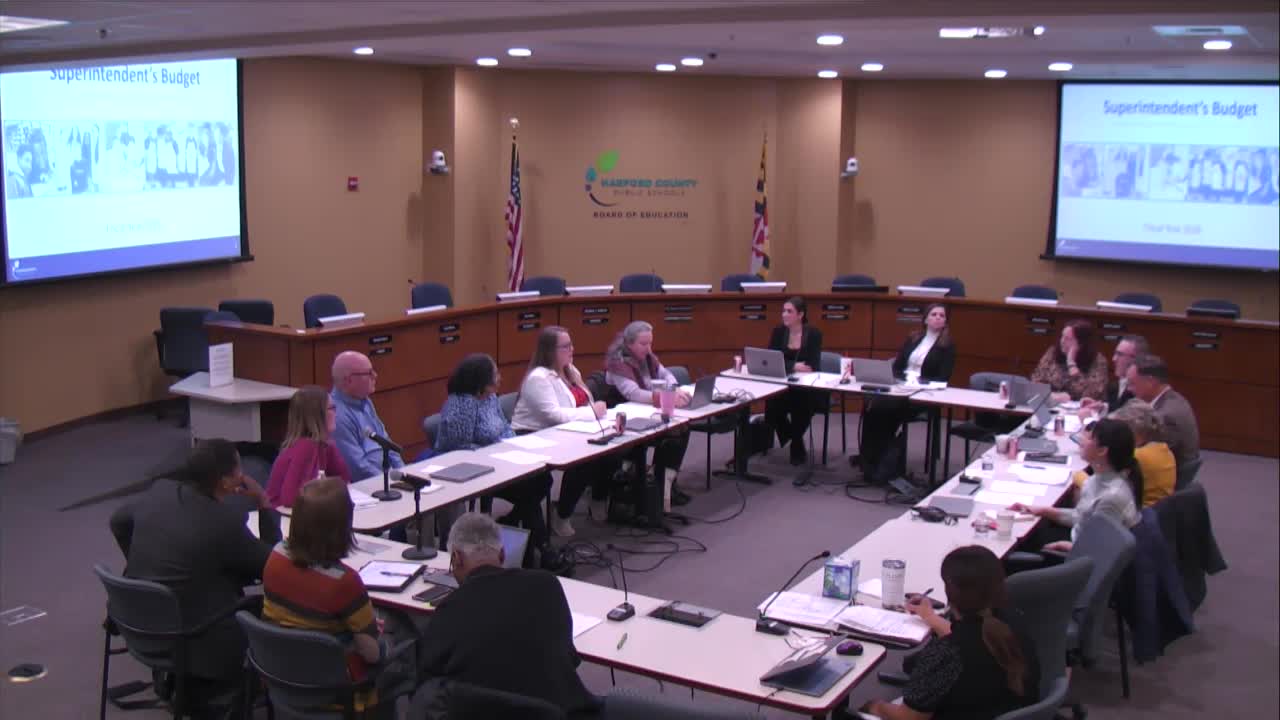
Superintendent Bolsom told the Harford County Board of Education on Jan. 13 that the system’s current budget work shows a range of pressures that could leave the district with a substantial local ask unless the board and county find additional resources.
Bolsom said the district’s baseline for FY‑26 spending started at roughly $653 million and that projected increases — including an assumption that the budget would rise about $20 million to approximately $673 million — reflect multiple cost drivers. She said the current-year budget calculations include a planned use of roughly $30 million in fund balance and that the board’s staff and negotiating parameters have trimmed the projected salary/wage package estimate. “We started at $653,000,000, and we're basically at…the budget is going up $20,000,000 to $6.73,” Superintendent Bolsom said (figures as presented).
Key cost drivers identified in the session included:
- Employee benefit and health‑care increases: the administration cited an estimate of slightly more than $13 million in insurance and fixed charges increases. - Electricity and facilities: the district’s consultants project an electricity cost increase of roughly 30 percent for FY‑26. - Safety and security: funding for recently approved security staff and maintenance costs for weapons‑detection systems totals just over $1 million projected for FY‑26. - Transportation and special education: additional special‑education program costs and contracted transportation were presented as a $2.3 million incremental need, with about $1.8 million tied to contracted services (administration’s figures).
Superintendent Bolsom said a package of systemwide reductions the administration developed would reduce the local “ask,” including a $13.4 million reduction that would correspond roughly to the elimination or repurposing of positions — she boxed that number as approximately 45 positions in the current estimate but said larger reductions would be needed if the district reduced the use of fund balance by more than the proposed step down.
Bolsom recommended stepping down the district’s planned use of fund balance from $30 million to about $10 million, explaining the difference would have to be found in expenditure reductions or additional county revenue. “My proposal at this point would be that stepping down from 30 to 10 is a big…you know my hope is we wouldn't go much beyond 10 and it's not so much because I'm worried about saving money for the future…it's about avoiding a structural deficit,” she said.
Board members and the budget review subcommittee (co‑chairs Carol Bruce and Terry) described an extensive review process. Bruce and Terry said the committee met multiple times and produced a list of possible savings and revenue options — from modest revenue increases such as building‑use fees and summer program changes to more consequential choices such as transportation-fee proposals, pay‑to‑play athletics, outsourcing some contracted services, or phasing in other structural changes. Terry said back‑of‑envelope ideas discussed during committee meetings could amount to roughly $18 million in potential options, but cautioned those were preliminary and logistically complex.
Transportation attracted sustained discussion. Staff said Harford’s transportation model includes contractual minimums (5 hours and 55 miles per bus per day) and a mix of district and contracted services. Administration compared Harford to a similar county and noted structural differences — for example, other systems have larger non‑service areas or fewer magnet programs — that affect ridership and costs. Staff said contracting out more special‑education routes had been considered previously; the current contract has about four years remaining and any change would require time and solicitation.
Board members repeatedly flagged equity consequences of potential fees: charging families for transportation or other core services would disproportionately affect lower‑income households and could increase absenteeism or reduce access. Several board members said they would prefer to exhaust other revenue or cost‑saving options before imposing fees on families, while acknowledging the political and fiscal constraints at the county level.
Timing: Superintendent Bolsom said more clarity on state funding would arrive after the governor’s budget proposal and Maryland State Department of Education preliminary spreadsheets are released; legislative session outcomes around state “blueprint” funding could meaningfully change the district’s need. The superintendent said the formal Superintendent’s Recommendation will be presented at the Jan. 27 board meeting, with a board vote planned on or near Feb. 10 and a final county submission requirement on or about March 1.