Get Full Government Meeting Transcripts, Videos, & Alerts Forever!
Get email alerts on the Budget topic
No spam. Unsubscribe anytime.
BCPS presents FY‑26 budget with $126 million operating gap as public urges full funding for special education and pre‑K
Summary
Superintendent Dr. Rogers presented the proposed FY‑26 operating budget and outlined a $126 million general‑fund increase over the adjusted FY‑25 budget; parents, unions and community groups urged the Board to fully fund special education, full‑day pre‑K, transportation and staff retention amid possible state cuts.
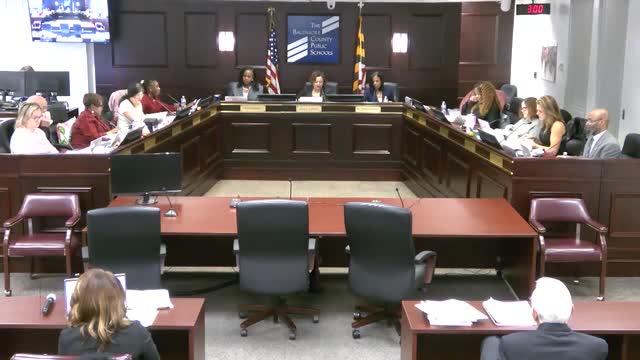
Vice Chair Robin Harvey presided over the Board of Education of Baltimore County meeting on Jan. 28, where Superintendent Dr. Rogers presented the proposed fiscal year 2026 operating budget and described a $126,000,000 increase over the FY‑25 adjusted general fund — a 6.5 percent change.
The superintendent said the request reflects salary and benefits, special education needs, rising utility and other operating costs, and capital requirements, and summarized reductions and efficiencies the district has already identified. “That is how we get to the $100,000,000 request that we're making to our county funding partners,” Dr. Rogers said, describing the portion of the request she said the district will ask the county to cover.
Why it matters: speakers at the board meeting said the superintendent’s proposal must be fully funded to maintain gains in student outcomes and to meet rising service needs. Dozens of public commenters, representing school‑affiliated committees, parent groups, unions and neighborhood organizations, pressed the board to protect funding for special education, full‑day pre‑K, multilingual learner services, community schools and transportation.
Special education was the most frequently cited concern. Megan Stewart Sikking, a longtime special‑education advocate and former chair of the county Special Education Citizens Advisory Committee, told the board: “You cannot shortchange special education without shortchanging every student, every teacher, and every aspect of our system.” Nicholas Richardson, who identified himself as a current CCAC member, and several parents described gaps in services, including related‑service providers and nonpublic placements, and urged sustained staffing investments.
Union and PTA representatives also urged preservation of staffing and student supports. Lloyd Allen, on behalf of TABCO, thanked the district for honoring compensation agreements but urged the board to scrutinize the budget “with a laser focus on what is best for our students.” Leslie Weber, president of the PTA Council of Baltimore County, said she supported preserving smaller class staffing allocations and expanding special education and multilingual‑learner resources.
Superintendent’s presentation and numbers: Dr. Rogers walked the board through the budget components and the district’s budget practices. Key figures she cited include: - A $126,000,000 difference in the general fund request versus the FY‑25 adjusted budget (a 6.5% change). - Estimated out‑of‑district/nonpublic placement and other state aid reductions of roughly $10.5 million in the revised state proposal plus an additional $9.4 million in required pension contributions — a combined unanticipated impact she said was “approximately $20,000,000.” - Year‑2 costs for negotiated compensation packages affecting roughly 20,000 employees totaling about $56,000,000. - A labeled amount of $23,000,000 for special education in the proposed budget presentation. - The district reported $104,000,000 in savings identified previously, and additional reductions of $26,000,000 from recent work to trim nonessential spending.
Dr. Rogers also described a larger capital request in the proposed FY‑26 package tied to several major facility projects, including three high schools the district is planning (Delaney, Towson and Lansdowne) and two elementary schools, and she warned the board and public that construction costs have risen since prior projections.
State and federal uncertainty: the superintendent and her staff told the board that the state’s revised proposed budget and an uncertain federal picture could reduce state aid and increase costs that the district must cover, prompting continued advocacy in Annapolis. Dr. Rogers and staff said they are actively engaging legislators and MSDE staff to seek preservation of funding.
Board reaction and next steps: board members asked for detailed line‑item clarifications and the administration agreed to provide written responses. The board approved a motion to hold an additional work session to continue budget questions and answers; the board leadership also set a process for submitting follow‑up questions.
What the board did not do tonight: the board did not vote to adopt the FY‑26 operating budget. Board members and the superintendent repeatedly emphasized that county and state actions — including the county executive and county council reviews and potential state reductions — will affect the final adopted numbers.
Context and community impact: commenters warned that cuts to special education, transportation and staff could reverse recent academic progress reported to the Maryland State Department of Education. Supporters asked the board to maintain investments in early childhood, community schools and career and technical education to preserve student supports and teacher retention.
Speakers quoted in this report spoke during the public‑comment period and during the superintendent’s budget presentation.
Ending: The board kept the matter open for further review and scheduled additional time for questions; the superintendent’s office will post detailed answers and the administration continues advocacy at the state level.