Citizen Portal

Senate HELP hearing questions Linda McMahon on plans to shrink Education Department, school choice and campus safety

2321653 · February 13, 2025

Get AI-powered insights, summaries, and transcripts

Subscribe
AI-Generated Content: All content on this page was generated by AI to highlight key points from the meeting. For complete details and context, we recommend watching the full video. so we can fix them.

Summary

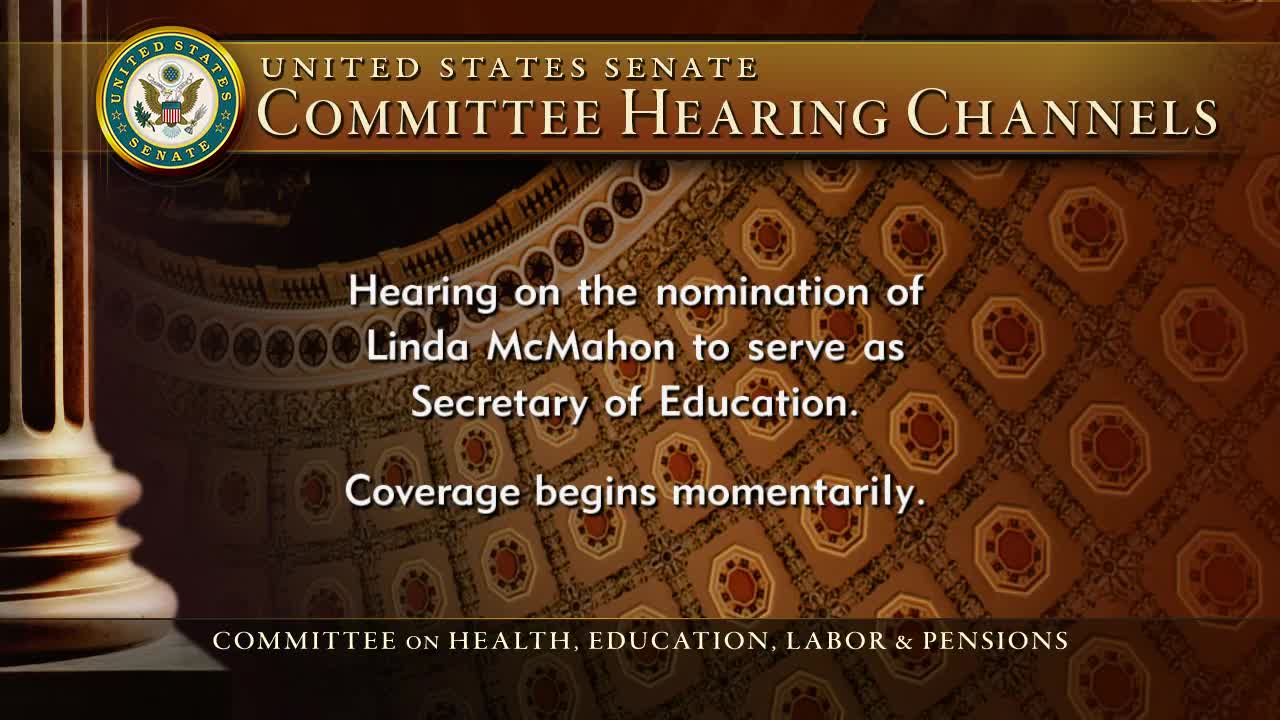
The Senate Health, Education, Labor and Pensions Committee took up Linda McMahon’s nomination to be secretary of education in a hearing that centered on whether the federal Department of Education should be downsized or its functions returned to states and other agencies.

The Senate Health, Education, Labor and Pensions Committee took up Linda McMahon’s nomination to be secretary of education in a hearing that centered on whether the federal Department of Education should be downsized or its functions returned to states and other agencies.

Committee Chairman Bill Cassidy opened the hearing by praising McMahon’s prior administrative experience and telling the committee she “has enormous challenges,” then outlined national test-score declines and said federal red tape is holding back schools. Ranking Member Bernie Sanders pressed McMahon on the potential impacts of proposed cuts on low-income students, special education and programs such as Pell Grants and public-service loan forgiveness.

Why it matters: Senators from both parties pressed McMahon to say how she would protect students and federal programs if the administration moves to “return education to the states” or reorganize the department. Many members asked for concrete commitments about continuing grants and civil-rights enforcement while others pushed her to describe specific implementation plans for reading interventions, special education (IDEA), and workforce-focused Pell Grant changes.

Most important takeaways

- McMahon said she supports returning more authority to states and local schools and favors “school choice” options such as charter schools, vouchers and education savings accounts. She described her aim as reducing bureaucracy so “we are presenting a plan that I think our senators could get on board with and our congress could get on board with.”

- On whether the department can be abolished without Congress, McMahon said it would require congressional action: “Certainly president Trump understands that—we'll be working with Congress.”

- On federal student supports, McMahon told senators she would continue programs that Congress has appropriated and that she supports preserving Pell Grants and existing public-service loan forgiveness programs: “Those that have been passed by congress. Yes. That's the law.”

- On civil-rights enforcement and campus safety, McMahon pledged to uphold Title IX and to act against antisemitic violence: “I would want to make sure that the presidents of those universities and those colleges are taking very strong measures not to allow those to happen.” She also said she would review the backlog of cases in the Office for Civil Rights if confirmed.

- Several senators raised recent administrative moves the nominee may inherit or oversee, including reports that external staffers (referred to in the hearing as “Doge” staffers) had been given access to Department data, and the administration’s termination of multiple Institute of Education Sciences contracts and training grants. McMahon said she would assess those actions once confirmed and “get in and understand” the backlog and contract changes.

Key numbers and program details cited in the hearing

- National Assessment of Educational Progress (NAEP): senators cited declines “5 points” in reading for fourth and eighth graders, and math declines of 5 points (fourth grade) and 8 points (eighth grade).

- Federal share of K–12 funding: senators repeatedly cited that federal dollars account for roughly 10% of public K–12 funding, with states and localities providing the remainder.

- IDEA funding gap: senators noted that Congress originally intended IDEA funding to cover 40% of special-education costs; witnesses and senators said actual federal funding was far lower (figures cited in the hearing were roughly 14–18%).

- Pell Grants: McMahon referenced Pell as serving “over 7,000,000 low-income students” and said she would continue the program and is open to options to expand Pell to short-term workforce certificates.

Discussion versus commitments

Senators pressed McMahon for firm, enforceable commitments. She consistently replied that many changes the administration favors would need congressional action, that she intended to “study” programs such as ESSA implementation and IES-funded evaluations before making final decisions, and that she would work with the committee and Congress on statutory obligations. Where senators sought yes-or-no assurances—on cutting federal funds, ensuring IDEA enforcement, and continuing specific grant programs—McMahon emphasized existing law and appropriations and pledged to “get in and assess” details if confirmed.

Quotations from the hearing

- Chairman Bill Cassidy: “You have enormous challenges.”

- Ranking Member Bernie Sanders: “We must not allow that to happen,” when warning against large cuts and privatization that would reduce supports for low-income students.

- Linda McMahon (nominee): “If confirmed as secretary, I will work with congress to reorient the department toward helping educators, not controlling them.”

What senators pushed for most often

- Clear assurances that appropriated funds will be distributed as Congress intended and that students who rely on federal programs will not lose services while policy reviews proceed.

- A detailed plan for addressing declines in early-grade reading and for targeting interventions to students with dyslexia and other learning differences.

- Robust enforcement of civil-rights laws on campuses, particularly for antisemitic incidents and Title IX matters, and expedited processing of OCR complaints.

- Continued support for teacher recruitment and retention and for alternative pathways—apprenticeships and short-term credentialing—using Pell Grant flexibility.

Context and next steps

No committee vote on McMahon’s nomination is recorded in the hearing transcript. Senators announced that written questions for the record are due by the committee deadline; McMahon said she would follow up with additional detail once she has had access to department files. Several senators said they would seek specific follow-up on how IDEA, Title I, Pell, OCR backlog and IES contract changes are being handled.

Ending note

The hearing highlighted deep bipartisan concern about protecting students who depend on federal supports while the nominee and the administration press for structural changes. McMahon repeatedly framed major changes as contingent on congressional action, and she pledged to review internal operations and consult with senators on implementation details if confirmed.