Get Full Government Meeting Transcripts, Videos, & Alerts Forever!
Get email alerts on the Land Development Code topic
No spam. Unsubscribe anytime.
Santa Rosa commissioners back 10‑member land‑development task force, push erosion controls and rural protection line
Summary
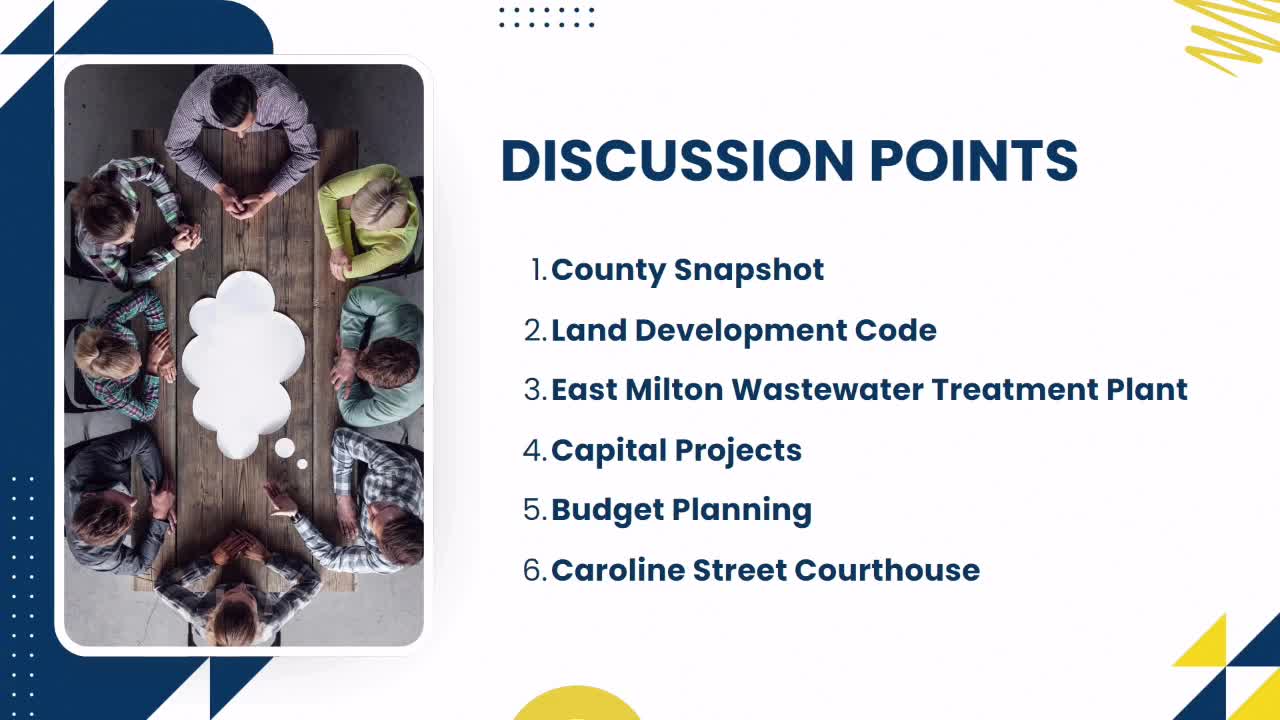
At a county workshop commissioners said they favor creating a 10‑member Land Development Code (LDC) task force to focus first on floodplain management, erosion control, design standards and tree mitigation, and agreed to study moving the county's rural protection line farther south.
The Santa Rosa County Board of County Commissioners on Jan. 30 directed county staff to form a 10‑member Land Development Code task force to review targeted chapters of the code and return recommendations to the board.
The board said the task force should be made of five subject‑matter experts and five local appointees, meet publicly under Florida’s Sunshine Law, and work to produce recommendations on tightened erosion and stormwater controls, tree mitigation, floodplain management and design standards. Commissioners discussed a roughly eight‑week timeline for initial work and a two‑thirds task‑force approval threshold for items the group forwards to the board.
Why this matters: Commissioners said targeted, short bursts of code work are more likely to succeed than out‑and‑out rewrites. Flooding and sedimentation were repeatedly cited as immediate problems county officials must fix to protect waterways and private property.
Discussion and proposed scope: County staff presented the recent rewrite history and recommended focusing on chapters 3 (floodplain management), 4 (design and development standards) and 7 (special overlay districts, including rural protections). Commissioners proposed a task‑force membership model of five technical experts (engineers, environmental advocates, builders) and five local representatives to ensure geographic balance and faster, more practical recommendations.
Names discussed for possible expert seats included Jeff Helms, Paul McLeod and Chris Kerr of Flood Defenders; builders including Nick Herbst were also suggested. County staff (identified in the workshop as Rebecca and Sean) said they will contact proposed members and support the group administratively.
Policy priorities raised: Commissioners repeatedly emphasized erosion control and enforcement, tighter requirements on clear‑cutting, and stronger sedimentation protections for tributaries and estuaries. Several commissioners urged staged development rules and stronger wetland buffers; one commissioner urged restoring an “alternative subdivision” approach to protect uplands and channel density where infrastructure already exists.
Rural protection line: Commissioners for the county's northern districts discussed moving the rural/ag protection line south, proposing the Pace–Allentown fire‑district boundary (roughly 10 Mile Road) as a clearer boundary than State Road 182. Several commissioners signaled consensus to pursue that change and asked staff to analyze mapping and impacts.
Next steps and constraints: Commissioners and staff stressed that task‑force meetings must comply with Florida’s Sunshine Law and that public comment would likely be handled in writing to keep meetings productive. Staff were directed to return with names, a draft charge, and a February/early‑March schedule so the group could report back in April.
Ending: Commissioners asked staff to provide clearer scopes for the first 8‑week work period, to identify the specific code sections the task force should evaluate, and to prepare outreach materials explaining the process to residents.