Get Full Government Meeting Transcripts, Videos, & Alerts Forever!
Get email alerts on the Water Infrastructure topic
No spam. Unsubscribe anytime.
Spring Hill backs option A in regional Duck River water feasibility effort; city share roughly one‑third, staff says
Summary
The board approved Resolution 25‑40 to join a multi‑utility cost‑sharing agreement for a long‑range water supply feasibility study, selecting “option A” that spreads costs among four major participants. City staff called the project a multibillion-dollar, multi‑decade effort.
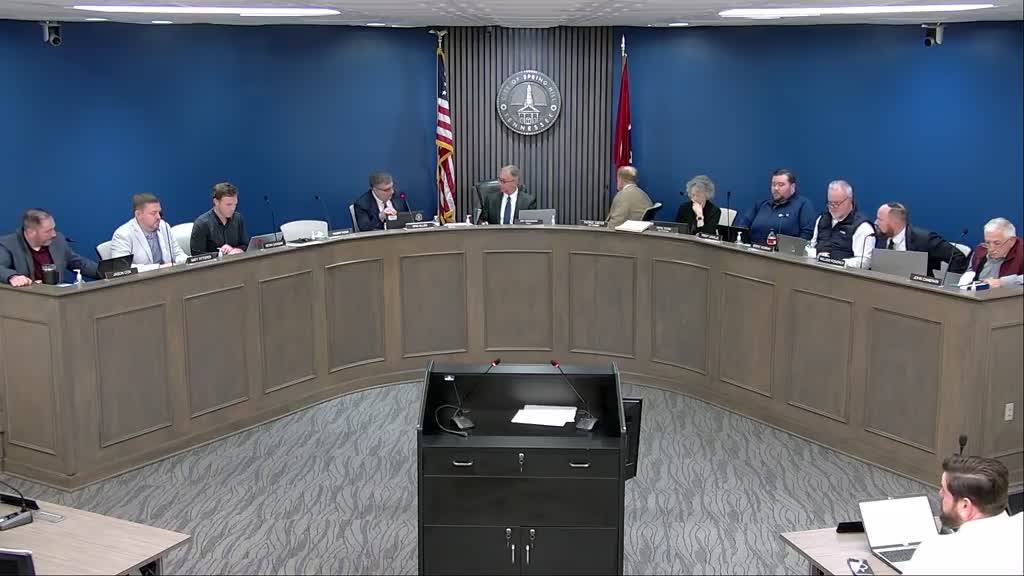
The Spring Hill Board of Mayor and Aldermen voted unanimously on Feb. 3 to approve Resolution 25‑40, joining a multi‑utility cost‑sharing agreement to study a long‑range water supply project tied to the Duck River and Cumberland River connections.
City Administrator Dan Allen told the board the project is at an early stage and described two cost‑share options presented in the packet. Option A — the measure the board approved — would divide initial study costs proportionally among the principal participants (Spring Hill, Columbia Power & Water Systems, Murray County Water and Mount Pleasant Water). Allen said Spring Hill’s proportional share would be about 34 percent under option A and estimated the overall project cost at “at least a billion dollars.” He described the effort as a 25–30‑mile pipeline from the Cumberland River to bring water to the region.
Allen recommended option A to signal regional collaboration and to encourage reimbursement possibilities from the Duck River Agency in the future, given Governor Lee’s executive order forming a Duck River Partnership Group. Vice Mayor Pomeroy moved approval of Resolution 25‑40 with option A; Alderman Murray seconded. The board voted 8‑0 in favor.
Why it matters Allen said the project addresses environmental pressures on the Duck River and potential impacts to rare and endangered species from additional withdrawals. The feasibility study and any subsequent design work aim to identify a long‑term, regional solution for water supply that involves multiple utility partners and substantial capital investment.
What happens next Staff and regional partners will proceed with the feasibility planning under the cost‑sharing framework. Allen characterized the effort as early stage and noted the potential to seek reimbursement or funding from regional entities later in the process.
Ending Board members framed the vote as an early commitment to collaboration; no detailed financing agreements were finalized at the meeting.