Get Full Government Meeting Transcripts, Videos, & Alerts Forever!
Get email alerts on the Emergency Assistance Shelter Supplemental topic
No spam. Unsubscribe anytime.
Massachusetts Senate passes supplemental spending bill with shelter reforms; rejects expanded universal background checks and residency limits
Summary
The Massachusetts Senate amended and passed a supplemental appropriations bill (House No. 508) on measures tied to the emergency assistance shelter system, adopting competitive-bidding and several eligibility and reporting changes while rejecting proposals for universal background checks and a one‑year residency requirement.
The Massachusetts Senate on the floor amended and passed a supplemental appropriations bill addressing the emergency assistance (EA) shelter system, approving multiple changes to procurement, reporting and eligibility rules while rejecting proposals to impose universal criminal background checks and a one‑year residency requirement.
The bill (House No. 508) passed on final reading after floor debate and multiple roll calls; the clerk recorded 33 votes in favor and 6 opposed on final passage.
Why it matters: Senators framed the bill as both a budgetary and public‑safety response to the costs and management of the commonwealth’s emergency shelter system. Lawmakers debated tradeoffs between tightening eligibility and preserving the right‑to‑shelter, and they voted for measures intended to increase transparency and procurement oversight while turning down some of the stricter screening and residency proposals.
Floor debate and key proposals
Senator Bruce E. Tarr, offering a series of amendments on funding and procurement, argued the chamber should preserve federally sourced funds for future crises and push for accountability in contracts. "We will have less than $200,000,000 remaining in the transitional escrow fund, account," Tarr said in explaining a funding amendment that sought to require general‑fund financing instead of drawing on one‑time federal money. That particular funding proposal was not adopted; another Tarr amendment requiring competitive bidding for any contracted service in the EA system (Amendment 17) was adopted, with the clerk announcing "the ayes have it and the amendment is adopted."
On background checks, "Senator Ta" (as identified in the transcript) offered Amendment 14 to require "universal background checks, including criminal history review, to include state, national, and international records," and to require Social Security and identification verification and screening against offender registries. The sponsor argued the change was needed to ensure safety in shelters and protect vulnerable residents. Senator Ta said the amendment would not examine employment or credit history, focusing instead on criminal history and identity verification.
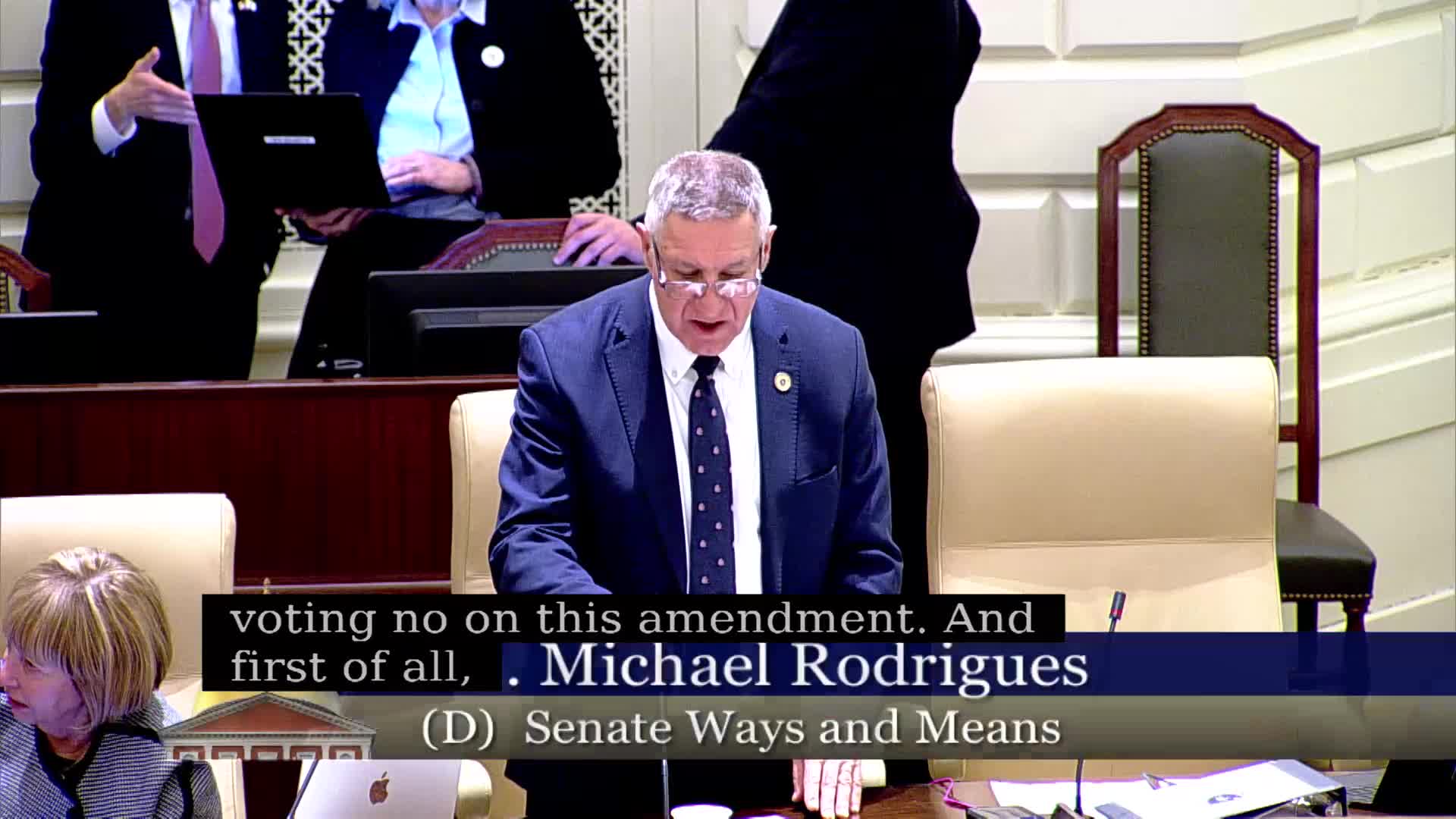
Opponents urged caution and more study. Senator Rogers asked colleagues to vote no, noting that a separate study amendment had been adopted earlier and warning of unclear implementation questions; Rogers said, "I rise to ask members to please join me in voting no on this amendment." After a roll call, the amendment was defeated; the clerk recorded 12 votes in the affirmative and 26 in the negative, and the chair announced "the amendment is not adopted."
Residency, extensions and vulnerable groups
Lawmakers also debated durational residency limits for EA eligibility. One floor amendment would have required a one‑year durational residency similar to the standard used for filing for divorce under Massachusetts law; the proposal drew sharp opposition on constitutional and humanitarian grounds. A senator opposing the residency amendment argued at length that "when you talk about something like health care, food, shelter, basic necessities of life, the Supreme Court of the United States has ruled more than once that those are matters that you cannot discriminate against people who don't happen to have lived here for very long." That residency amendment was not adopted on the floor.
The body did adopt narrower extensions and protections for specific vulnerable groups. Amendment 23 (filed by Senator Rebecca L. Rausch) added an "upcoming due date" for pregnant people as a specified reason to extend shelter stays; the clerk announced "the ayes have it. The amendment is approved." Amendment 46 (filed by Senator Kennedy) added families with a child under age 6 to the list of eligible extensions beyond the six‑month period; the clerk announced that amendment was adopted as well.
Oversight, reporting and procurement
Several proposals would have created or directed outside oversight. Senator Messick’s amendment to create a three‑year special unit in the Office of the Inspector General, funded at $250,000 per year, was defeated on the floor. Senator Rebecca L. Rausch and others pushed for an independent IG review with a May 15 deadline to inform FY26 budget debates; that proposed amendment was brought to a roll call but did not secure final adoption. Senator Ryan C. Fattman’s Amendment 64 — requiring more detailed shelter cost reporting (weekly cost‑per‑family reporting) — was adopted; Senator Fattman later said the measure will make spending more digestible for constituents.
The Senate also adopted Amendment 17 (competitive bidding for contracted services in the EA system) to increase procurement transparency. Several other oversight or audit proposals were debated — including a motion (Amendment 66) to authorize the Senate Post Audit and Oversight Committee to investigate the EA program — but the Senate voted against ordering that committee investigation on the floor.
Criminal record rules and resettlement supports
The Senate approved a measure on criminal‑record treatment in eligibility (Amendment 50 offered by Senator Adam Gomez) that the clerk announced was adopted; the sponsor argued that denying shelter for low‑level and nonviolent offenses would harm reentry and public‑safety goals, saying, "A criminal record does not make you a dangerous person." Another adopted amendment (No. 51) focused on supporting resettlement agencies and streamlining shelter placement to help families, particularly people in the Commonwealth "under the color of law," obtain documentation and move quickly into permanent housing.
Votes at a glance (selected floor actions)
- Amendment 14 (Universal background checks; "Amendment number 14 by Mister Ta"): defeated — recorded tally 12 yes, 26 no; outcome: not adopted. - Amendment 17 (Competitive bidding for contracted EA services; "Amendment number 17 by Mister Tarr"): adopted (clerk: "the ayes have it and the amendment is adopted") — tally not specified on the floor transcript. - Amendment 23 (Add "upcoming due date" for pregnant people as basis for extension; Sponsor: Senator Rebecca L. Rausch): adopted (clerk: "The ayes have it. The amendment is approved."). - Amendment 46 (Extensions: add families with child under age 6; Sponsor: Senator Kennedy): adopted (clerk announced "the ayes have it and the amendment is adopted"). - Amendment 50 (Criminal records protections; Sponsor: Senator Adam Gomez): adopted (clerk announced "the ayes have it and the amendment is adopted"). - Amendment 64 (Shelter cost reporting requirement; Sponsor: Senator Ryan C. Fattman): adopted (clerk announced "the ayes have it. The amendment is adopted"). - Various inspector general and independent oversight amendments (multiple sponsors): debated and defeated (several floor actions recorded as "the noes have it" or lost on roll calls). - Final passage: An act making appropriations for FY2025, House No. 508 — Passed to be engrossed; recorded final roll call: 33 in the affirmative, 6 in the negative.
What the Senate did not resolve
The Senate rejected a broad universal background‑check requirement and multiple durational residency limits; several proposals to create time‑limited inspector general units or to direct the IG were also defeated on the floor. Several senators signaled continued interest in oversight groups or working groups; some said the working group announced on the floor and the budget process in May will be the vehicle for additional evaluation.
Context and next steps
Senators repeatedly framed the debate around two competing priorities: controlling skyrocketing EA system costs and protecting vulnerable people (pregnant people, young children, families) who rely on the right‑to‑shelter framework. Provisions adopted on procurement, reporting and selective eligibility extensions are intended to increase transparency and preserve capacity; several senators said they expect further scrutiny during the FY26 budget process and through the working group created by the chamber.
Ending note: After the amendments and third reading, the clerk read the bill for a final vote and the Senate ordered the bill to be engrossed. The Senate recessed with the bill passed and to be delivered for further processing.