Get Full Government Meeting Transcripts, Videos, & Alerts Forever!
Get email alerts on the Fisheries topic
No spam. Unsubscribe anytime.
Maryland fisheries briefing: striped bass juvenile decline, strong adult biomass; oysters and invasive catfish shape management agenda
Summary
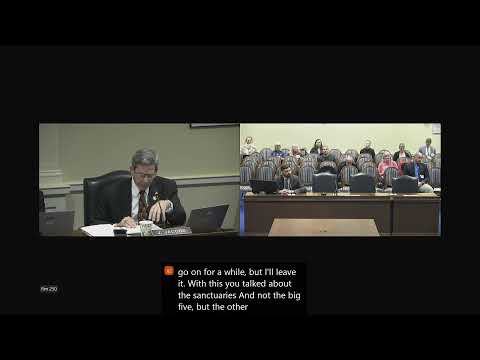
Secretary Kurtz briefed the Environment and Transportation Committee on the state of Maryland fisheries, saying managers see “high biomass for our adult spawners” of striped bass even as juvenile indices remain weak and new science is needed to guide next-year management decisions.
Secretary Kurtz briefed the Environment and Transportation Committee on the state of Maryland fisheries, saying managers see “high biomass for our adult spawners” of striped bass even as juvenile indices remain weak and new science is needed to guide next-year management decisions.
The briefing explained why survey design matters and how past mistakes inform current practice. “A lot of it can be traced back to the collapse of the Atlantic cod fishery in 1992,” Kurtz said, describing how overreliance on harvest data rather than broad scientific surveys contributed to a catastrophic collapse that cost jobs and ecology. The department performs 33 surveys statewide and staffs year-round fieldwork to track species across the Susquehanna Flats, Tangier Sound, the Atlantic approaches and the Potomac.
The nut graf: managers face competing signals that complicate short-term decisions and interstate coordination. At the Atlantic States Marine Fisheries Commission (ASMFC) and other regional bodies, Maryland must align state interests with coastwide rules; that alignment is a driver of recent motions on sector separation and of ongoing science work intended to produce peer-reviewed data usable at ASMFC.
On striped bass, Kurtz said adult spawning biomass and fishing mortality currently look favorable, but juvenile age indices have not shown matching recruitment. “We are not seeing that associated increase in those smaller fish in those different age classes,” he said, and the department has convened a joint striped bass management committee and hosted a multi-part science workshop to examine causes such as food availability mismatches and predation by species like blue catfish.
Oysters provided more positive indicators. Kurtz reported disease prevalence lower than expected, biomass above the long-term average for the seventh consecutive year, and a spat index about 64% above the long-term median. The department completed large-scale restoration in the so-called “big five” sanctuaries and has identified three additional large-scale restoration targets (Herring Bay, Hooper Strait and the Nanticoke River) while conducting smaller projects in the Magothy, Severn, Eastern Bay and other sites.
Kurtz said oyster aquaculture remains small relative to public fishery harvests: aquaculture produced about 94,000 bushels last year versus roughly 750,000 bushels from the public fishery. He noted sanctuaries may be used to support aquaculture and emphasized substrate limitation—particularly public shell availability—as a constraint, adding that West Coast shell importation has been considered as a source.
On invasive species, Kurtz said blue catfish commercial harvests have risen and the department has launched an invasive catfish advisory committee. A catfish pilot program began recently with nine watermen; applications were described as open “until the twentieth” (application deadline not specified in the transcript). The pilot will test gear such as trotlines south of the Bay.
Freshwater and recreational fisheries also featured in the briefing. Kurtz highlighted trout programs and habitat restoration, estimating the trout economy generates about $400,000,000 in economic activity statewide and noting the state stock-trout program produces about $27,000,000 in activity. He described work on a climate-adapted fisheries process to enable faster regulatory responses to emerging species (shrimp, cobia, red drum and others) but said statutory limits and recent changes have delayed pilot licensing.
Committee member Delegate Jacobs pressed on the role of blue catfish predation and survey interference in the apparent decline of juvenile striped bass, citing widespread reports of large adult fish in the Upper Bay and localized catfish concentrations near survey sites. “You can’t believe the amount of big fish in the Upper Bay right now,” Jacobs said, recounting calls from fishermen and a recent net haul of large fish.
Kurtz acknowledged the need for more and better peer-reviewed survey data that ASMFC and similar bodies will accept, and reiterated the department’s plan to refine survey tools and expand the science toolbox to capture climate and predation effects. He said oyster sanctuary performance varies by site and requires reevaluation, and that combinations of restoration, aquaculture and substrate additions are being considered to increase abundance.
No formal votes or motions were recorded during this briefing portion. Kurtz invited questions and noted that further discussion and specific management measures will follow as surveys, stock assessments and advisory-committee work produce peer-reviewed results.
Looking ahead, the department expects an updated Chesapeake-based blue crab stock assessment in 2026–2027, an oyster stock assessment to be discussed by the Oyster Advisory Commission in May (year not specified), and additional management deliberations on striped bass during the next ASMFC cycle.