Get Full Government Meeting Transcripts, Videos, & Alerts Forever!
Get email alerts on the Legislation topic
No spam. Unsubscribe anytime.
Environment and Transportation Committee advances slate of departmental and technical bills; vote summary
Summary
At a February 14 voting session, the House Environment and Transportation Committee approved a series of departmental and technical bills—many with subcommittee amendments—and held one bill for a later session. A notable policy change requires water bottle filling stations in many new or renovated buildings beginning Oct. 1, 2025.
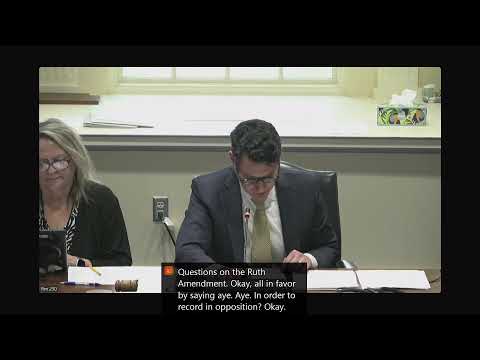
The House Environment and Transportation Committee met Friday, Feb. 14, and approved a slate of departmental and technical bills by voice vote, adopting several subcommittee amendments and recording no roll-call tallies during the session.
The committee adopted measures affecting agricultural boards and funds, planning and recordation processes, municipal annexation notices, driver education, water bottle filling stations and drinking fountains in new or renovated buildings, and several condominium and common‑ownership community provisions. Most bills were described as departmental or technical and drew limited floor discussion; one bill (authorizing sidewalk use by bicycles and similar devices) was held for the next voting session at the request of a committee member.
Votes at a glance: - HB 262 (Maryland Agriculture Commission / Young Farmers): Favorable with amendments; committee adopted two amendments (technical and conforming change to the Maryland Agricultural Land Preservation Foundation Board of Trustees statute) and moved the bill to pass. Presented by Chair Boyce. Outcome: passed by voice vote; individual roll-call tallies were not recorded during the session. - HB 104 (Maryland Farms and Families Fund): Favorable with subcommittee amendment (technical; clarifies definition of “person” for the fund). Presented by Chair Boyce. Outcome: passed by voice vote. - HB 100 (Resilience authority insurance/self‑insurance): Favorable, no amendments; bill authorizes a resilience authority to make or coordinate purchases of casualty, property or health insurance or to self‑insure. Presented by Chair Healy. Outcome: passed by voice vote. - HB 279 (Municipal annexation notices / Maryland Department of Planning): Favorable, no amendments; adds the Maryland Department of Planning to recipients of annexation resolution notices. Presented by Chair Healy. Outcome: passed by voice vote. - HB 375 (Sidewalk use by bicycles, play vehicles, unicycles): Proceeded to a favorable recommendation from subcommittee but was held at the request of a committee member (Vice Chair Boyce) for the next voting session; no final vote taken. - HB 463 (Driver education for those previously licensed abroad or by U.S. military): Favorable with amendments; subcommittee amendments adopted. Presented by Chair Stewart. Outcome: passed by voice vote. - HB 272 (Planning law updates / population projections): Favorable with amendments; among other changes, the bill allows the Maryland Department of Planning to use population figures developed by the Metropolitan Washington Council of Governments and its member jurisdictions for Washington Metropolitan Area projections. Presented by Chair Lewis. Outcome: passed by voice vote. - HB 347 (Land records modernization): Favorable with amendments; authorizes receiving documents submitted through an electronic recordation system, updates format and indexing requirements, and repeals obsolete requirements tied to bound books and microfilm. Presented by Chair Lewis. Outcome: passed by voice vote. - HB 277 (Water bottle filling stations / drinking fountains): Favorable with amendments. As amended, beginning Oct. 1, 2025, at least one water bottle filling station or combined filling station/drinking fountain must be installed in all new construction and in building renovations where a drinking fountain is required under the adopted International Plumbing Code, with enumerated exceptions for certain commercial and industrial settings and situations where potable water is available through other sources. A subsequent amendment (requested by MTA and presented by Delegate Ruth) clarified that chiller requirements apply only to indoor units. Outcome: passed by voice vote. (Effective date and exceptions are specified in the bill text presented to the committee.) - HB 172 (Community Health and Safety Works program changes, DHCD): Favorable, no amendments; bill alters eligibility and applicant definitions and repeals minimum/maximum grant caps for the program administered by the Department of Housing and Community Development. Presented by Chair Holmes. Outcome: passed by voice vote. - HB 363 (Common ownership communities / display period for candidate and ballot initiative signs): Favorable, no committee amendments; extends the minimum display period for candidate/initiative signs to at least 30 days before early voting. Presented by Chair Holmes. Outcome: passed by voice vote. - HB 615 (Condominiums / budget submission and receivership references): Favorable, no amendments; clarifies statutory references related to condominium budget submissions and appointment of a receiver in homeowners associations. Presented by Chair Holmes. Outcome: passed by voice vote.
Committee housekeeping: Members moved to withdraw six bills (the bill numbers withdrawn were not specified during the session). The chair announced a brief recess after the voting session before returning for a briefing and bill hearings.
Why it matters: Several passed measures are technical or departmental but change administrative processes or statutory references used by state agencies and local governments (for example, allowing electronic recordation and changing which entities receive annexation notices). HB 277 establishes a state building‑equipment standard (water bottle filling stations) with a future compliance date and several exceptions; that item drew the most substantive explanation and an amendment clarifying an MTA‑requested technical exception.
The committee made most decisions by voice vote during this session; when members requested recorded votes, the chair said he would take roll-call votes on request. Individual roll-call tallies were not recorded in the transcript for the bills considered.