Get Full Government Meeting Transcripts, Videos, & Alerts Forever!
Get email alerts on the Healthcare topic
No spam. Unsubscribe anytime.
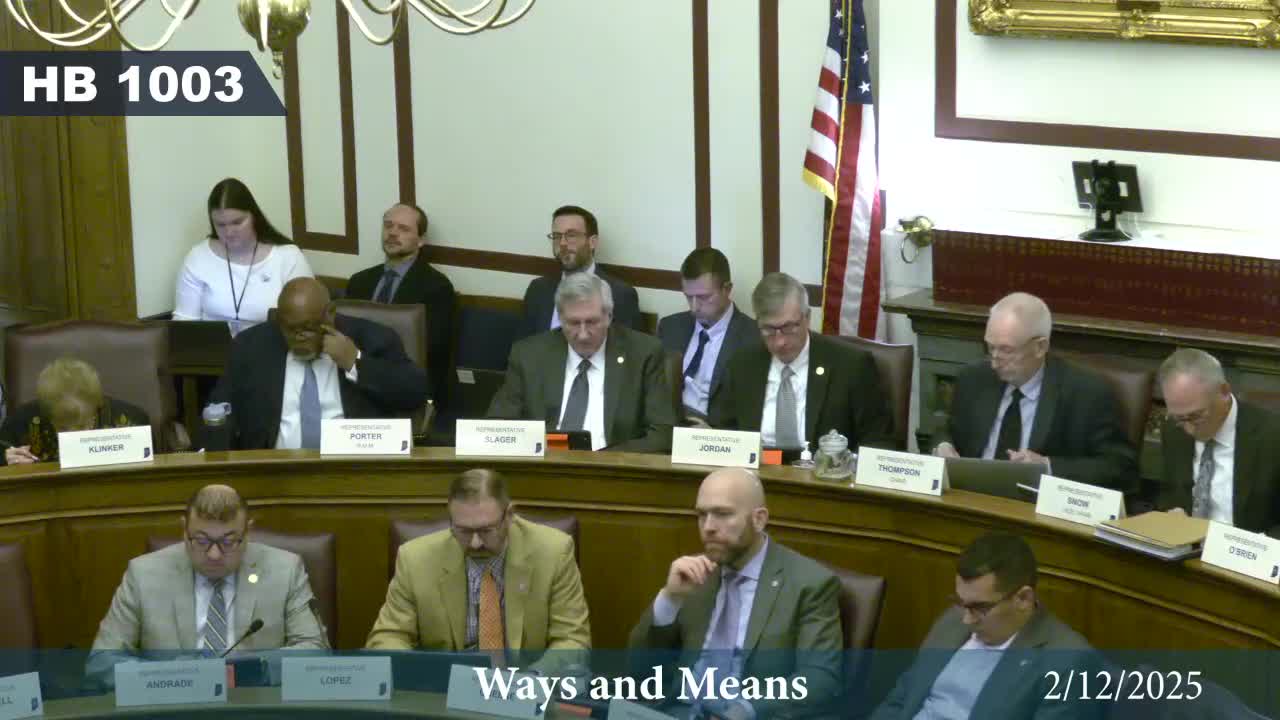
House committee advances broad healthcare bill after adopting surprise-billing and Medicaid-fraud data-sharing amendments
Summary
The Indiana House Ways and Means Committee advanced House Bill 1003 after adopting amendments aimed at addressing surprise medical bills by aligning carrier network standards with CMS rules and enabling wider interagency data sharing for Medicaid fraud investigations while carving out certain community health providers.
House Bill 1003, a wide-ranging healthcare measure, moved forward in the Indiana House Ways and Means Committee after members approved amendments intended to curb surprise medical billing and improve state investigations into Medicaid fraud.
The bill, described by its sponsor as a multipronged effort to lower costs, fight waste and fraud, expand access and increase competition in health care, is about 40 pages long with roughly 70 sections and had an 18-page amendment filed in committee. Committee members voted to adopt Amendment 6, which expands interagency data sharing to aid Medicaid fraud investigations and clarifies exclusions for certain social-service grantees, and proceeded to pass the amended bill.
The surprise-billing change in Amendment 7 would require health carriers to meet network adequacy standards set by the Centers for Medicare & Medicaid Services and to address the recurring problem of out-of-network specialists working inside in-network facilities — for example anesthesiologists or pathologists whose bills reach patients unexpectedly. Sponsor remarks said the amendment is an early, state-level approach to a problem the legislature first addressed in 2020 and that federal law has since also touched.
Amendment 6 contains two main parts. First, it authorizes secure information-sharing among state agencies — including, by example discussed in committee, the Department of Revenue, the Bureau of Motor Vehicles and the Department of Workforce Development — to help correlate data in fraud investigations. Second, it adjusts the bill’s language to exempt certain federally supported social-service providers from regulatory changes tied to 340B program rules; the sponsor cited organizations that had testified in committee, naming the Damien Center, hemophilia treatment centers and federally qualified health centers as examples of groups the amendment seeks to protect.
The amendments prompted questions about privacy and statutory authority. Representative Campbell asked whether the Attorney General needed a statute to obtain the requested data; the sponsor answered, “Yes,” saying the provision is intended to create a clear legal channel for confidential investigatory use. Committee members pressed on how medical-record confidentiality and HIPAA protections would be preserved; the bill specifies that complaints to the state Medicaid fraud control unit remain confidential until formal filing.
Committee members expressed mixed views on privacy and access. One legislator said the proposal raised “a breach of privacy” concerns, arguing that storing medical data outside medical facilities should be approached cautiously. The sponsor repeatedly emphasized that the changes are intended to enable interagency coordination while preserving confidentiality safeguards already in place.
On procedure, the committee approved Amendment 6 by roll call (tally: 16 yes, 7 no). After additional brief debate and explanations of concern by several members, the committee voted to pass House Bill 1003 as amended (tally: 15 yes, 8 no). Those tallies were recorded on the committee roll calls.
The bill’s sponsor told the committee he is willing to continue work on language and represent the amendments on the floor if members desire further refinement. The committee did not specify an immediate implementation date in its discussion; the bill will move to the next stage of the legislative process with the adopted amendments.
Notes on procedure and next steps: the sponsor asked for additional stakeholder engagement and said he and staff had already met with the Department of Insurance for clarification. He offered to represent the amendment on the floor if the committee preferred.