Lifetime Citizen Portal Access — AI Briefings, Alerts & Unlimited Follows
Senate EPW hearing: federal delays, backlogs hinder carbon‑capture deployment
Loading...
Summary
Lawmakers and witnesses told the Senate Environment and Public Works Committee that slow implementation of the USE IT Act, a backlog of EPA Class 6 permit applications, and long federal review timelines are slowing carbon capture, utilization and storage (CCUS) projects and state requests for primacy.
WASHINGTON — Lawmakers and technical witnesses told the Senate Environment and Public Works Committee at a Feb. 26 hearing that federal delays and a backlog of Class 6 underground injection control applications are impeding carbon capture, utilization and storage projects across the country.
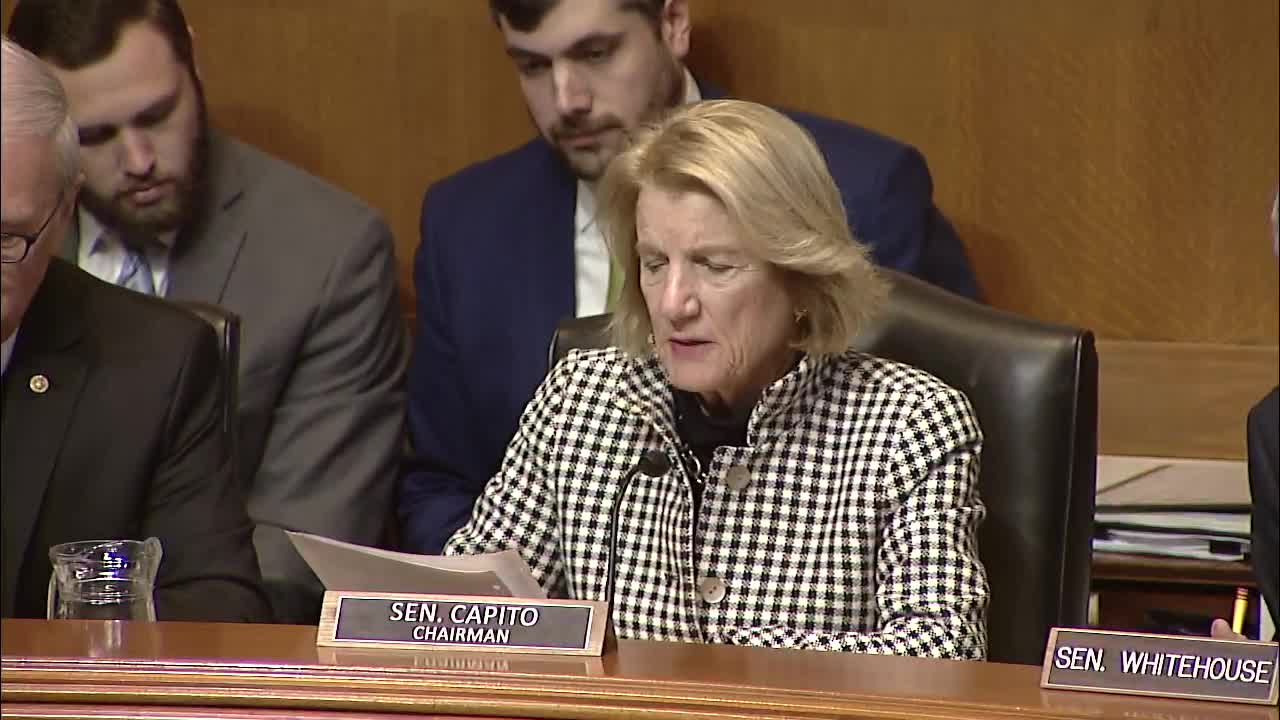
Chairman Shelley Moore Capito, Republican of West Virginia, told the committee that implementation of the Utilizing Significant Emissions with Innovative Technologies Act — the USE IT Act — has fallen short of congressional intent. She said interagency guidance and task forces required by the law were slow to form and that CEQ guidance did not provide a clear pathway to expedite permitting. "The guidance failed to present a clear pathway to expedite permitting for these projects," Capito said.
The hearing centered on three recurring barriers identified by witnesses: the cost of retrofitting large emitters for capture, CO2 pipeline permitting and public opposition, and long federal review times for geologic storage permitting under EPA's Class 6 UIC rule. Kevin Connors, assistant director for regulatory compliance and energy policy at the University of North Dakota’s Energy and Environmental Research Center, told senators that EPA regional offices had a substantial backlog of permit applications. "There's a hundred and lehi I checked, 161 well permits that have been backlogged at the EPA regional offices," Connors said.
Witnesses urged Congress and the administration to move faster on granting states Class 6 primacy — the authority for a state to run its own Class 6 program — and on improving federal-state coordination. Dan Yates, executive director of the Groundwater Protection Council, said state agencies have local geologic knowledge and can be more efficient: "States are best suited. They're better suited," he said, describing state staff familiarity with local geology, prior UIC experience and data access.
Lawmakers repeatedly pointed to funding and rulemaking as levers for speed. Capito noted bipartisan steps including $25 million in the Infrastructure Investment and Jobs Act (IIJA) for EPA to review Class 6 applications and $50 million for states to obtain primacy, and urged the administration to use those resources to clear backlogs. Witnesses also recommended clearer interagency guidance, more transparent EPA crosswalks used during primacy reviews, and additional federal grants to build state permitting capacity.
Ranking Member Sheldon Whitehouse, Democrat of Rhode Island, framed the urgency in climate terms and urged faster deployment of carbon removal alongside emissions reductions. "Carbon dioxide removal will be necessary to achieve net negative CO2 emissions," Whitehouse said, citing peer‑reviewed scenario work and the need to scale capture to gigaton levels.
Committee members and witnesses also discussed administrative fixes: streamlining EPA’s primacy review process for states that demonstrate equivalent protections, clarifying permitting roles for CO2 pipelines, and ensuring that the bipartisan federal task forces established under the USE IT Act complete and publish actionable permitting recommendations. Jack Kavanaugh of Breakthrough Energy, who serves on one of the White House task forces, said the panels are producing recommendations but noted they need political appointee replacements before finalization.
The hearing produced no formal votes. Senators asked witnesses to supply written responses on coordination and permitting improvements. Several senators urged the administration to prioritize clearing the existing backlog so private investment and state permitting programs are not left waiting.
Ending: Committee members set deadlines for written questions and asked witnesses for follow‑up recommendations; the committee paused for votes and adjourned following the hearing.