Get Full Government Meeting Transcripts, Videos, & Alerts Forever!
Get email alerts on the Budget topic
No spam. Unsubscribe anytime.
Braun budget proposes major K‑12 increase, fully funds Medicaid growth and expands school choice while cutting administrative costs
Summary
Secretary Lisa Hirschman and State Budget Director Chad Rainey presented Governor Braun's recommended biennial budget to the House Ways and Means Committee, proposing nearly $1 billion in new K‑12 funding, fully funding projected Medicaid growth and expanding the Choice Scholarship Program while seeking $700 million in spending reductions and a 5% administrative cut.
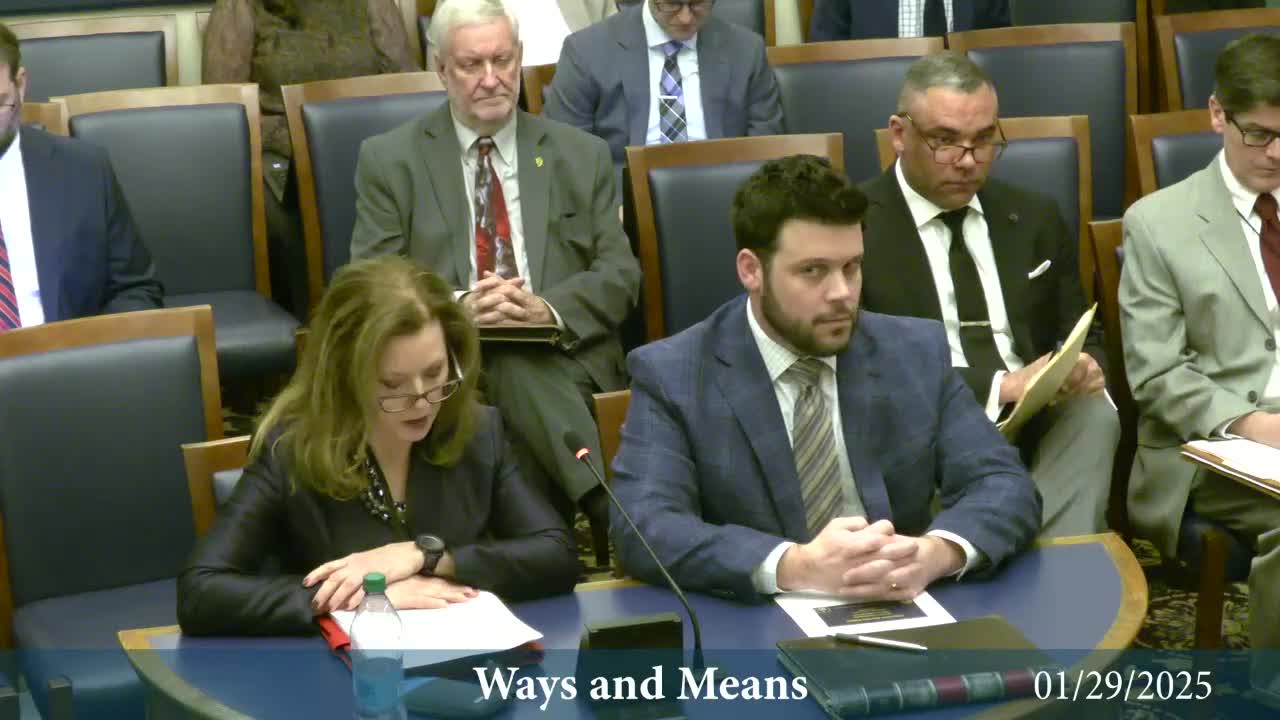
Secretary Lisa Hirschman, the governor's Secretary of Management and Budget, and State Budget Director Chad Rainey presented Governor Braun's recommended biennial budget to the House Ways and Means Committee, saying it preserves a structural surplus while prioritizing education, Medicaid and tax relief.
The administration's proposal invests roughly $540,000,000 in new K‑12 funding over the biennium, fully funds close to $1,700,000,000 in projected Medicaid growth, expands the Choice Scholarship (voucher) program to all families, and seeks to eliminate the childcare subsidy wait list with a $312,000,000 appropriation for early childhood learning and $46,000,000 for a pre‑K pilot. Secretary Hirschman said the budget also includes significant tax relief initiatives and aims to keep the state's AAA credit rating.
Why it matters: The presentation frames the package as balancing competing pressures: slowing revenue growth, rising Medicaid costs and a desire to deliver tax relief and education investments. Rainey repeatedly said the administration designed the budget to maintain a structural surplus and protect reserves while redirecting funds toward the governor's priorities.
Details and debate
Tax policy: Rainey and Hirschman described a package of tax changes that would index four income tax exemptions (personal, dependent, standard elder/blind exemptions and one targeted 65+ exemption tied to a $40,000 income threshold) to inflation; eliminate state tax on tips; exempt certain farm savings accounts; expand an employer health reimbursement arrangement (raising the small‑business threshold from 50 to 75 employees and increasing the annual cap from $10,000,000 to $15,000,000); and authorize three separate sales tax holidays (back‑to‑school, youth sporting goods and outdoor recreation). The budget office estimated sales tax holiday revenue losses around $52.6 million in FY26 and $54.8 million in FY27.
Choice scholarship expansion and cost assumptions: The administration said it included funding to expand the state's Choice Scholarship Program to all eligible students. Rainey and committee members debated cost estimates: the state budget agency's projection assumed a slower ramp‑up (about $25,000,000 per year cited by members), while Legislative Services's analysis used a higher take‑up scenario closer to a full upper bound. Committee members pressed Rainey on the difference; Rainey said the gap largely stemmed from differing assumptions about take‑up in the first two years.
Targeted reductions and administrative savings: Rainey told the committee the administration identified more than $700,000,000 in spending reductions over the biennium, including roughly $540,000,000 of targeted program reductions (rolling some appropriations back toward 2023 levels or eliminating programs judged ineffective) and a 5% across‑the‑board reduction on agency administrative/operating lines (the administration identified roughly $180,000,000 in administrative reductions as a baseline target). Rainey emphasized the 5% was applied only to operating and administrative lines, not programmatic funding that directly serves Hoosiers.
Childcare and health investments: The budget would eliminate the childcare assistance wait list through $312,000,000 to early childhood learning and $46,000,000 for the pre‑K pilot, plus a $2,000,000 per year local childcare assistance fund. It also proposed a primary care access revolving fund (amount discussed but not finalized) to expand primary care loans and long‑term care savings accounts with tax benefits.
Process and follow up: Committee members repeatedly asked for supporting detail. Several representatives requested line‑by‑line lists of the $540,000,000 targeted reductions and further clarification on take‑up assumptions for the voucher expansion and on how the 5% administrative reductions would avoid undermining service delivery. Rainey said the administration would provide those lists and continue working with Legislative Services and the committee.
Ending note: The administration framed the budget as a balancing exercise between constrained revenue growth and rising program costs, with a stated goal of preserving reserves while delivering targeted investments and tax relief.