Get Full Government Meeting Transcripts, Videos, & Alerts Forever!
Get email alerts on the Resource Adequacy topic
No spam. Unsubscribe anytime.
Lawmakers and experts press PJM, utilities and regulators on capacity market, retirements and renewables' role
Summary
At a Senate hearing, legislators probed how retirements of dispatchable plants, PJM capacity prices and state renewable mandates interact to affect customer costs and grid reliability; experts said retirements and supply‑demand imbalances are raising capacity prices while renewables' limited effective capacity changes how PJM credits generation.
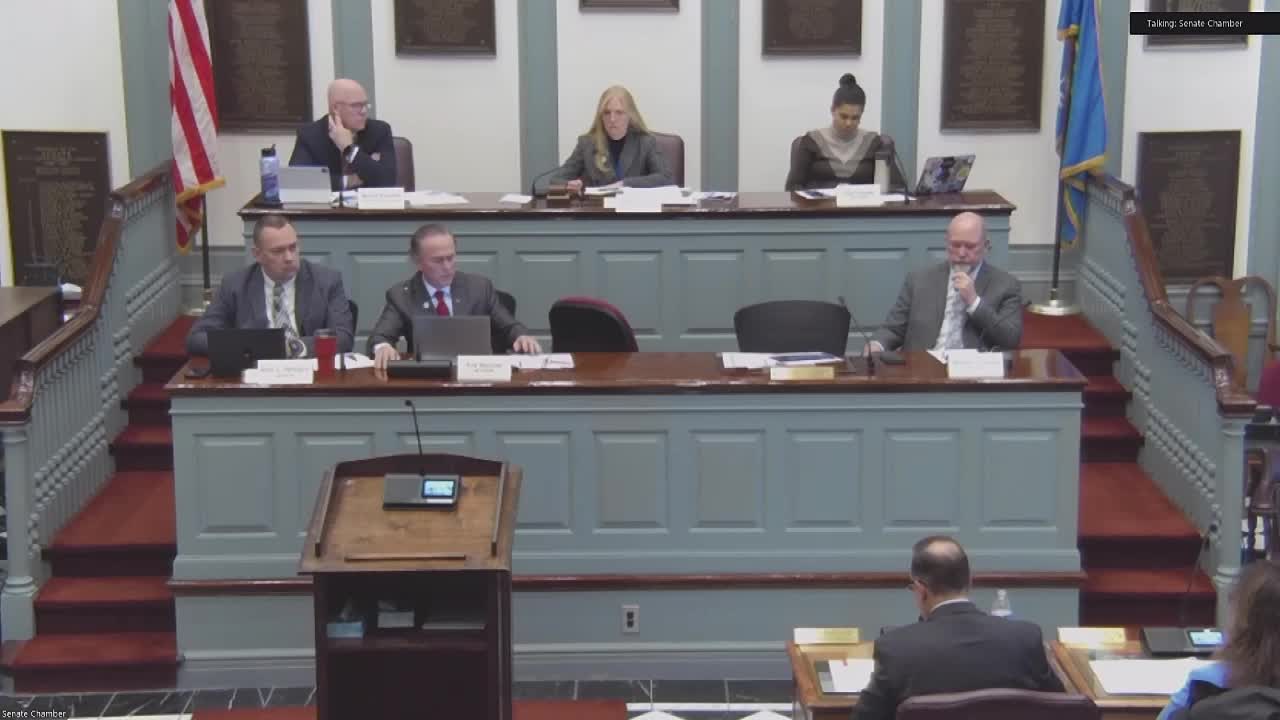
Lawmakers at a Feb. 14 Senate Environment, Energy and Transportation Committee hearing pressed Delmarva Power, the Public Service Commission and energy‑policy experts about how retiring dispatchable power plants, regional capacity auctions and state renewable mandates combine to affect customer bills and grid reliability.
The committee’s nut graf: Senators focused on whether retirements of dispatchable generation in the PJM region, higher capacity auction results and growing demand — including new data centers and electrification — have created a supply scarcity that pushed wholesale and capacity costs higher, and whether Delaware’s renewable goals or policy decisions contributed to that scarcity.
Mario Giovannini of Delmarva explained that PJM’s capacity auction (the Base Residual Auction) assigns capacity credits based on a plant’s dispatchability. “If there are retirements on the system at PJM and they're not replaced timely with acceptable generation or dispatchable generation,” Giovannini said, “yes. That would be imputed into a capacity charge that we purchased from wholesale suppliers during the SOS function.” Matt Hartigan, executive director of the Delaware Public Service Commission, described the auction timing and noted that the July 2024 auction settled for the June 2025–May 2026 delivery year; Delmarva representatives said customers will see related costs beginning June 1, 2025.
Drew Slater, executive director of Energize Delaware, told the committee the PJM interconnection queue is a major bottleneck — projects face permitting, siting, supply‑chain and financing delays — and that effective load‑carrying capability (ELCC) produces much lower capacity values for solar and wind than for dispatchable plants. He said those lower ELCC values mean the system needs more renewable nameplate capacity to deliver the same reliable supply as dispatchable generation, and batteries and storage are part of the solution but require scale and financing.
Several senators, including Eric Buxton and Brian Pettyjohn, warned that policy timelines and mandates had encouraged retirements and that renewable buildout has not yet produced the dispatchable capacity needed to replace retiring plants; others cautioned that natural gas is also volatile and that an ‘‘all‑of‑the‑above’’ approach — including storage and, potentially, advanced nuclear or new dispatchable gas units — should be considered.
Committee members asked for PJM to appear at a follow‑up hearing. The PSC said it applies Delaware’s business‑judgment legal standard in rate reviews and that commission actions are constrained by statutory and legal standards.
Ending: Senators and experts agreed further hearings are necessary. The committee flagged the June 1, 2025 SOS pricing impact and asked agencies and PJM to provide more detailed data on capacity auction drivers, retirements, and the interconnection queue.