Get Full Government Meeting Transcripts, Videos, & Alerts Forever!
Get email alerts on the Utility Billing Relief topic
No spam. Unsubscribe anytime.
Delmarva tells Delaware lawmakers winter usage drove most bill increases; company offers temporary relief
Summary
Delmarva Power told a Senate committee that an unusually cold January and increased household usage — not new line items — were the primary drivers of recent spikes in customer bills, and announced short‑term customer relief measures including suspended disconnections and longer repayment plans.
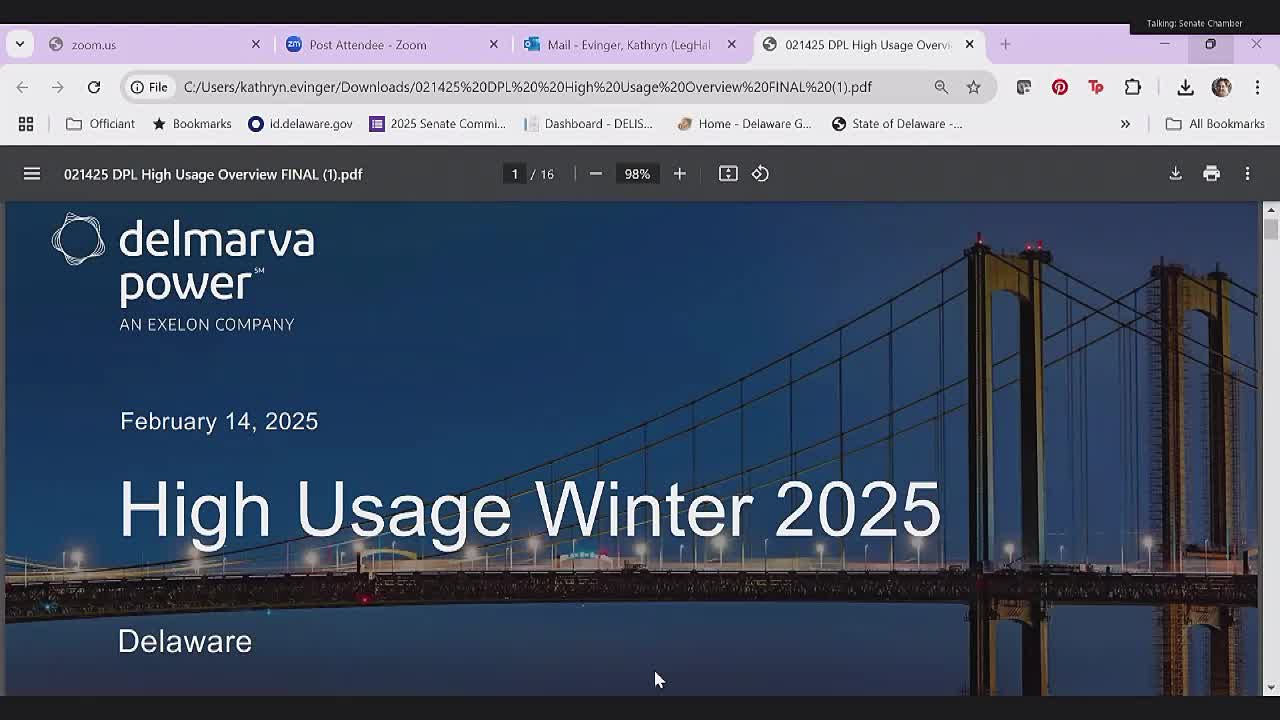
Delmarva Power told the Senate Environment, Energy and Transportation Committee on Feb. 14 that unusually cold weather and higher customer usage were the primary drivers of the large residential bills that prompted the hearing. Philip Vavila, regional president for Delmarva Power, said Delmarva’s review of customer bills found usage — not newly added charges — accounted for the bulk of recent month‑to‑month increases.
Vavila said, “there are no new charges on the bill.” He told legislators the company redesigned its bill last November to break out supply and delivery so customers could see how much usage, delivery, taxes and program charges each contributed to the total. The company showed an example in which roughly 90% of the month‑over‑month increase was usage driven while rate changes made a much smaller contribution.
The nut graf: Lawmakers and residents came to the committee seeking both explanations and immediate help as hundreds of public commenters reported bills far above recent norms. Delmarva presented technical drivers (usage, transmission and supply costs) and announced near‑term customer relief while senators pressed regulators and regional grid actors for broader answers about capacity and market prices.
In the body of the hearing Delmarva said the region experienced a new winter peak from Jan. 20–23 that also drove an all‑time winter peak on its electric system and peak gas send‑out in New Castle County. Vavila noted Delmarva serves more than 400,000 customers on the Delaware Peninsula and has about 1,200 employees in the state; he said the company connected about 8,000 customers to roughly $8.8 million in energy assistance in 2024 and planned similar community events in 2025.
Delmarva outlined the bill components: a customer (fixed) charge, a usage‑based distribution charge, and supply and transmission components that are purchased on customers’ behalf. Vavila said the standard offer service (SOS) supply price is a pass‑through determined by an auction and not set by Delmarva. Mario Giovannini, Delmarva’s energy acquisition executive, explained that capacity and transmission costs are set by regional markets (PJM) and that retirements of dispatchable plants can raise capacity prices.
To reduce immediate hardship, Delmarva announced temporary measures: no late payment fees for January and February 2025, up to 24‑month repayment plans for arrears, suspension of disconnections for nonpayment in February 2025, and waiving deposits for customers restoring service. Vavila said more than 3,800 customers had already enrolled in the special programs in the first days after they launched.
Senators, including Eric Buxton and Russ Huxtable, pressed Delmarva about the timing of rate‑case and supply‑price changes. Delmarva and the Public Service Commission (PSC) staff clarified that Delmarva had a distribution rate decision in April 2024 and that a separate SOS auction settled in July 2024 that will affect customer bills beginning June 1, 2025. Matt Hartigan, PSC executive director, explained the commission applies Delaware’s business‑judgment rule in rate cases and that disallowing costs requires proof of waste, fraud or abuse.
Ending: Delmarva emphasized customer outreach tools (a My Account portal with smart‑meter data and alerts, budget billing, community assistance events) and urged residents with concerns to use the company’s bill‑support resources or the public advocate. The committee scheduled follow‑up hearings to bring PJM and other agencies into the conversation about market and reliability drivers.