Get Full Government Meeting Transcripts, Videos, & Alerts Forever!
Get email alerts on the Child Welfare Budget Fy26 topic
No spam. Unsubscribe anytime.
Kids Department asks for targeted contract increases, housing funds and staffing authority in FY26 budget
Summary
Secretary Yeatman presented the Department of Services for Children, Youth and Their Families budget request to the Joint Finance Committee, seeking increases to adoption contract rates, treatment services and temporary housing supports and reporting metrics and vacancies for child welfare programs.
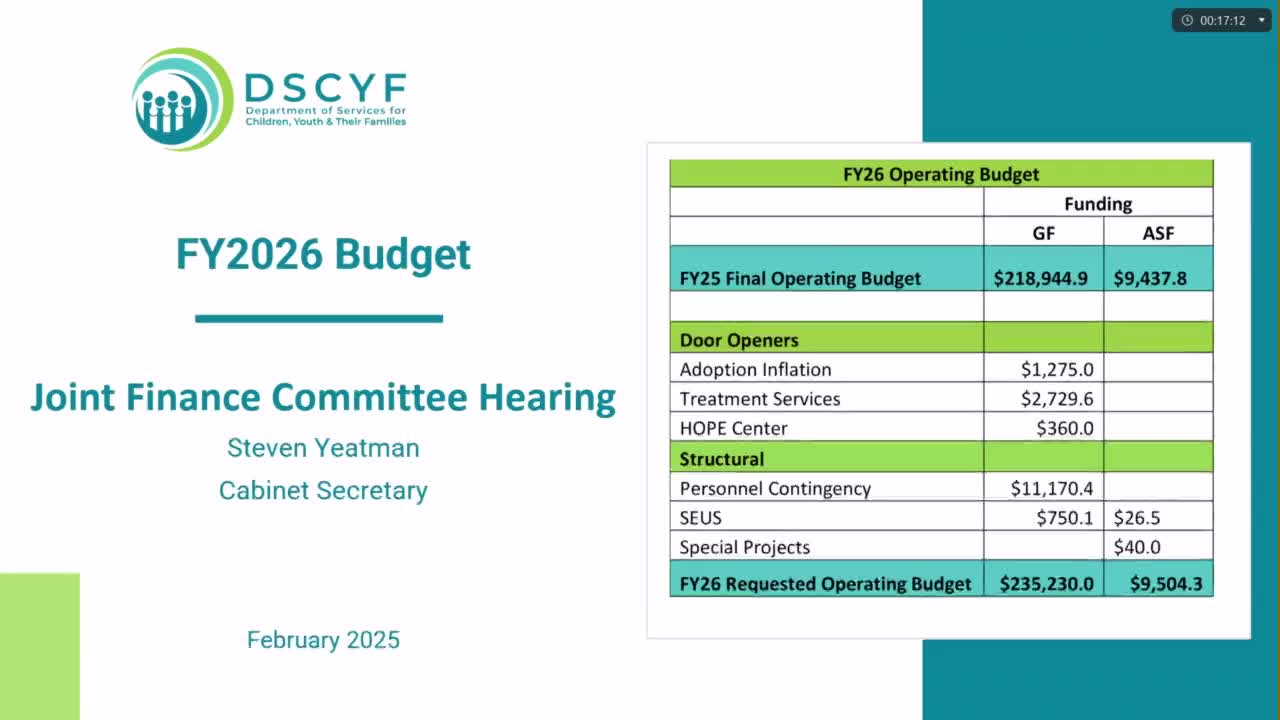
Secretary Stuart Yeatman presented the Department of Services for Children, Youth and Their Families (DSCYF) fiscal year 2026 budget request to the Joint Finance Committee, asking for targeted increases for contracted adoption services, treatment services and temporary housing supports.
The governor’s recommendation includes $1,275,000 in general funds to cover increased rates for adoption contracts and $2,700,000 for contractual treatment services intended to expand contracted case management and family visitation. Yeatman said the department also requested—and the governor recommended—$360,000 for temporary housing and case management at the Hope Center, a pilot the department launched in February 2024 that has helped families remain intact while seeking permanent housing.
Why it matters: The adoption contract increase responds to new rates after a recent request for proposals, Yeatman said; the treatment-services funding is aimed at addressing shortfalls identified in a federal child welfare audit and at improving family-time visits and monthly caseworker contacts. Committee members pressed for metrics and vacancy counts before agency officials’ appearances.
Yeatman described how contract inflation followed a long period when adoption services were not recompeted and rates were “artificially low.” She said the treatment-services request would pay for contractors who can run quality family-time visits, noting the department’s frontline workforce shortages increase the need for contracted visitation services. “If all of our frontline positions were filled, there wouldn’t be as large of a need for this ask,” Yeatman said.
The presentation included departmental performance measures. Over fiscal 2024 the child abuse and neglect report line received 24,143 reports; 6,646 cases were screened in; and the department reported 523 children in foster care at the time of the hearing. Yeatman said Delaware meets federal standards on several timeliness metrics but underperforms on lower‑risk initial responses and monthly caseworker visit requirements, and that the requested treatment funding targets those gaps.
Committee members asked for additional detail on vacancy counts, especially positions vacant three years or more. Yeatman said DSCYF had identified five and a half positions vacant three or more fiscal years and that five of those were still needed for operations. Director Trenty Parker (Division of Family Services) provided the child‑abuse hotline number and described the structured decision-making tool the hotline uses to screen calls.
The department also reported implementation details for other line items: payment to the independent driver license and insurance program, an increase proposed for DTI Secure End User Services, and position annualizations. Yeatman closed by thanking the committee and offering to supply detailed cost breakout and metrics.
Committee direction and next steps: Committee members asked the department to return with additional vacancy and metric detail when the divisions appear for their hearings. Several lawmakers signaled support for the department’s approach to direct funds toward contracts that produce measurable family outcomes.
The DSCYF presentation followed the committee agenda and generated public‑comment support from partner nonprofits during the in‑person comment period.