Get Full Government Meeting Transcripts, Videos, & Alerts Forever!
Get email alerts on the Geologic Hazards topic
No spam. Unsubscribe anytime.
DGGS seeks emergency‑response staff for geologic hazards; volcano monitoring highlighted
Summary
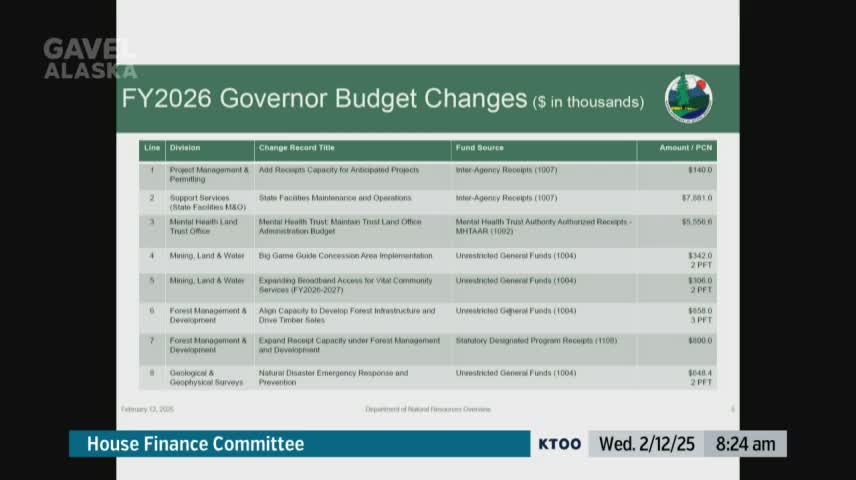
The Division of Geological and Geophysical Surveys requested two permanent positions and funding for a natural disaster emergency response team to address more frequent floods, landslides and avalanches; the Alaska Volcano Observatory and geospatial efforts were also discussed.
Deputy Commissioner John Crother and the department outlined a request to bolster the Division of Geological and Geophysical Surveys' capacity to respond to natural disasters and to expand monitoring of geological hazards.
The FY26 request includes $648,400 in unrestricted general funds to add two permanent positions — a geologist and a GIS analyst — to create a team dedicated to emergency response and geologic hazard prevention. Crother told the committee Alaska is experiencing more frequent floods, landslides and avalanches and that the division currently lacks sufficient dedicated staff to meet emergency requests from the state emergency operations center.
Crother also reviewed DGGS programs that collect geological and geophysical data across the state, including mineral resource mapping, energy resource assessments, hydrology and the geologic materials center. He highlighted the Alaska Volcano Observatory, a joint effort with the U.S. Geological Survey, and said recent investments in instrumentation have been important given renewed activity at some volcanoes.
"Those instrumented and understood. And of course, Mount Spur waits across the inlet, for those of us who live in Anchorage," Crother said, noting the importance of monitoring remote volcanoes because of their potential to disrupt air travel and commerce.
Why it matters: improved DGGS emergency capacity aims to speed hazard assessments and mitigation work that protect communities and infrastructure. The requested positions would create a standing team to respond to events rather than drawing staff away from ongoing research projects.
DNR told the committee it will continue to provide detail on how the new team would be mobilized and funded if the FY26 request is approved.