Get Full Government Meeting Transcripts, Videos, & Alerts Forever!
Get email alerts on the Carbon Programs topic
No spam. Unsubscribe anytime.
DNR: CCUS regulations near final; carbon‑offset projects could generate revenue in 18–24 months
Summary
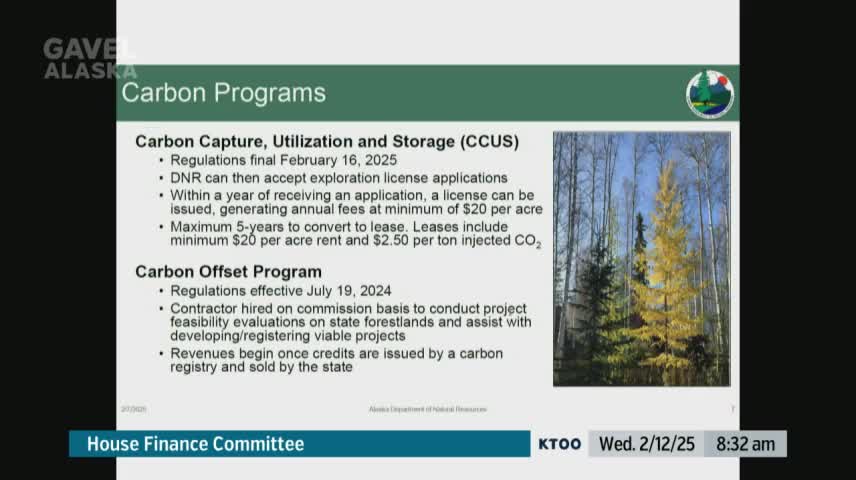
Deputy commissioners told the House Finance Committee that implementing regulations for CCUS will be effective soon and that state carbon‑offset projects (the "trees" program) are beginning feasibility work, with potential credit generation 18–24 months after project initiation.
Department of Natural Resources officials said the department is implementing two carbon programs: a subsurface carbon capture, utilization and storage (CCUS) licensing program and a voluntary carbon offset program that would generate credits from state lands.
Deputy Commissioner John Crother said the CCUS implementing regulations promulgated last year are "about to be live" and the department expects to begin receiving license applications in the weeks or months after the rules take effect. He described rentals for license areas and the potential for per‑ton injection fees "pursuant to law" should long‑term injection occur.
"We have been working over the last year to, implement, to promulgate implementing regulations, which are about to be live. I believe next week is when those will be formally in force and effect," Crother told the committee.
On the carbon‑offset program — referred to in the hearing as the "trees bill" — Crother said the state has retained a consultant and is starting assessments in the Tanana State Forest. He said expected credit generation from a sanctioned project would likely occur about 18 to 24 months after project initiation.
Commissioner John Boyle told the committee the department is "seeing interest" from potential developers and that some early feasibility work is already underway on the North Slope and Cook Inlet. Crother and Boyle both noted international and federal partners are involved in some feasibility efforts; the committee discussed federal incentives including references to 45Q tax credits and the Infrastructure Investment and Jobs Act as drivers for interest.
Representative Stapp and others pressed for odds on whether the state would see revenue soon; Boyle declined to give a percentage but said "we have an active participant" and that he believes it is "more likely than not" the state will see revenue from carbon offsets in the future.
Lawmakers also asked whether non‑forest approaches, such as mariculture and kelp, are covered. Boyle said the program contemplates mariculture opportunities and the department has had inquiries about kelp projects that could be eligible pending development of accepted protocols.
Why it matters: the programs could create new revenue streams for the state and affect land management, permitting and long‑term monitoring requirements. Officials warned timelines are uncertain and depend on project approvals, evolving voluntary carbon market standards, and federal incentives.