
Speakers outline Alaska Infant Learning Program services, eligibility and transition challenges
Get AI-powered insights, summaries, and transcripts
Sign Up Free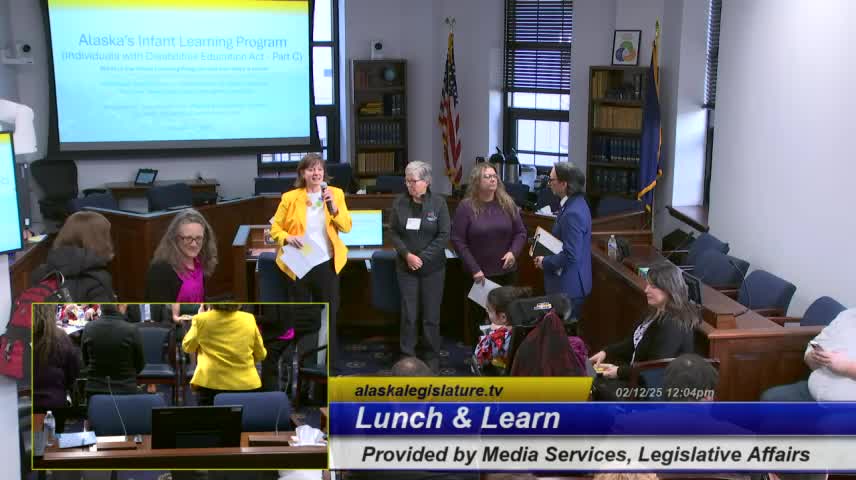
Summary
Program leaders described Part C services under the Individuals with Disabilities Education Act, gave enrollment and referral figures, explained eligibility rules and the 45‑day evaluation requirement, and outlined transition options at age 3. Parents at the luncheon described how ILP services affected their families.
At a community luncheon in Anchorage, program leaders described Alaska’s Infant Learning Program — the state’s Part C services under the Individuals with Disabilities Education Act — and walked attendees through how children are referred, evaluated and transitioned out of the program.
Heidi Haas, executive director of the Alaska Center for Children and Adults (ACCA), said the Infant Learning Program serves children from birth to 3 who have developmental delays or disabilities and that services are funded with a mix of state general funds and federal dollars and, where possible, billed to insurers. “We have 45 calendar days to do those evaluations,” Haas said, adding that programs must also begin services within that same 45‑day window when a child qualifies.
The program is administered for Alaska by the Department of Health’s Division of Senior and Disability Services and is delivered statewide by a network of grantees, Haas and Amy Simpson, executive director of programs for Infants and Children (PIC) in Anchorage, said. Simpson and Haas said 15 grantees cover the state and that, in the federal fiscal year that ended June 30, 2024, the network enrolled almost 1,900 children and logged about 25,000 service hours in the state database. The programs recorded more than 3,500 referrals during the same period.
Haas and Simpson described three pathways for a child to qualify for Part C services: a 50 percent developmental delay in an area of development; a diagnosed disability on an accepted list from a medical provider; or a multidisciplinary team determination when standard tools do not fully capture a child’s needs. The presenters noted a policy difference between early intervention and K‑12 special education: the school‑district eligibility threshold was described as 25 percent delay compared with the 50 percent threshold for Part C eligibility.
On transitions, presenters said services must be transferred when a child turns 3. Families can choose a school‑district evaluation and services, private therapy providers, or other options; staff said ILP programs help families navigate the process but do not themselves continue services past the Part C cutoff. A parent who spoke at the event described multiple years of ILP support and said, “They did not want to let him go at 3 years old,” and later credited the program with helping her family secure appropriate school‑age services.
Speakers discussed the COVID era decline in enrollment and service delivery, noting a period in which programs moved to telehealth and some families declined remote services or lacked reliable connections. Haas said providers who continued telehealth learned new coaching skills, but that not all regions could deliver telehealth consistently. The presenters said service numbers have rebounded but acknowledged added stress on staff and uneven regional access.
Program staff and parents at the luncheon emphasized that initial screening and referral sources matter: pediatricians and other medical providers supplied nearly half of referrals, the presenters said, but caregivers and others may also refer children. Speakers said many referrals lead to full assessment; presenters estimated roughly two‑thirds of referrals proceed to full assessment and that about 80 percent of those assessed were found eligible for Part C services.
Both presenters stressed that core ILP services — evaluations, family service coordination and many direct therapies — are provided at no cost to families. They said programs will bill insurance for occupational, physical or speech therapy when permitted and with caregiver permission, but services remain available regardless of a family’s insurance status.
Program leaders invited families to contact their local ILP provider for referrals, to request evaluations, or to get help navigating transitions to school‑age supports. They recommended public resources such as Help Me Grow for milestone information and noted that program contact lists and provider logos are posted by location on the state website.