Get Full Government Meeting Transcripts, Videos, & Alerts Forever!
Get email alerts on the Department Of Agriculture topic
No spam. Unsubscribe anytime.
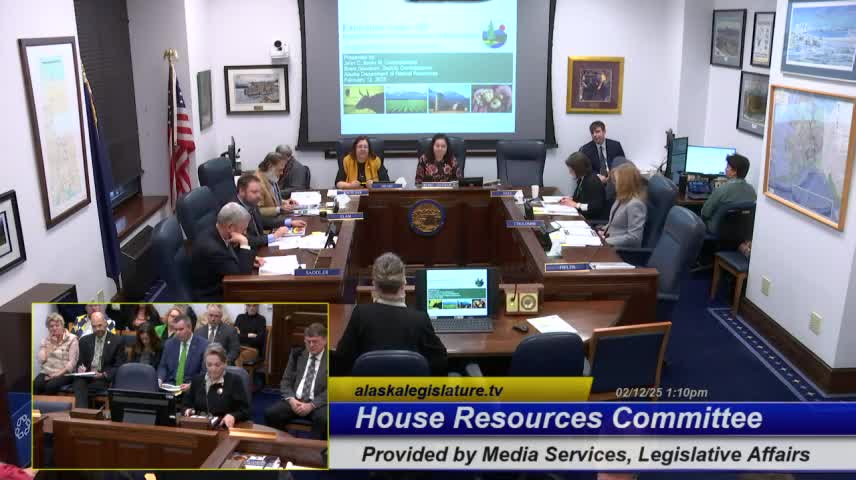
House Resources advances governor’s Executive Order to create Department of Agriculture; disapproval resolution fails in committee
Summary
The House Resources Committee voted Feb. 12 to move Gov. Dunleavy’s Executive Order 136, which would create a cabinet-level Department of Agriculture effective July 1, 2025; a companion House Special Concurrent Resolution that would disapprove the order failed to advance after a 3-4 vote.
On Feb. 12 in Capitol Room 124, the Alaska House Resources Committee voted to move Gov. Mike Dunleavy’s Executive Order 136 — which would create a Department of Agriculture and transfer the Division of Agriculture out of the Department of Natural Resources (DNR) — out of committee; a separate House Special Concurrent Resolution 1, which would disapprove the order, failed to advance after a 3-4 roll call.
The executive order would establish a Department of Agriculture with an effective date of July 1, 2025, transfer existing statutory responsibilities from DNR’s Division of Agriculture, and add a commissioner's office and lean support staff. Deputy Commissioner Brent Goodrum told the committee the governor’s proposal would create 13 new permanent full‑time positions for the commissioner’s office and support services and estimated the incremental cost at about $2,734,400 for FY2026.
Senator Shelley Hughes, chair of the Alaska Food Strategy Task Force, told the committee she delivered the task force’s final report and recommendations to lawmakers and said the group’s top recommendation was “to create a Department of Agriculture.” Hughes said the task force prepared 34 recommendations and that several items — including procurement changes to help get locally produced food into schools — are already under consideration this year.
John Boyle, commissioner of the Department of Natural Resources, said the move would provide a single, cabinet‑level advocate for agriculture. “When it comes to the Department of Agriculture, it is… really time for us to have a quarterback,” Boyle said, arguing a dedicated commissioner would sustain attention on food security and coordinate with the University of Alaska, the U.S. Department of Agriculture and other stakeholders.
DNR officials told members the Division of Agriculture currently has 37 employees, about $7.2 million in fiscal footprint, and a seed and plant‑material program that last year cleaned more than 50,000 pounds of native seed and 96,000 pounds of cereal grain. Goodrum cited the division’s revolving agriculture loan fund at about $21.5 million in equity, and the division’s management of roughly $10 million in federal grants.
Supporters at the public testimony table urged the committee to approve the order. Robbie Mixon, executive director of the Alaska Food Policy Council and director of the USDA regional food business center for Alaska, said elevating agriculture to the cabinet level would increase food security and research tailored to Arctic conditions. “A department of agriculture will empower our communities, strengthen our economy, and safeguard our food security for generations to come,” Mixon said.
Scott Magridge, president of the Alaska Farm Bureau and a farmer in Delta Junction, told the committee the change would “strengthen our state's commitment to food security” and help expand production. Beth Van Sant, a peony grower from Homer, urged more research and marketing support for floriculture and perishable agricultural products. Inga Peterson, Alaska FFA state president, said a department would better support growing agricultural education programs and future workers.
Committee members questioned scope, costs and which programs should remain in DNR. DNR officials said some functions — including mariculture and forestry — would remain with DNR for now because of land‑management links, federal program primacy and fire‑management synergies, but they acknowledged future review could consider additional transfers if appropriate.
Representative Donna Mears moved Executive Order 136 from committee; the motion was renewed after an earlier procedural withdrawal and was moved without objection. Representative Mears later moved House Special Concurrent Resolution 1 (the disapproval resolution) from committee; Representative Joe Sadler objected and the committee called the roll. The clerk recorded 3 yeas (Representative Nicole Hall, Representative Donna Mears and Cochair Representative Tiffany Burke) and 4 nays (Representative David Elam, Representative Colom, Representative George Rauscher and Representative Sadler), with Representative Fields absent, and the resolution failed to move from committee.
The committee adjourned at about 3:06 p.m. and announced it will meet next on Friday at 1 p.m. to hear a presentation from the DNR Division of Forestry and Fire Protection on wildfire preparedness and response.
What was decided: Executive Order 136 will proceed out of House Resources for further legislative consideration; House Special Concurrent Resolution 1 to disapprove the order did not pass the committee.