Get Full Government Meeting Transcripts, Videos, & Alerts Forever!
Get email alerts on the Building Code topic
No spam. Unsubscribe anytime.
Public testimony on HB 80 divides Alaska builders and mayors over statewide residential building code
Summary
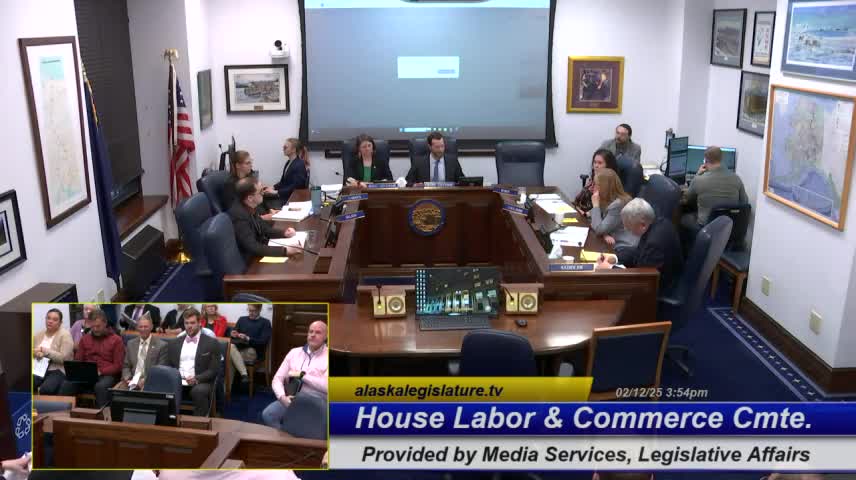
Public testimony at the House Labor and Commerce Committee hearing presented sharply different views on House Bill 80, which would establish a statewide minimum residential building code with local options.
Public testimony at the House Labor and Commerce Committee hearing presented sharply different views on House Bill 80, which would establish a statewide minimum residential building code with local options.
Proponents said a baseline tailored to Alaska’s climate and permitting regimes would protect consumers and reduce duplication of work for local governments; opponents said a statewide code could raise costs, create enforcement burdens and slow construction in fast‑growing boroughs already struggling with housing shortages.
Aaron Welterlund, a Fairbanks builder and vice president of the Alaska State Home Builders Association, told the committee the association supports a statewide code as a consumer protection measure and said most builders exceed the minimum standard. “This bill creates a statewide building code… there is some consumer protectionism,” Welterlund said.
But builders from the Matanuska‑Susitna Borough urged caution. David Miller, a Mat‑Su builder, said the borough has one of the state’s fastest growth rates and that a statewide mandate could increase permit times and enforcement costs. “If this code was adopted at a statewide level at this point, what that would necessitate is eventually there would be a need to enforce that,” Miller told the committee, and he said his Mat‑Su association currently opposes the bill as written.
Housing researcher Mia (Leah) Winters of the Full Employment Housing Research Center testified in favor of HB 80’s approach to provide an Alaska‑specific starting point and to preserve local flexibility where needed. She told the committee the bill is written to allow local amendments and explicitly exempts owner‑builders and recreational cabins, a provision Winters said protects Alaskans who build independently while providing a consistent baseline elsewhere.
Several borough mayors testified against immediate statewide adoption. Mat‑Su Borough Mayor Edna DeVries said the bill would remove local control and could force boroughs without building departments to create new enforcement structures. “It takes away the local control,” DeVries said.
Kenai Peninsula Borough Mayor Peter Micciche described his jurisdiction’s geography and argued current local options better fit many residents. “We have the choice for those that choose to live in our cities that have building codes to live in those codes … more of my constituents are moving out away from those areas because of the cost of building,” Micciche said, and he urged legislators to consider housing shortages before adopting new mandates.
One public witness argued passionately against statewide standards. Dean Barch, speaking for himself, criticized state interference in builders’ choices and said local residents should control how they build. His testimony included strongly worded remarks about personal authority and government limits.
Committee members asked about enforcement, flexibility for remote communities and exemptions for owner‑builders; witnesses pointed to existing local codes, AHFC work on Alaska‑specific standards and the practical differences across Alaska’s climates and settlement patterns. Representative Fields closed public testimony saying the committee will hold more hearings and invited additional information and proposed amendments from stakeholders.
Ending: The committee did not act on HB 80 during the session. Lawmakers signaled they will continue hearings to weigh local control, enforcement cost and the bill’s effect on housing affordability before advancing any statutory changes.