Get Full Government Meeting Transcripts, Videos, & Alerts Forever!
Get email alerts on the Financial Literacy topic
No spam. Unsubscribe anytime.
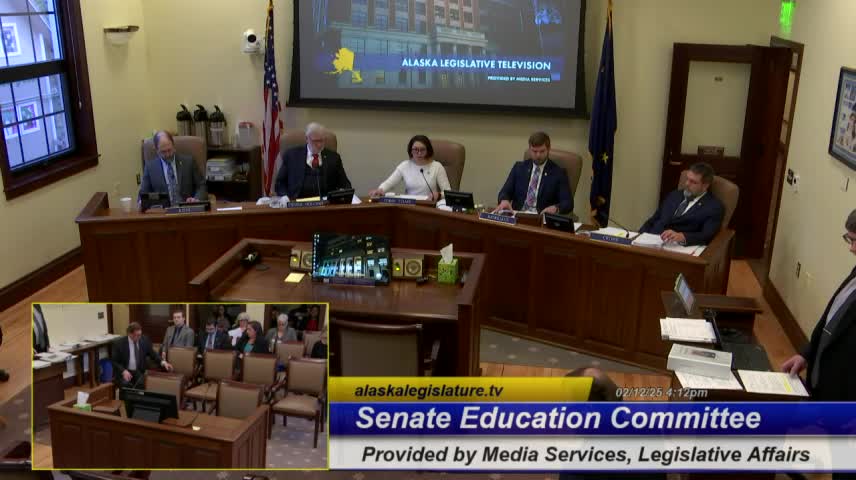
Senate hears bill to add financial‑literacy requirement for high school graduation, holds measure
Summary
Senate Bill 22 would require a half‑credit financial literacy program for high school students, direct the department to curate approved open educational resources, and become applicable to the graduating class of 2027; the Senate Education Committee heard invited testimony and held the bill.
Senate Bill 22, introduced by Senator Bill Wilkowsky, would require school districts to provide a financial literacy education program equivalent to a half credit for grades 9–12 and become applicable to students graduating in 2027. The Senate Education Committee heard invited testimony Wednesday and held the bill for further consideration.
The bill would require the Department of Education and Early Development to curate and make available a list of approved open educational resources (OER) that satisfy the topics listed in the statute and direct districts to establish programs “to the maximum extent practicable.” It creates an exemption for students who enroll after grade 10 (similar to Alaska studies) and specifies the program’s first applicability for graduating classes of 2027 with an effective date in 2026.
Sponsor Hunter Lotzfeld (staff) outlined core financial topics the bill would cover — budgeting, tracking expenses, loan terms, credit management, FAFSA and Alaska Performance Scholarship information — and argued the requirement is a “light touch” intended to be delivered through existing courses (e.g., algebra, economics) or as a standalone module. The sponsor noted Alaska’s low FAFSA completion rate and high average credit‑card and student‑loan debt as motivation for the bill.
Deputy Director Kelly Manning explained the fiscal note includes costs to convene a committee of educators to develop an evaluation rubric, provide stipends to participating educators (20 educators at $1,500 each in the department’s estimate), hire a contractor with financial‑literacy expertise and cover regulation change fees. Manning defined open educational resources as free curriculum developed by nonprofit or federally funded programs that districts can use without purchase.
Committee members asked about the stipend practice, the definition of “maximum extent practicable,” and whether districts such as Anchorage could provide ready curriculum; Vice Chair Stevens and others urged the department to identify cost‑saving measures. The committee held the bill for a future meeting and invited the sponsor and department to work with committee staff on amendments. No vote was taken.